Professor Markus Riegler
View Markus' Researcher Profile

Professor Riegler's research interest focuses on the biology and diversity of arthropod symbionts, their role in insect adaptations to the environment and their application for the management of pest and vector species. He joined the Hawkesbury Institute for the Environment in 2009, after conducting post doctoral research at the School of Biological Sciences, The University of Queensland (2002-2008).
Professor Riegler obtained his doctoral degree in Entomology (Dr. nat. tech.) from BOKU – University of Natural Resources and Applied Life Sciences, Vienna, Austria, in 2002, where he also graduated in Agriculture (Diplom Ingenieur) in 1999.
During his research career Professor Riegler has worked in several research institutions, including the IMBB-FORTH, Heraklion, Crete, Greece (2002), the Institute Jacques Monod, Universitee Paris 6 & 7, France (2001), Wageningen Agricultural University, Netherlands (1997), and the University of Reading, UK (1997).
At the Institute, Professor Riegler is studying the microbial symbionts of Australian insects of ecological and economic importance, and is establishing entomological research in the context of the Hawkesbury Forest Experiment.
Areas of Research / Teaching Expertise
General & Applied Entomology, Insect Molecular Biology, Microbiology, Population and Ecological Genetics, Evolutionary Biology
Awards and Recognition
- Awarded the University’s Excellence in Postgraduate Research, Training and Supervision Award, 2020
- Awarded the 'Klaus Fischer' Award for Innovative Research, BOKU-Vienna, Austria, 2002
- Awarded the 'Dr Berthold Pohl' Award, Society of the Agronomists and Forestry Engineers of the Autonomous Province of Bozen/Bolzano (BZ), Italy, 2002
Grants / Current Projects
Improved diagnostic capacity for plant-parasitic nematodes using Nanopore
Co-Researcher: Uffe Nielsen
Partner/Funding Body: NSW Department of Primary Industries
Period: 2024
Australian horticulture market access research partnership
Co-Researchers: Uffe Nielsen, James Cook, Jennifer Morrow, Sitaram Aryal
Partner/Funding Body: Queensland Department of Agriculture and Fisheries (via Hort Innovation Australia)
Period: 2023-2030
Supporting the health and expansion of the Australian stingless bee industry
Co-Researchers: James Cook, James Makinson, Robert Spooner-Hart , Sally Power, Amy-Marie Gilpin
Partner/Funding Body: Horticulture Innovation Australia
Period: 2023-2028
Crop and varietal data to better understand the importance of pollination
Co-Researchers: James Cook, Ben Moore, Sally Power and James Makinson
Partner/Funding Body: Horticulture Innovation Australia via Plant and Food Research, New Zealand
Period: 2022-2026
Entomopathogenic nematodes as biological control agents of important honey bee pests in Australia
Co-Researchers: James Cook, Robert Spooner-Hart, Uffe Nielsen, Clarissa House
Partner/Funding Body: Horticulture Innovation Australia
Period: 2022-2026
Diet, gut microbiota and the evolution of lifespan and reproduction
Co-Researchers: Tom Jeffries and John Hunt
Partner/Funding Body: Australian Research Council Discovery
Period: 2022-2024
A national biocontrol program to manage pest fruit flies in Australia
Partner/Funding Body: Department of Agriculture, Water and the Environment [via Agriculture Victoria Research]
Period: 2021-2022
DPIE Cumberland Plain Conservation Plan - Research Strategy and Implementation
Co-Researchers: Paul Rymer, Uffe Nielsen, Matthias Boer, Rachael Nolan, Elise Pendall, Jeff Powell, Yolima Carrillo, Catriona Macdonald, Ben Moore, Neil Perry and Juan Salazar
Partner/Funding Body: NSW Department of Planning, Industry and Environment
Period: 2021-2025
Development of Blue-banded bees as managed buzz pollinators
Co-Researchers: Ben Moore, James Cook, Robert Spooner-Hart and Michelle Mak
Partner/funding body: Horticulture Innovation Australia
Period: 2021-2026
Boosting diagnostics for plant production industries: using Xanthamonas as a model organism for increasing bacterial diagnostic capacity
Co-Researcher: James Cook
Partner/funding body: Grains Research and Development Corporation [via DPI NSW]
Period: 2020-2022
Port Augusta QFly Sterile Insect Technology factory pilot operation
Co-Researchers: James Cook and Ian Anderson
Partner/funding body: Horticulture Innovation Australia
Period: 2019-2022
Stingless Bees as Effective Managed Pollinators for Australian Horticulture
Co-Researchers: Ian Anderson, Robert Spooner-Hart, James Cook, Brajesh Singh, David Tissue and Sally Power
Partner/funding body: Horticulture Innovation Australia, Olam Orchards Australia Pty Ltd, Syngenta Australia Pty Ltd
Period: 2017-2023
Healthy bee populations for sustainable pollination in horticulture
Co-Researchers: Ian Anderson, James Cook, Robert Spooner-Hart, Sally Power, Paul Rymer, Brajesh Singh and Catriona Macdonald
Partner/funding body: Horticulture Innovation Australia, Bayer Australia Limited, Syngenta Australia Pty Ltd
Period: 2016-2021
Centre for Fruit Fly Biosecurity Innovation, ARC Industrial Transformation Training Centre
Co-researchers: James Cook and Alexie Papanicolaou
Partner/Funding Body: Australian Research Council Industrial Transformation Training Centre
Period: 2016-2021
Current Research Interests
Insects and other arthropods carry manifold microbial symbionts that contribute to their ecological success and economic importance. These symbionts can be seen as 'acquired' genomes that can synthesise required nutrients for hosts, protect their hosts against parasites and pathogens, or influence patterns of host plant use. Some of these symbionts can also act as parasites, for example, by hijacking the reproductive biology of hosts for their own transmission benefit. My research focuses on different aspects of arthropod symbiosis, with examples listed below.
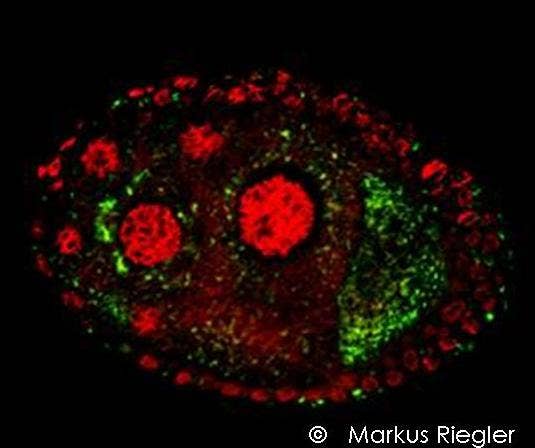
Transfer of Wolbachia symbionts into pest and vector insects
Wolbachia are maternally inherited, intracellular α-Proteobacteria, are extremely common in insects (with up to 70% of all species infected) and can manipulate host reproduction.
The most common reproductive phenotype is cytoplasmic incompatibility (CI) that occurs between Wolbachia infected males and uninfected females, leading to embryonic mortality in the offspring. This effect can be applied in pest and vector management by mass-releasing Wolbachia infected males into uninfected target populations.
Wolbachia will then lead to local suppression of insect populations. We are currently establishing and testing this method as a new biocontrol strategy for fruit flies of economic importance. In another international research project, we are currently targeting the Dengue mosquito Aedes aegypti with a virulent Wolbachia strain that not only causes CI but also shortens the lifespan of mosquitoes – a phenotype that will stop mosquitoes from transmitting human pathogens.
Climate change and insects
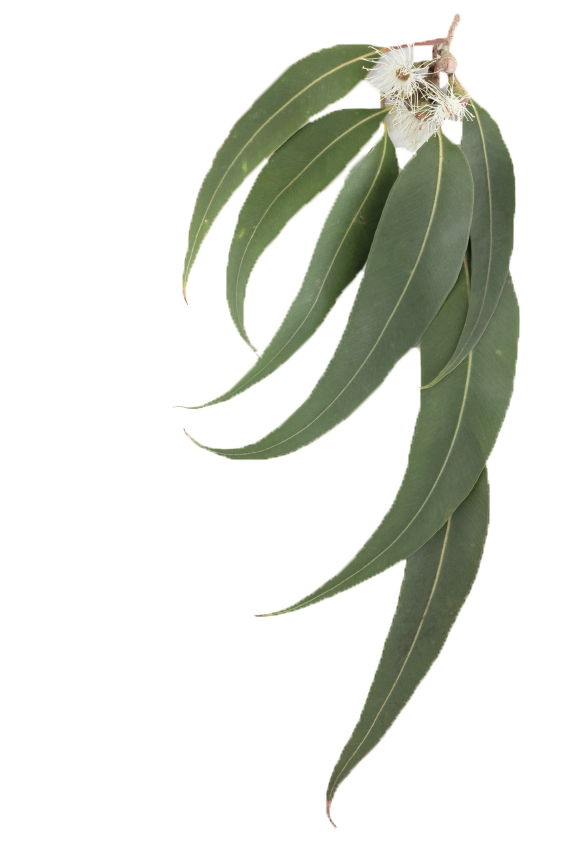
The Hawkesbury Forest Experiment (HFE) is the world's leading experiment on how eucalypts will react and adapt to climate change within the next decades.
The HFE demonstrates that increased atmospheric concentrations of carbon dioxide (CO2) and changed rainfall patterns dramatically affect the growth and biochemistry of eucalypt leaves.
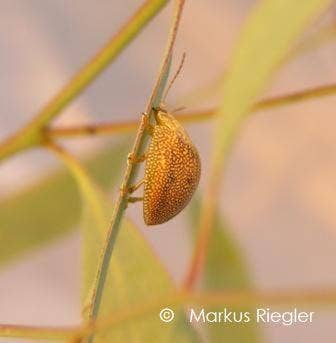
These changes will most likely cause stress in the broad array of insects that feed on Australian eucalypts. We are surveying the arthropod diversity and herbivorous activity in HFE plots that include several eucalypt species under different fertilization and irrigation treatments.
We have established lab colonies of eucalypt leaf feeders (leaf beetles and geometrid moths) in order to assay physiological and developmental parameters of these herbivorous insects and their microbial associations on leaves from CO2 and drought treatments.
Research Collaborations
- Professor Scott O'Neill (UQ)
- Professor Bill Foley (ANU)
- Professor Christian Stauffer (BOKU, Austria)
- Professor Wolfgang Miller (Medical University Vienna, Austria)
- Dr Marianne Frommer (University of Sydney)
- Dr Deborah Shearman (University of Sydney)
- Professor David Ellsworth (Western Sydney University)
- Professor Andrew Beattie (Western Sydney University)
- Assoc. Prof. Robert Spooner-Hart (Western Sydney University)
- Ms Sarah Bingham (Research assistant)
Student Supervision
- Mr Andrew Gherlenda, PhD candidate
- Mr Aidan Hall, PhD candidate
- Mr Peter Kern, PhD candidate
- Ms Jocelyn King, PhD candidate
- Dr Jennifer Morrow, PhD candidate
- Mr Robert Mueller, PhD candidate
- Ms Duong Nguyen, PhD candidate
- Mr Deane Woruba, PhD candidate
Honours and PhD research projects are available for qualified and enthusiastic students. Feel free to approach me if you are interested in pursuing research in any of the areas listed above. Post-doctoral research candidates are invited to contact me with regard to potential research projects.
People
- Professor Matthias Boer
- Associate Professor Yolima Carrillo
- Associate Professor Chris Cazzonelli
- Professor Brendan Choat
- Professor James Cook (Theme Leader - Plants Animals and Interactions)
- Doctor Eleonora Egidi
- Professor David Ellsworth
- Doctor Manuel Esperon
- Doctor Adam Frew
- Associate Professor Rachael Gallagher
- Professor Oula Ghannoum
- Doctor Christopher Gordon
- Professor Scott Johnson
- Associate Professor Catriona Macdonald
- Doctor James Makinson
- Doctor Jessica Meade
- Distinguished Professor Belinda Medlyn (Theme Leader - Ecosystem Function and Integration)
- Associate Professor Ben Moore
- Professor Uffe Nielsen (Theme Leader - Soil Biology and Genomics)
- Associate Professor Rachael Nolan
- Associate Professor Alexie Papanicolaou
- Professor Elise Pendall
- Associate Professor Jonathan Plett
- Professor Jeff Powell
- Professor Sally Power
- Doctor Renée Marchin Prokopavicius
- Professor Markus Riegler
- Associate Professor Paul Rymer
- Doctor Demi Sargent
- Associate Professor Robert Sharwood
- Distinguished Professor Brajesh Singh
- Professor Ben Smith (Director of Research)
- Distinguished Professor David Tissue
- Professor Mark Tjoelker (Interim Director)
- Doctor Bin Wang
- Doctor Jun-Tao Wang
- Professor Justin Welbergen
- Distinguished Professor Ian Wright (Chief Scientist)
Honorary and Adjunct Appointments