You can search for courses, events, people, and anything else.
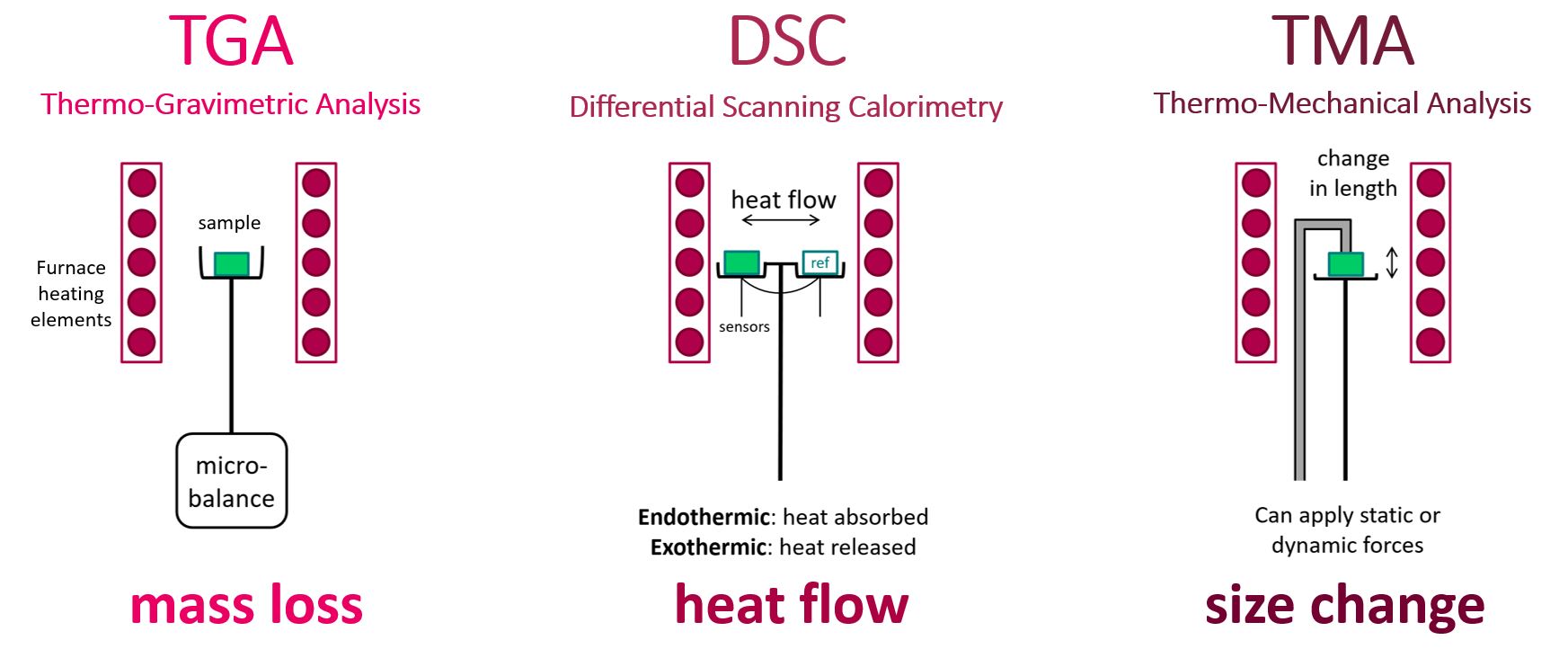
Thermal analysis involves the characterisation of solid and liquid materials during heating, cooling. or static temperatures. Various thermal events can be monitored and quantified with high accuracy across a broad temperature range. The AMCF houses instruments that can conduct three main thermal techniques:
Thermo-Gravimetric Analysis (TGA): Monitors changes in mass as a function of temperature or time (e.g. mass loss due to thermal decomposition or mass gain due to oxidation)
Differential Scanning Calorimetry (DSC): Monitors flow of energy into (endothermic) or out of (exothermic) a sample as it is heated/cooled. Information about thermal events such as glass transitions, melting points, crystalisation temperatures and phase transitions can be found.
Thermal Mechanical Analysis (TMA): Samples are monitored for changes in physical characteristics as a function of temperature. There are different setups which can allow for analysis of characteristics such as expansion, contraction, pentration, softening points, glass and phase transitions, young’s modulus and elasticity to name a few.
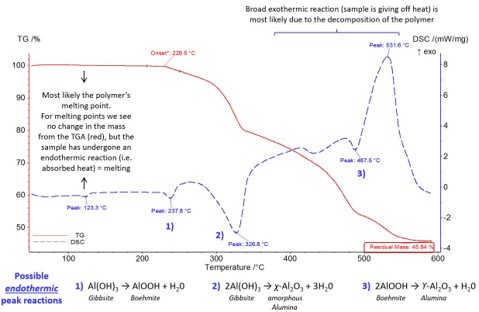
STA results (simultaneous TGA and DSC) for a piece of composite building cladding material (polyethylene with aluminium hydroxide filler) heated up to 600oc in an Air atmosphere. Here a melting point becomes apparent in the DSC at 123oC as there is no mass loss in the TGA. The evaporation of water at three points as the aluminium hydroxide dechydrates is an endothermic event, and therefore these peaks face down. The thermal degradation of polyethylene is exothermic.
All thermal techniques are complimentary, and data from each can plotted against temperature on the same graph. The AMCF has a suite of thermal instrumentation, including two Simultaneous Thermal Analysers (STA), which can simultaneously perform TGA and DSC at the same time. By analysing these signals together, we can get a better understanding of the thermal events taking place in a sample.
Before beginning an experiment, it is first important choose what has atmosphere you would like to conduct your experiment under, as this will affect how your sample behaves. Which gas you choose will also be influenced by what you are wanting to understand about your sample. For example:
- Is there a real life senario you are wanting to replicate?
- Are you wanting to understand more about the material’s structure?
Atmospheres available at the AMCF and how they thermally affect sample behaviour
Software available for analysis
- Netzsch Proteus: For analysis of STA, TGA, DSC and TMA results
- Netzsch Kinetics Neo: For analysis of thermal data for kinetics calculations and modelling
- Netzsch Peak Separation Software: For analysis of overlapping thermal events
- Bruker OPUS 3D Package: Analysis of EG-FTIR data
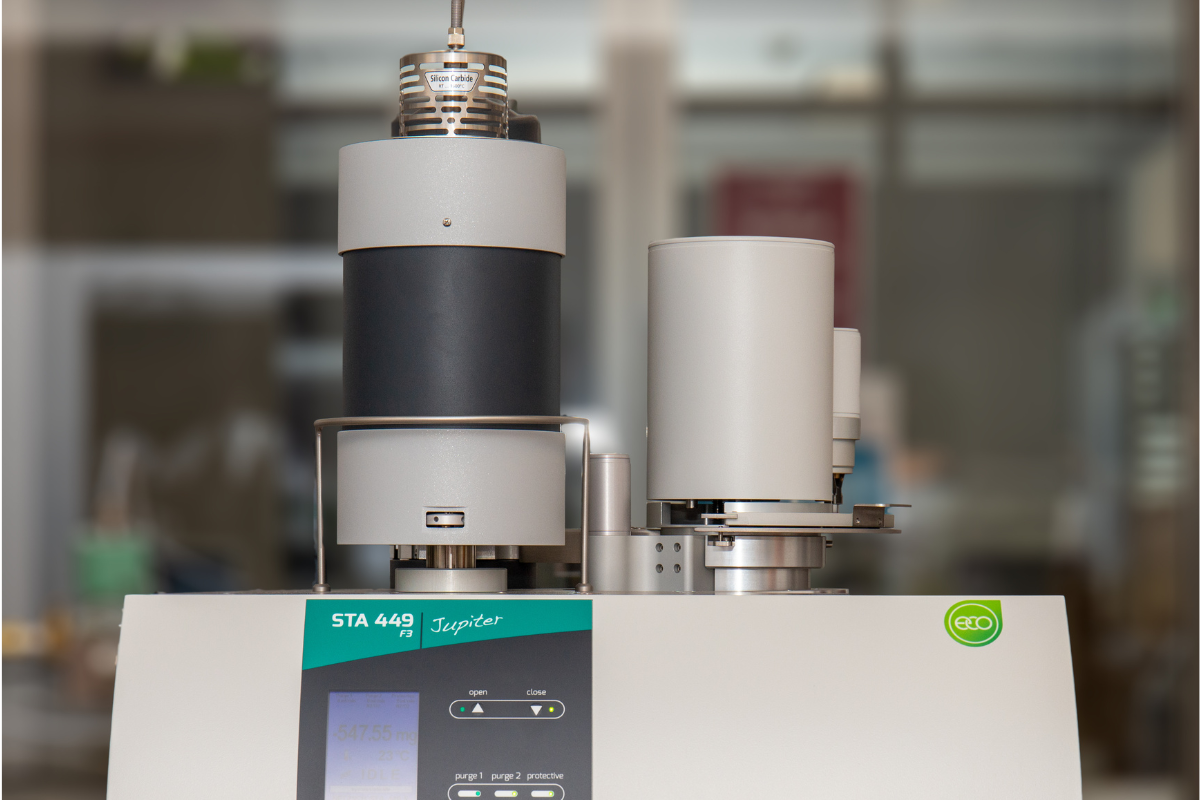
Netzsch STA 449F3 Multi
Analysis Type: Simultaneous TGA and DSC
Furnace: Silicon Carbide
Temperature Range: Room Temperature up to 1600°C.
Thermocouple: S-type
Gases: Instrument Air, Nitrogen and Argon.
Crucibles: Aluminium, alumina and platinum. Alumina and platinum crucibles may need to be purchased.
Advantages: With a 20 position auto-sampler, this instrument is great for the routine analysis of many samples. This system is supported by Proteus 8 software which includes the Auto-Evaluate feature. Also installed is Netzsch’s Kinteics Neo software (for analysis of the thermo-kinetic properties of samples, such as activation energies) and Netzsch’s Peak Separation Software, which can be used for thermal, FTIR and mass spec data.
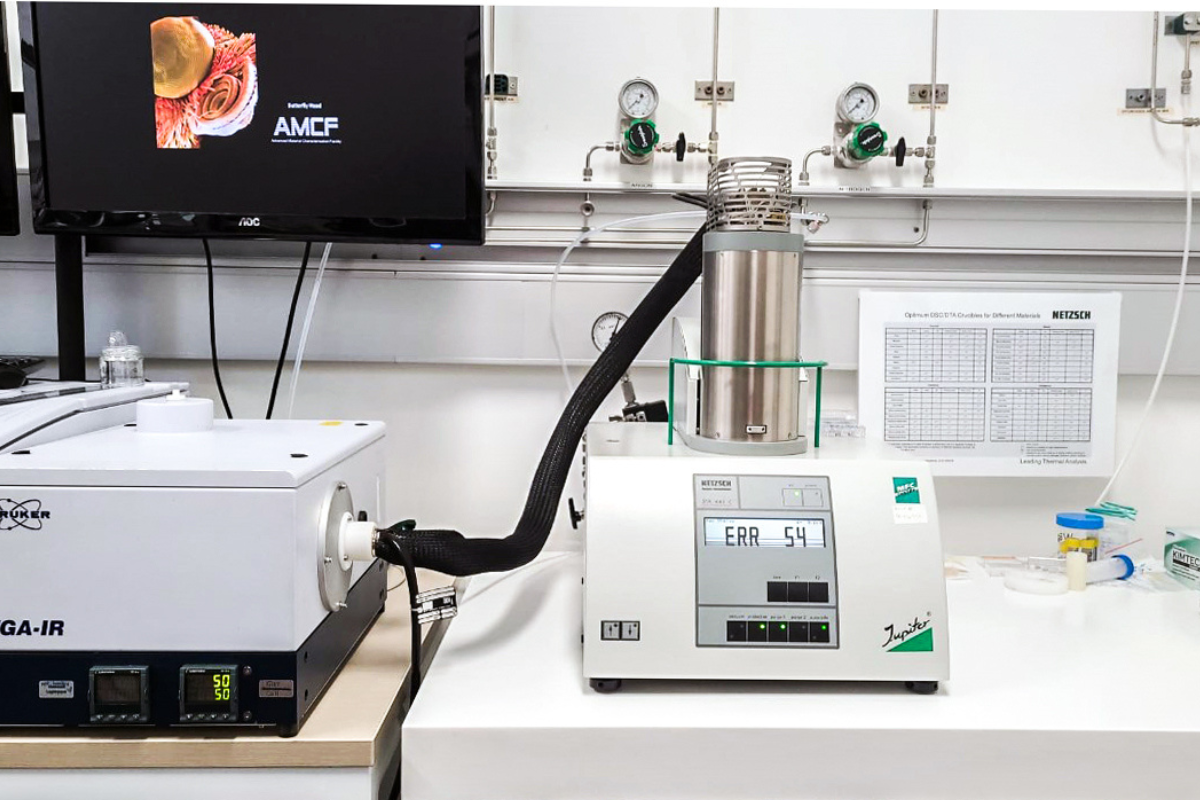
Netzsch STA 449C Jupiter
Analysis Type: Simultaneous TGA and DSC. Can also be setup for TGA-only analysis of large samples, or coupled to gas FTIR for evolved gas analysis.
Furnace: Platinum-Rhodium
Temperature Range: Room Temperature up to 1600°C.
Thermocouple: S-type
Gases: Instrument Air, Nitrogen and Argon.
Crucibles: Aluminium, alumina and platinum. Alumina and platinum crucibles may need to be purchased.
Advantages: This versatile instrument is equipped with a number of different holder types and accessories for more specific experiments. It’s metal furnace means its ideal for sensitive specific heat measurements. It can also be coupled to a gas FTIR cell for evolved gas FTIR analysis.
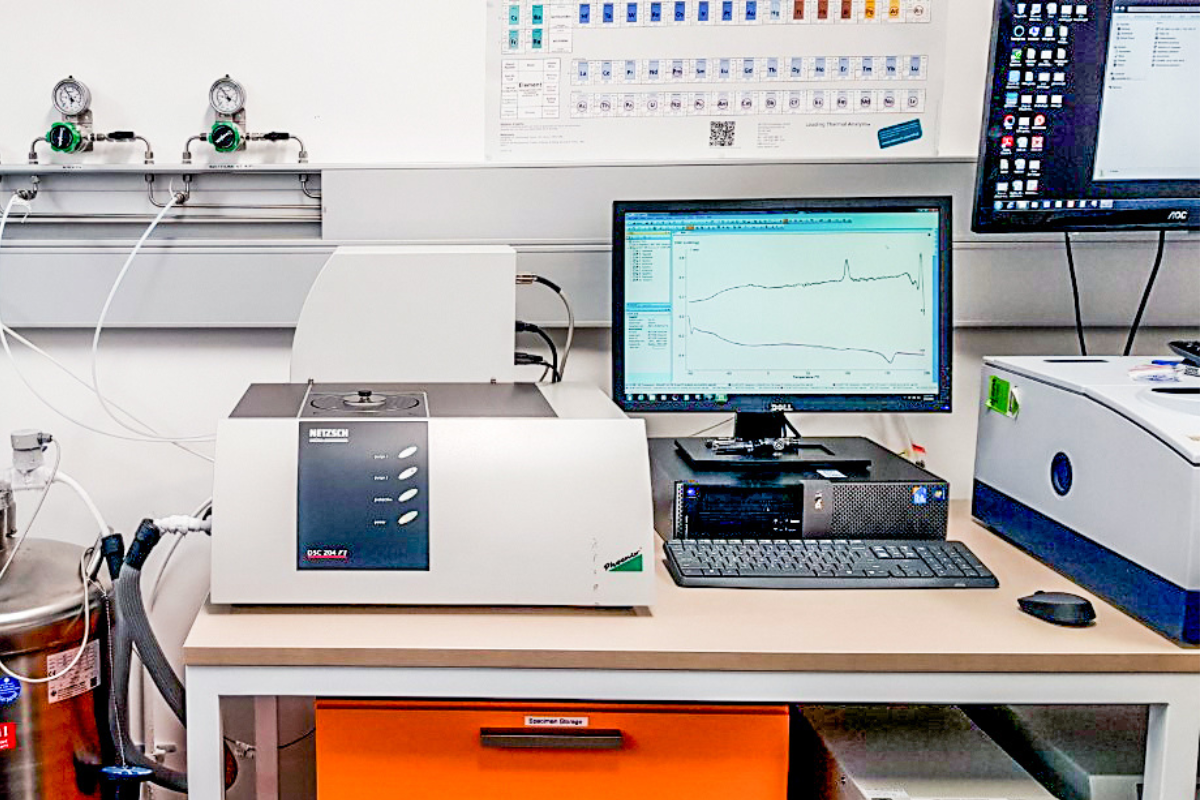
Netzsch DSC (Cold-Stage) 204F1 Pheonix
Analysis Type: DSC
Furnace: Platinum-Rhodium
Temperature Range: -160°C up to 700°C
Thermocouple: K-type
Gases: Instrument Air, Nitrogen and Argon. Helium may also be possible on consultation with AMCF staff.
Crucibles: Aluminium.
Advantages: This stand alone DSC offers the most sensitivity for DSC measurements, handy for analysis of small changes in sample properties which other instruments may not pick up. It is also coupled to a high pressure liquid nitrogen dewer, allowing the user to analyse their samples under negative temperature conditions approaching liquid nitrogen temperatures.
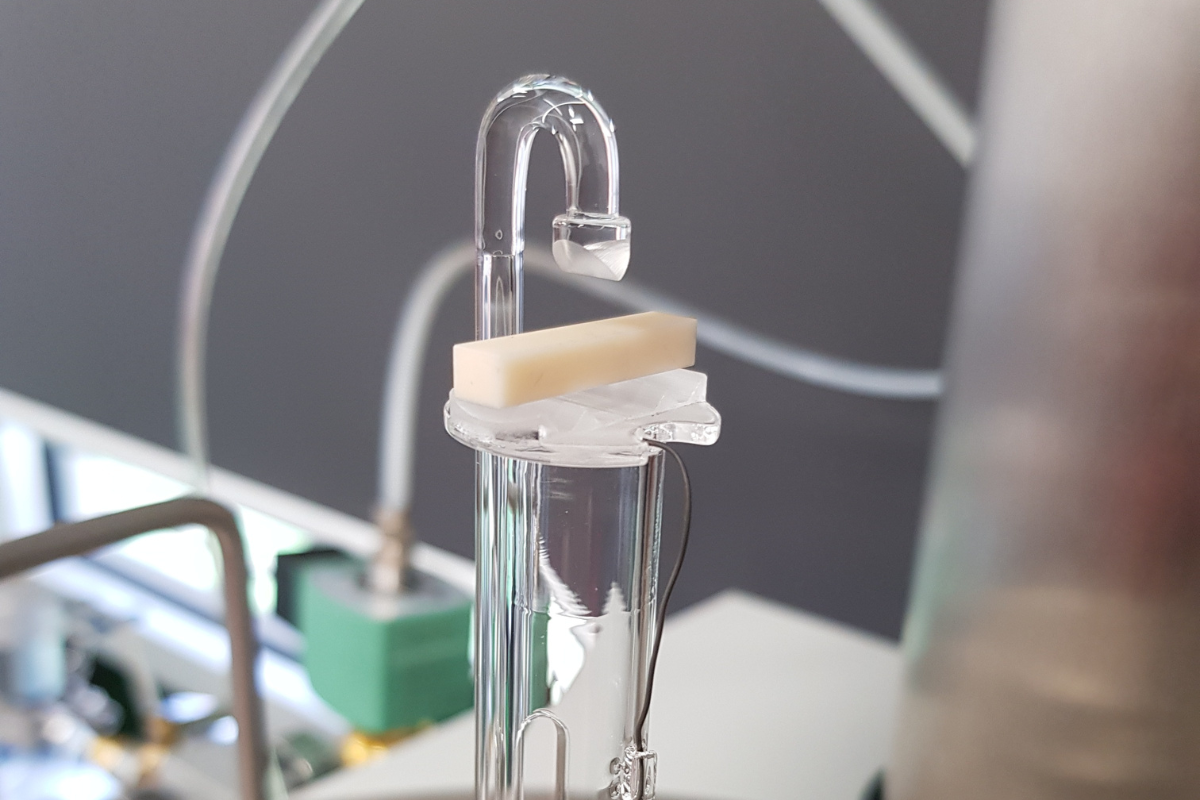
Netzsch TMA 402F1/F2 Hyperion
Analysis Type: TMA with multiple setups including those for Expansion, Penetration, Tension and 3-Point Bending.
Furnace: Choice of Steel or Silicon Carbide.
Temperature Range: -140°C up to 1000°C (Steel furnace) or room temperature up to 1600°C (SiC furnace).
Thermocouple: S-type or K-type (depending on setup).
Sample Holder/rod materials: Quartz for low temperatures and Alumina for high temperatures.
Maximum Force: 3N
Gases: Instrument Air, Nitrogen and Argon.
Advantages: The vertical design of the TMA’s furnace with motorized hoist allows for many different sample geometries (rods, squares, plates, films, fibers, powders, liquids). Static and/or dynamic forces can be exerted allowing for the setup of custom experiments as needed.