Control Systems Inspired by Insect Central Pattern Generators that can Adapt to Dynamic Environments.
Supervisors:
Primary supervisor Dr Saeed Afshar
Description:
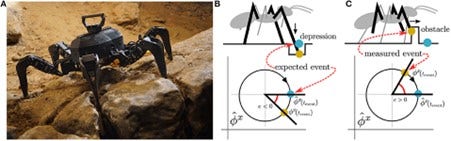
This project will investigate modelling various Central Pattern Generators of insects to apply them for practical control systems. The project is focussed on building control systems targeted towards specific robotic functions that can adapt to dynamic changes in the environment. The project would also involve exploration of adaption and learning mechanisms using the central pattern generators to enhance robustness.
The insect kingdom is full of examples of organisms that are capable of surviving in adverse weather and environmental conditions. Biological systems can adapt to rapid changes in the environments and without any training. Current neural network-based control systems require long periods of simulated training to adapt to various conditions. In this project, we aim to build simple control systems that are inspired by the central pattern generators of various insect nervous systems. These control systems do not require training but are specially designed to adapt to challenging environments and targeted towards a solving a specific control task and not achieve domain general intelligence. The control systems are focussed on simplicity to enable ease of manufacturing and functioning through minimal computational resources.
Outcomes:
- Explore the models of various Central Pattern Generators found in biology and replicate them in simulation to study their behaviour.
- Investigate control systems that can use the CPG models to perform specialized functions in dynamic environments. Investigate adaptation and learning mechanisms to enable the resulting system to rapidly adopt to changes in the environment.
- Simulate the control systems in software and benchmark their capacity to adapt to different conditions.
- Develop working prototype(s) that can be applied to real world scenarios and test their functional capacity under varying conditions.
Eligibility criteria:
Experience with C++, Python, MATLAB, or other equivalent languages for developing and testing the algorithms. Experience with algorithms and strong mathematical background.
Projects
-
- Task-Driven Model Evaluation in Large-Scale Spiking Neural Networks
- A Neuromorphic Ferroelectric field-effect Ultra-Scaled Chip for Spiking Neural Networks
- Event Based Wavefront Sensing Modalities
- Physics-Based Encoding for Spiking Neural Networks
- Neuromorphic Computational Imaging
- Defining Performance Metrics for Closed Loop Event Based Imaging Systems
- A Neuromorphic Framework for Event-Based DNNs using Minifloats
- A RISC-V instruction set architecture (ISA) extensions for neuromorphic computing using minifloats
- Astrometry with Event-based Vision Sensors
- Automatic Evaluation of Bushfire Risk via Acoustic Scene Analysis
- Bio-inspired Sensors for Space Situational Awareness
- Building a Neuromorphic Auditory Pathway for Sensing the Surrounding Environment
- Cold Start Astrometry for High-Precision Airspace and Space Objects Tracking with Neuromorphic Cameras
- Control Systems Inspired by Insect Central Pattern Generators that can Adapt to Dynamic Environments.
- Design of Neuromorphic Spiking Neural Networks for Real-Time Processing
- Enhanced Maritime Situational Awareness with Neuromorphic Cameras
- Environmental Situational Awareness using Neuromorphic Vision Sensors and IMU-based SLAM
- Fault Tolerant Distributed Swarm Intelligence using Neuromorphic Computing and Local Learning Principles
- Honey Bee Waggle Dance Detection via Neuromorphic Engineering
- Integrated Circuit Design for Event-based Vision Sensors
- Low-Power Acoustic Ecological Monitoring in Remote Areas using Machine Learning and Neuromorphic Engineering
- Neuromorphic Computing in Extreme Environments
- Neuromorphic Cyber Security at the Edge
- Neuromorphic Engineering for Acoustic Aerial Drone Detection in Visually Obscured Environments
- Machine Learning-Based Tool for Therapists to Monitor Speech Progress in Late Talkers
- Machine Learning for Automated Child Reading Assessment and Intervention
- Underwater Acoustic Drone Detection via Neuromorphic Models of Marine Mammal Audition