Neuromorphic Cyber Security at the Edge
Supervisors:
Primary supervisor Dr Saeed Afshar
Description:
We invite applications from highly motivated graduates seeking to undertake a Doctor of Philosophy (PhD) degree to work with Neuromorphic Engineering pioneer, Professor André van Schaik, in one of the world’s leading neuromorphic engineering research labs, on a project to design a Neuromorphic processor that dynamically learns the normal operating states of an edge device and detects, prevents and reports anomalous behaviour and communications.
Smart edge devices are becoming ever more ubiquitous in defence environments. As the functional complexity of these devices increases, so does the likelihood of security vulnerabilities. The conventional approach to cyber security for edge devices such as remote autonomous vehicles involves the collection and transmission of sensory, actuator and network data for inspection by a centralized high-performance computing system. This approach, of gathering and transmitting large quantities of data from the edge to a central node for processing, requires continuously reliable high bandwidth communication channels as well as costly local storage and transmission capabilities at the edge device. As the number of edge devices and their information gathering and complexity increase, this model of information processing becomes ever less sustainable.
Agent based anomaly detection systems are still in an early stage of development with the state-of-the-art solutions relying on computationally expensive Machine Learning (ML) solutions which limits their use in edge applications.
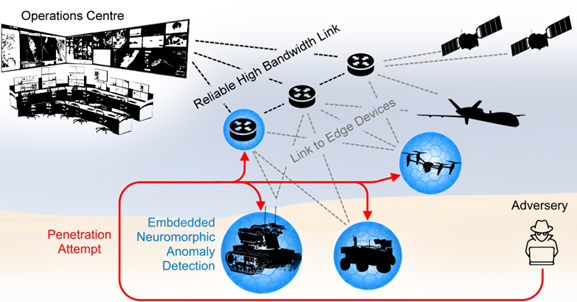
Figure 1. Use of Neuromorphic anomaly detection systems in hardware can protect edge devices and detect traffic and behavioural anomalies in real-time without flooding the network with unnecessary data.
The International Centre for Neuromorphic Systems (ICNS) is a leading research group focused on the development of neuromorphic sensors, processors, and algorithms. The Centre’s primary focus is on real world applications of neuro inspired perception and processing, where biological systems have natural advantages over conventional solutions: where robust, low power, high speed processors must respond autonomously to noisy, unpredictable environments.
ICNS is part of the MARCS Institute for Brain, Behaviour, and Development. Together we investigate the psychological, neurophysiological, developmental and computational mechanisms that enable humans to interact with each other, their environment, and with technology, and develop technology based on what we learn. Your PhD position with us will therefore provide you the opportunity to interact and contribute across a range of disciplines.
Outcomes:
In this project, you will first survey the current state of the art anomaly detection systems in the Neuromorphic and Machine Learning fields. Building on these solutions, you will design and test novel low-power high speed spiking neural network architectures which can build internal models of normal edge device behaviour with respect to sensory and network input and detect anomalous behaviour against this background model. As shown in Figure 1, by only transmitting anomalies and through learning to respond locally to anomalies, the system could dramatically reduce the burden on the available communication channels and human operators while rapidly dealing with normal signal traffic at the edge. After simulation on a conventional processor, your developed architecture must be implemented in FPGA hardware and be put to the test on real-world autonomous platforms in live trials against expert hackers.
What does the scholarship provide?
- Domestic candidates will receive a tax-free stipend of $30,000(AUD) per annum for up to 3 years to support living costs, supported by the Research Training Program (RTP) Fee Offset.
- International candidates will receive a tax-free stipend of $30,000(AUD) per annum for up to 3 years to support living costs. Those with a strong track record will be eligible for a tuition fee waiver.
- Support for conference attendance, fieldwork and additional costs as approved by MARCS.
- Access to the extensive range of MARCS specialised equipment and laboratory facilities.
- Additional funding to support training and equipment purchases.
- A rich environment of support and academic expertise via supervisory panels, seminars, colloquia, international and industry collaborations.
International candidates are required to hold an Overseas Student Health Care (OSHC) insurance policy for the duration their study in Australia. This cost is not covered by the scholarship.
Eligibility criteria:
The successful applicant should:
- hold qualifications and experience equal to one of the following (i) an Australian First Class Bachelor (Honours) degree, (ii) coursework Masters with at least 25% research component, (iii) Research Masters degree, or (iv) equivalent overseas qualifications in electrical engineering, or computer science.
- have demonstrated research experience in neuromorphic engineering.
- have a background in signal processing with strong programming skills in Python, Matlab, and/or C++, and an interest in signal processing in biology.
- be enthusiastic and highly motivated to undertake further study at an advanced level.
Desirable skills include:
- demonstrated expertise using Verilog or VHDL for FPGA programming.
- experience in experimental design.
- experience with mixed-signal integrated circuit design.
- proven ability to work successfully as part of a team.
- familiarity with machine learning and machine learning concepts.