Underwater Acoustic Drone Detection via Neuromorphic Models of Marine Mammal Audition
Supervisors:
Primary supervisor Dr Saeed Afshar
Description:
Marine mammals, like dolphins and whales, possess exceptional auditory systems, enabling them to navigate and communicate efficiently in the underwater world, even in challenging conditions. Mimicking these remarkable bioacoustic capabilities, this project aims to develop an automated system that can detect the acoustic signatures of underwater drones. To accomplish this, we will employ neuromorphic engineering principles that replicate the functioning of the marine mammal auditory system. This approach leverages the energy-efficient, adaptive, and intelligent capabilities inherent in neuromorphic systems, making it ideal for real-time, on-device processing in remote or power-limited aquatic locations.
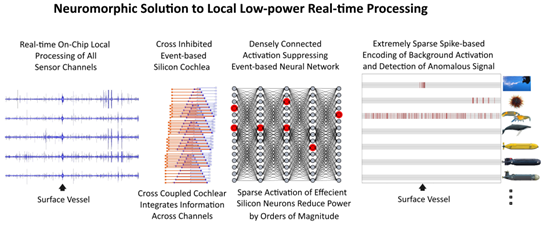
Neuromorphic engineering offers a promising solution for power-efficient, real-time systems. In remote underwater environments where power resources are limited, neuromorphic hardware, like event-based sensors and neuromorphic processors, can significantly reduce power consumption. These devices only consume power when processing actual changes in the acoustic scene, making them ideal for continuous monitoring of underwater drones.
Furthermore, neuromorphic systems can process data on the edge, right on the device, instead of needing to send it to a central server. This can save a significant amount of energy that would otherwise be spent on communication, especially for remote sites with limited connectivity.
In addition to its practical applications, this project can contribute significantly to the understanding of marine mammal auditory systems, potentially leading to new insights in bioacoustics and neuromorphic engineering.
Outcomes:
The purpose of this project is to create an efficient and automated system capable of detecting underwater acoustic drones, modeled after the superior auditory capabilities of marine mammals. By using the principles of neuromorphic engineering and bio-inspired algorithms, we aim to provide a robust detection system that mimics the marine mammals' natural sonar capabilities. The resulting system would not only enhance the monitoring and management of underwater drone activities but also be power-efficient, making it ideal for continuous monitoring in remote or power-limited aquatic environments. This will include the following tasks:
- Literature Review: Conduct a comprehensive review of existing research on marine mammal audition, underwater acoustics, and the state of the art in neuromorphic engineering and bio-inspired algorithms.
- Data Collection: Collect high-quality underwater acoustic data from various drone models and types of marine environments.
- Algorithm Development: Develop and test neuromorphic algorithms inspired by marine mammal audition for detecting and interpreting underwater drone acoustics.
- Validation and Analysis: Validate the algorithm(s) using ground truth data (e.g., known drone acoustic signatures). Perform statistical analysis to evaluate the system's performance and reliability.
- Optimization: Depending on the initial results, iteratively optimize and fine-tune the system for increased accuracy and efficiency.
- Interpretation of Results: Analyze the gathered data in the context of underwater drone detection and marine mammal audition. Consider what new insights can be gleaned from the data and how they can be applied to underwater drone monitoring and bioacoustic research.
- Communication and Publication: Write up the results in a format suitable for publication in a scientific journal. Present the results at relevant conferences and workshops.
Eligibility criteria:
Experience in Matlab, Python or C++ for network design and testing is needed. Knowledge of underwater acoustics and bioacoustics, along with experience working with neuromorphic hardware and software, will be advantageous. Familiarity with machine learning algorithms, particularly those designed to run on neuromorphic hardware, and data analysis skills would also be beneficial.