Professor Scott Johnson

Scott is a community ecologist working on insect–plant interactions, particularly on pest species.
He gained his PhD from the University of York in the UK and held a number of positions in the UK, including at the University of Reading and the Scottish Crop Research Institute (now The James Hutton Institute), before moving to Australia in 2011 to take up the position of Senior Lecturer.
His research group aims to identify novel approaches for managing pest species and preserving ecosystem services, based on a better understanding of how organisms within ecosystems interact.
This includes exploiting chemical signals used by insects to locate resources, enhancing biological control by increasing searching efficiency of the herbivores' natural enemies and using plant-microbes to help plants resist herbivore attack.
A major theme of the research involves understanding how atmospheric and climate change affects insect herbivores, especially in terms of ecosystem resilience, resistance breakdown in crops and disruption of behavioural interactions (e.g. predator-prey interactions, insect mutualisms).
By characterising multi-trophic interactions, particularly in response to global change, we identify vulnerabilities in ecosystems, but more crucially where resilience and the opportunities for adaptation lie...
Most recently Scott’s research group has focused on the functional role of silicon in plant biology, particularly in terms of enhancing plant protection from insect pests. Much of this research includes a climate change component.
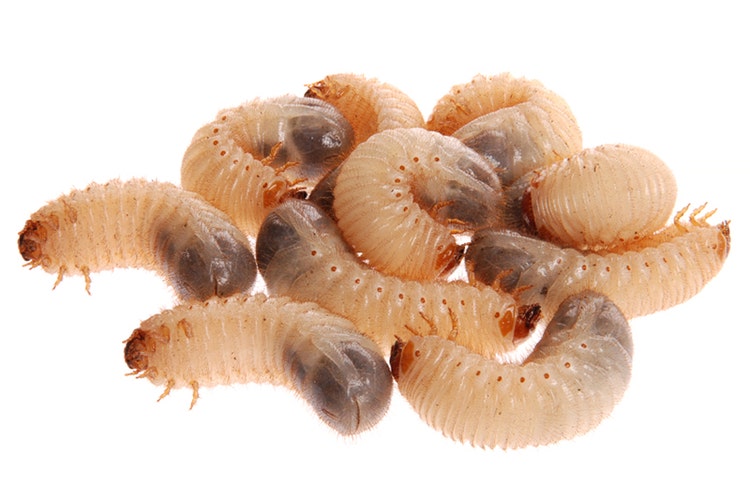
Our research is interested in root-feeding herbivores such as these Scarab Beetle larvae, and specifically how they interact with plants and influence defence responses under a range of environmental conditions.
Grants / Current Projects
Silicon: a novel solution to reduce water use and pest damage in wheat
Co-Researchers: David Tissue, Yolima Carillo
Partner/Funding Body: Australian Research Council Linkage
Period: 2023-2027
Improving plant resilience to biotic and abiotic stresses via silicon accumulation
Partner/Funding Body: Horticulture Innovation Australia
Period: 2023-2028
Assessing Plant Available Silicon uptake of different grades of Amorphous Silica when applied to Wheat (Triticum aestivum)
Partner/funding body: Agripower Australia
Period: 2022
Benefits from below: using silicon to alleviate drought and salinity stress in wheat
Co-Researcher: David Tissue and Zhonghua Chen
Partner/Funding Body: Agripower Australia Ltd and WSU Research Partnerships
Period: 2021
Are we really heading for 'insectageddon"? Characterising changes in Eucalypt invertebrate communities under rising CO2
Partner/Funding Body: Herman Slade Foundation
Period: 2019-2022
Port Augusta QFly Sterile Insect Technology factory pilot operation
Co-Researchers: Markus Riegler, Ian Anderson, James Cook and John Hunt
Partner/funding body: Horticulture Innovation Australia
Period: 2019-2022
Down to earth defence: unlocking soil-derived defences for plant protection
Co-Researcher: David Tissue and Susan Hartley
Partner/funding body: Australian Research Council Discovery
Period: 2017-2019
Time to prime: using silicon to activate grass resistance under higher CO2
Partner/funding body: Australian Research Council Future Fellowship
Period: 2017-2021
Get tough, get toxic and get a bodyguard: Using silicon to augment direct and indirect anti-herbivore defences in cereals.
Partner/funding body: Australian Steel Mill Services and WSU Industry Partnership
Period: 2016-2017
Back to the future: how past, present and impending atmospheric carbon dioxide concentrations affect silicon defences against herbivores in grasses
Co-Researcher: James Ryalls
Partner/Funding Body: British Ecological Society
Period: 2015
How increased atmospheric carbon dioxide concentrations affect aphid-ant mutualisms: turning bodyguards into assassins?
Partner/Funding Body: British Ecological Society
Period: 2015
Exploiting soil microbe associations with sugarcane roots for resistance to canegrubs
Co-Researcher: Jeff Powell, Peter Allsopp and Nader Sallam
Partner/Funding Body: Sugar Research Australia
Period: 2014-2016
Get tough, get toxic or get a bodyguard: How root herbivores shape grass defences
Co-Researcher: Ben Moore
Partner/Funding Body: Australian Research Council Discovery
Period: 2014-2016
Drought, deluge and diversity decline - How do root herbivores affect grassland resilience to predicted changes in rainfall patterns?
Co-researcher: Sally Power
Partner/Funding Body: Hermon Slade Foundation
Period: 2013-2016
Grazing in the dark - how will climate change affect root-feeder impacts on aboveground insects? Co-Researcher: Markus Riegler
Partner/Funding Body: University of Western Sydney
Period: 2012-2013
Characterising vine weevil aggregation pheromone
Partner/Funding Body: Horticultural Research Company and Genecom
Period: 2011-2012
Genetic basis of physical resistance traits in plants and their effects on pests and pathogens
Co-Researcher: J Graham
Partner/Funding Body: Technology Strategy Board
Period: 2010-2014
Do mycorrhizal fungi facilitate root defence signalling in belowground predator-prey interactions?
Partner/Funding Body: Natural Environment Research Council; CASE award with Royal Holloway College, University of London
Period: 2010-2014
Aboveground-belowground interactions in a changing climate
Partner/Funding Body: Natural Environment Research Council; CASE award with Centre for Ecology and Hydrology
Period: 2010-2014
Effects of elevated CO2 on breakdown of plant defences
Partner/Funding Body: Natural Environment Research Council; CASE award with Cardiff University
Period: 2010-2014
Modelling host-prey interactions in crop systems (EPSRC) Partner/Funding Body: Engineering & Physical Sciences Research Council; CASE award with the University of Dundee
Period: 2007-2012
Lab Members
Current PhD and Postgraduate students
- Fikadu Biru
- Jamie Waterman
- Rocky Putra
- Ximena Cibils Stewart
- Tarikul Islam
Past Researchers and PhD Students
- Rhiannon Rowe (MRes, 2018). Principal Supervisor. Does silicon supplementation affect plant traits that impact the performance and feeding behaviour of cereal aphids?
- Dr Adam Frew - PhD 2016 - Principal Supervisor with Professor Jeff Powell. How the soil environment affects root-feeding scarabs with particular emphasis on the canegrub (Sugar Research Australia) –
- Dr Sarah Facey - PhD 2016 - Principal Supervisor with Professor David Ellsworth and Dr Jo Staley (CEH, UK). Resilience versus decline: precipitation and atmospheric change drive contrasting responses in invertebrate communities.
- Dr Kirk Barnett - PhD 2016 - Co-supervisor with Professor Sally Power. Hidden herbivory, precarious precipitation and punished pastures: Australia's grasslands under root herbivory and altered rainfall.
- Jenni Kremer (Honours/Masters, 2017) – Principal Supervisor with Professor James Cook and Dr Sabine Nooten. odyguards and Assassins: Bottom up control in ant-aphid mutualism
- Dr James Ryalls - PhD 2017. The impacts of climate change and belowground herbivory on aphids via primary metabolites.
- Dr Andrew Gherlenda – PhD 2016. The effects of CO 2 and temperature on Eucalyptus insect herbivores from individuals to communities.
- Dr Aidan Hall – PhD 2016. Ecology and evolution of Cardiaspina psyllids, their endosymbionts and parasitoid wasps
- Dr Ivan Hiltpold (Postdoctoral Research Assistant), ARC Discovery project
- Dr Ruth Wade – PhD 2015. The effect of simulated precipitation change on multi-trophic interactions in a cereal crop.
- Dr James Hourston – PhD 2015. Do mycorrhizal fungi facilitate root defence signalling in belowground predator-prey interactions?
- Dr Carolyn Mitchell (Postdoctoral Research Assistant). Soft fruit entomology research projects funded by HDC and TSB.
- Dr William Hentley (PhD, 2014). The impact of global change on multi-trophic interactions.
- Dr Scott McKenzie (PhD, 2014). An aboveground-belowground herbivore interaction in a woody perennial crop and its response to elevated atmospheric CO 2
- Dr Lindsay McMenemy (PhD, 2011). Raspberry viruses manipulate plant-aphid interactions.
- Dr Katy Clark (PhD, 2010). Linking aboveground and belowground insect herbivore interactions: a case study with the vine weevil (Otiorhynchus sulcatus)
Awards/Recognition
- Awarded the position of Theme Research Coordinator (Plants, Animals and Interactions) at the HIE, 2019
- Invited to chair the organising committee for the 2017 Ecological Society of Australia conference, 2017
- Vice President of the Royal Entomological Society, 2010-2011
- Honorary Lecturer at the University of Dundee
- Fellow (FRES) and Trustee of the Royal Entomological Society
- Associate Editor, Ecological Entomology
- President of the European Congresses of Entomology, 2010-2014
- Deputy Chair of British Ecological Society Meetings, 2004-2009
- Stapledon Research Fellow, 2007
- Awarded the Anne Keymer Prize by the British Ecological Society, 2001
Research Opportunities
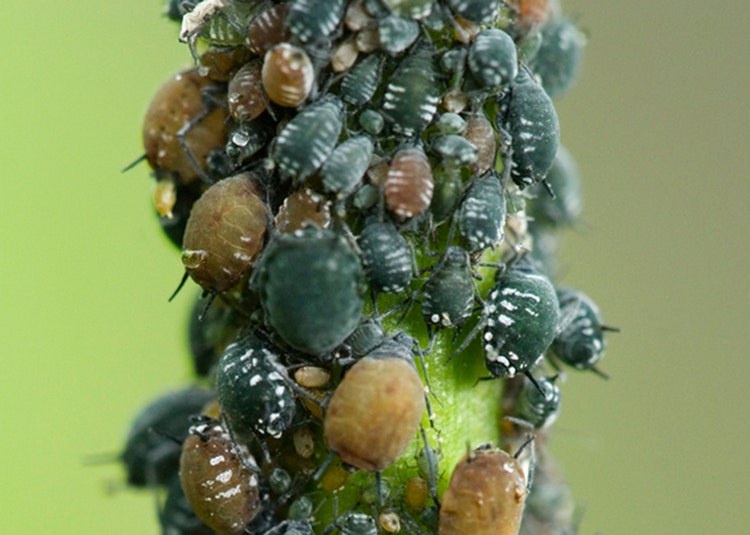
Aphids cluster on a stem. Our research includes investigating insects such as aphids and how they respond under conditions such as elevated CO2.
"Little things that run the world" is how the biologist E.O. Wilson described invertebrates.
There is a great deal of truth in this, with invertebrates playing major roles in the functioning and processes of most terrestrial and aquatic ecosystems.
Besides humankind, invertebrates shape the world around us perhaps more than any other group and their response to global climate change is therefore pivotal in future global challenges, including food security, conservation, biodiversity and human health.
We welcome enquiries from undergraduate and postgraduate students about research opportunities in our areas of research.
These range from short-medium term research placements, Honours / Masters projects to PhD scholarships.
Funding opportunities arise throughout the year, so please make contact in good time to maximise your chances of success.
Example projects include:
Why it sucks being an aphid in a high CO2 world?
While sap-sucking aphids are identified as potential beneficiaries of increased atmospheric greenhouse gases such as CO2, much depends on their interactions with other players such as natural enemies and mutualistic partners (e.g. ants).
The limited evidence available suggests when these players are thrown in the mix, the situation becomes much worse for aphids.
We'll aim to incorporate this trophic realism into such research and gain insights into how these interactions shift in the future.
Putting the 'upstairs-downstairs' into ecosystem responses to global climate change?
Traditionally studied separately, it's now recognised that above- and belowground systems are linked via plant-mediated mechanisms.
The effects of global climate change on, say, a root herbivore would therefore have cascading effects on aboveground herbivores and their natural enemies.
Using state-of-the art facilities, this research will identify key drivers and ecosystem engineers in future climates.
The real Hunger Games – how ladybird and parasitic wasps regulate lucerne aphid populations
Around 30 years ago, Australia's lucerne industry suffered massive losses with the arrival of three exotic aphid pests.
Resistant cultivars and natural enemies have helped control aphids since, but breakdowns in cultivar resistance are increasingly common.
Understanding how natural enemies regulate aphid populations is therefore of pivotal importance.
People
- Professor Matthias Boer
- Associate Professor Yolima Carrillo
- Associate Professor Chris Cazzonelli
- Professor Brendan Choat
- Professor James Cook (Theme Leader - Plants Animals and Interactions)
- Doctor Eleonora Egidi
- Professor David Ellsworth
- Doctor Manuel Esperon
- Doctor Adam Frew
- Associate Professor Rachael Gallagher
- Professor Oula Ghannoum
- Doctor Christopher Gordon
- Professor Scott Johnson
- Associate Professor Catriona Macdonald
- Doctor James Makinson
- Doctor Jessica Meade
- Distinguished Professor Belinda Medlyn (Theme Leader - Ecosystem Function and Integration)
- Associate Professor Ben Moore
- Professor Uffe Nielsen
- Associate Professor Rachael Nolan
- Associate Professor Alexie Papanicolaou
- Professor Elise Pendall
- Associate Professor Jonathan Plett
- Professor Jeff Powell (Theme Leader - Soil Biology and Genomics)
- Professor Sally Power
- Doctor Renée Marchin Prokopavicius
- Professor Markus Riegler
- Associate Professor Paul Rymer
- Doctor Demi Sargent
- Associate Professor Robert Sharwood
- Distinguished Professor Brajesh Singh
- Professor Ben Smith (Director of Research)
- Distinguished Professor David Tissue
- Professor Mark Tjoelker (Interim Director)
- Doctor Bin Wang
- Doctor Jun-Tao Wang
- Professor Justin Welbergen
- Distinguished Professor Ian Wright (Chief Scientist)
Honorary and Adjunct Appointments