Cumberland Plain Research
About the Research Strategy
The draft CPCP Research Program Implementation Strategy was developed by a team from Western Sydney University in collaboration with the NSW Department of Planning and Environment to guide the delivery of a 35-year research program that will help achieve the CPCP’s outcomes in Western Sydney.
The Research Strategy will:
- help to improve knowledge about the area’s threatened species and ecosystems and our ability to manage, restore and monitor plant, animal and ecosystem responses to our efforts
- deliver the data and new knowledge needed by the different stakeholders who are working to conserve and restore the native plants and animals of the Cumberland Plain.
The Cumberland Plain is the Country of the Darug, Dharawal and Gundungurra peoples while Aboriginal and Torres Strait Islander peoples from many other groups also live in, or have care relationships with, the area. The Strategy will also recognise the need to undertake research to support Aboriginal peoples to maintain their distinctive cultural, spiritual, physical and economic relationships with the land and waters in the Cumberland Plain.
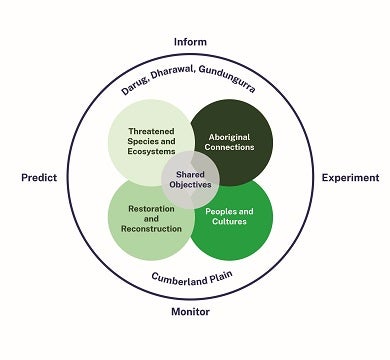
The draft Research Strategy proposes research priorities around four key themes:
- Supporting Aboriginal connections: Partnering with Aboriginal peoples on research which helps maintain their distinctive cultural, spiritual, physical and economic relationships with their land and waters in the Cumberland Plain.
- Engaging with peoples and cultures: Understanding the attitudes and behaviours of the community toward biodiversity and conservation values found in the Cumberland Plain and how these can be positively influenced.
- Conserving threatened species and ecosystems: Understanding the ecology, habitat requirements, the geographic distribution and genetic diversity of species and ecological communities and in particular, their likely responses to changing land use and climate.
- Restoring and reconstructing ecosystems: Understanding how to successfully restore degraded ecosystems and overcome barriers to enable the reconstruction of functional habitats to enhance the extent and value of conservation areas in the Cumberland Plain.
The strategy identifies research priorities in four key themes to support the Cumberland Plain Conservation Plan, though many priorities cut across multiple themes.
Aboriginal-identified PhD scholarship
Western Sydney University is offering the Yarramundi PhD scholarship to a highly motivated Aboriginal and/or Torres Strait Islander PhD Candidate to contribute to our project. The successful candidate will receive a tax-free stipend of $50,000 (AUD) per annum for up to 3.5 years to support living costs. We are looking for an enthusiastic and skilled PhD candidate to develop a research program addressing knowledge gaps as identified within the draft Research Strategy objective “enhancing Aboriginal knowledges and practices”.
For further information, please contact the program’s lead investigator Associate Professor Paul Rymer (p.rymer@westernsydney.edu.au)
Aboriginal-identified Master of Research (MRes) scholarship
The Yarramundi Master of Research (MRes) scholarship presents a unique opportunity for highly motivated Aboriginal and/or Torres Strait Islander individuals to contribute to our collaborative research program. The program aims to enhance Aboriginal practices supporting the Cumberland Plain Conservation Plan in Western Sydney. The candidate will participate in projects addressing knowledge gaps in Aboriginal knowledges and practices, focusing on cultural, conservation, and restoration outcomes. The Yarramundi scholarship provides a generous tax-free stipend of AUD$50,000 per annum for up to 2 years, support for additional costs, and mentoring from leading research institutes.
For further information, please contact the program’s lead investigator Associate Professor Paul Rymer (p.rymer@westernsydney.edu.au))
Call for research partners
Western Sydney University has been awarded funding to implement the first four years (Stage 1) of research under the program.
The objectives for Stage 1 are:
- Strengthening Aboriginal knowledges and practices
- Prioritising sites for shared cultural, conservation and restoration values
- Enhancing the health and resilience of ecosystems
- Improving management of climate change risks
- Identifying cost-effective management practices to enhance biodiversity.
We are looking for people to engage, partner and conduct research in collaboration with Western Sydney University and the NSW Department of Planning and Environment
Our People
Matthias Boer (opens in a new window); Yolima Carrillo (opens in a new window); Ben Moore (opens in a new window); Rachael Nolan (opens in a new window); Elise Pendall (opens in a new window); Jeff Powell (opens in a new window); Markus Riegler (opens in a new window); Juan Francisco Salazar Sutil (opens in a new window);
Michael Franklin (opens in a new window); Hannah Carle (opens in a new window)
Paola Raupp
Caitlin Dagg
Emmanuel Ugwu
Chaminda Alahakoon
Dylan Bristol
Zahra Emlaei
Proudly co-funded by the
NSW Government Department of Planning and Environment
and Western Sydney University


Research
- Soil Biology and Genomics
- Plants, Animals and Interactions
- Ecosystem Function and Integration
- ARC Training Centre for Smart & Sustainable Horticulture
- Bushfire Research
- Cumberland Plain Research
- National Vegetable Protected Cropping Centre
- Future Food Systems CRC
- CoE In Translational Photosynthesis - Western Sydney University Node
- ARC Centre for Plant Success – WSU node
- Blue Mountains Hub for Ecology & Conservation