You can search for courses, events, people, and anything else.
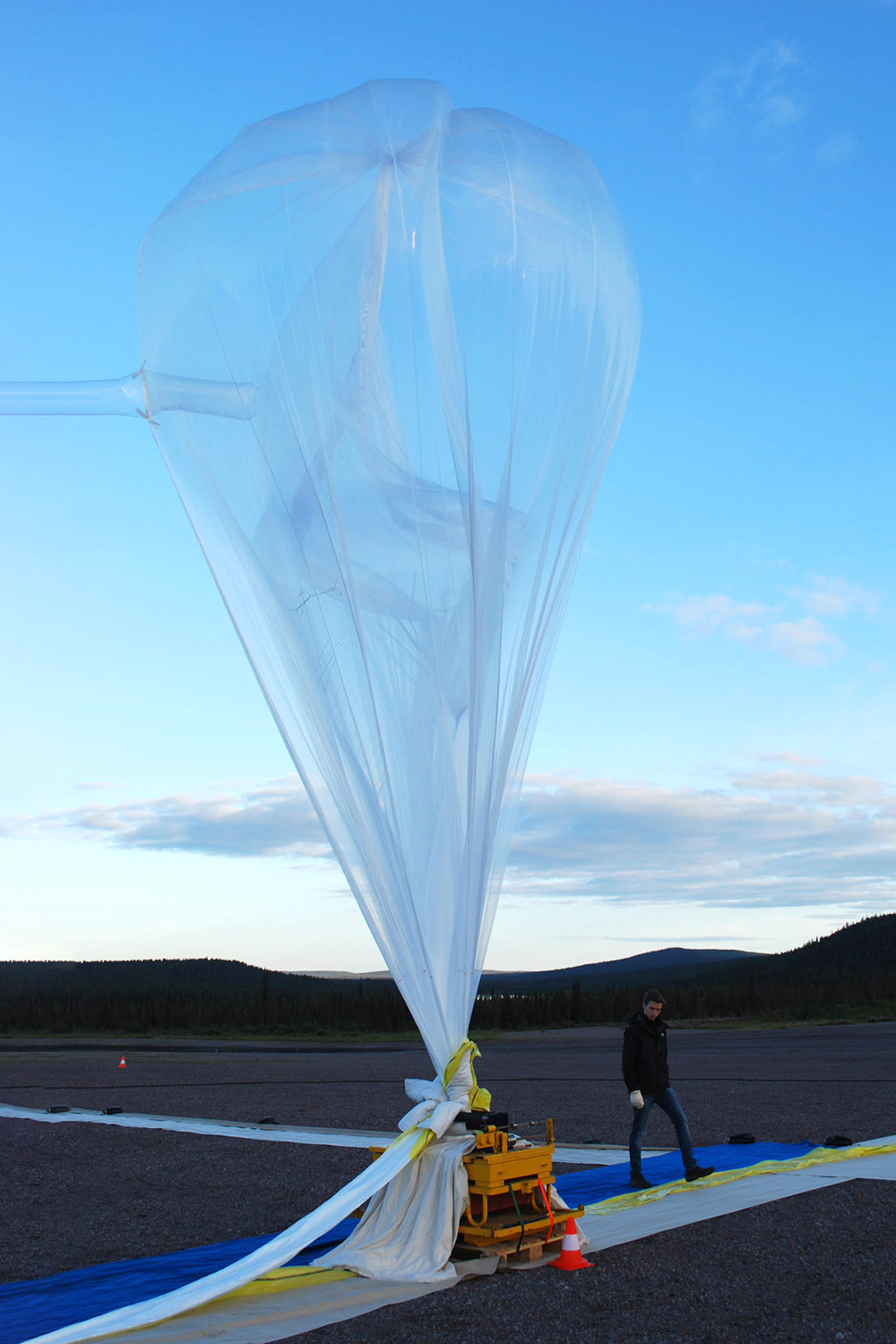
A high-altitude balloon that was part of NASA’s BARREL (Balloon Array for Radiation Belt Relativistic Electron).
We live in an era of satellites — an armada of 15,000 or so circle the Earth — and we rely on them for everything, from navigation and communication to weather forecasting. So it might feel a bit strange to turn to something based on the 18th-century technology of high-altitude balloons to carry out near-space sensing and imaging.
Dr Nic Ralph, a postdoctoral research fellow at the MARCS Institute for Brain, Behaviour and Development and the International Centre for Neuromorphic Systems at Western Sydney University, is incorporating bio-inspired sensors with specially designed high-altitude balloons as a short-term and vastly cheaper alternative to satellites for certain applications. While near-space systems are not a replacement for satellites, they offer an interesting approach to ‘de-risking’ new satellites in development with a short-term deployment to test functionality before going all the way to outer space.
MIMICKING NATURE
The high-altitude balloons are equipped with special sensors that mimic the way the human brain processes visual information. “For example, neuromorphic sensors don’t continuously record the entire field of view, but only regions that change between frames.” Thanks to this bio-mimicry approach, they are extremely lightweight and consume little power.
“Biology is incredibly efficient and really good at performing in resource-constrained conditions,” Ralph explains. In contrast, modern computing and sensing is very precise and fast, but it uses a lot of power and equipment. High-speed cameras which record millions of frames per second require too much power and data to operate in space or at high altitudes. Neuromorphic cameras are much more efficient but still produce high-speed imaging.
Ralph’s project marries these state-of-the-art neuromorphic sensors with the long-established technology of high-altitude balloons which bypass the previous limits on the type of science and engineering equipment that can be deployed to near space.
High-altitude balloons typically operate in near space at altitudes of between 20 and 100 kilometres. This region has been dubbed a ‘death zone’ because the conditions are so harsh to our technology.
“There’s almost no atmosphere there, it is near vacuum,” says Ralph. “It’s very cold, sometimes getting down to –45 °C. There’s a huge amount of radiation from cosmic rays as well — about 50 times the radiation levels on the ground.”
High-altitude balloons need to be lighter than 4 kg, not a gram over, or due to regulations they can’t be flown anywhere near people because of the safety hazard they pose. These tight engineering constraints have traditionally limited the application of high-altitude balloons, but using neuromorphic sensors instead of conventional imaging systems could achieve dramatic reductions in size, weight, and power.
“When we started looking at ballooning, we realised we had a particular niche,” says Ralph. “Since our cameras and sensors are lightweight and super low power, they can help us open up the near-space domain. We’re the first people to deploy neuromorphic sensors in near space, and this breakthrough allows us to deploy agile, affordable platforms capable of high-speed, wide-area sensing.”
When it comes to short-term imaging, high-altitude balloons offer many advantages over satellites. At about A$2,000 per balloon, they are a tiny fraction of the cost of satellites.
They don’t orbit, but drift over the region of interest. “A low-Earth orbit satellite might only pass over your target area once every 90 minutes,” says Ralph. A geostationary satellite, which remains in place over the same region of the Earth, requires “significant optics to be able to see close up, and then you’re looking at a nearly hundred-million-dollar satellite.” In contrast, high-altitude balloons can remain in the general area for hours or longer in the right conditions.
Furthermore, unlike satellites — which are prohibitively expensive to launch and manoeuvre — balloons can be launched at the drop of a hat. “We can respond rapidly to an evolving scenario like a bushfire, and we can have it in near space within 45 minutes of launching,” says Ralph.
LOOKING UP AND DOWN
Ralph’s team is looking at using their balloons for applications that require collecting data both in space and on the ground.
One application is using balloons to track satellites, which is important for ensuring air safety and for improving the success rate of satellite launches. “We can use balloons to track satellites from launch, to transfer into orbit, and to re-entry,” says Ralph. “We have a very cheap way of doing that.” They can also use balloons to track orbiting space debris, which is a growing problem as more satellites go into orbit.
Australia is launching more and more satellites, increasing the need to manage traffic in space, Ralph notes.
The team also intends to use balloons to monitor bushfires. “Fire and disaster agencies need something that can cover more area than drones and aircraft, but still image at a higher resolution, like a satellite,” says Ralph. “They need to collect data before and after a disaster, but also rapidly during an ongoing fire and flood.” That’s exactly what high-altitude balloons can do.
Another big advantage of high-altitude balloons is that they enable students to directly research space. Several engineering students at Western are playing key roles in this project as their first space project, explains Ralph. “High-altitude balloons give them a near-space experience, which covers the whole lifecycle of the project.”
Need to know
- High altitude balloons offeran affordable way to directly research space.
- Incorporating neuromorphicsensors allows them to be lightweight and energy efficient.
- Engineering students at Western are able to access these balloons.
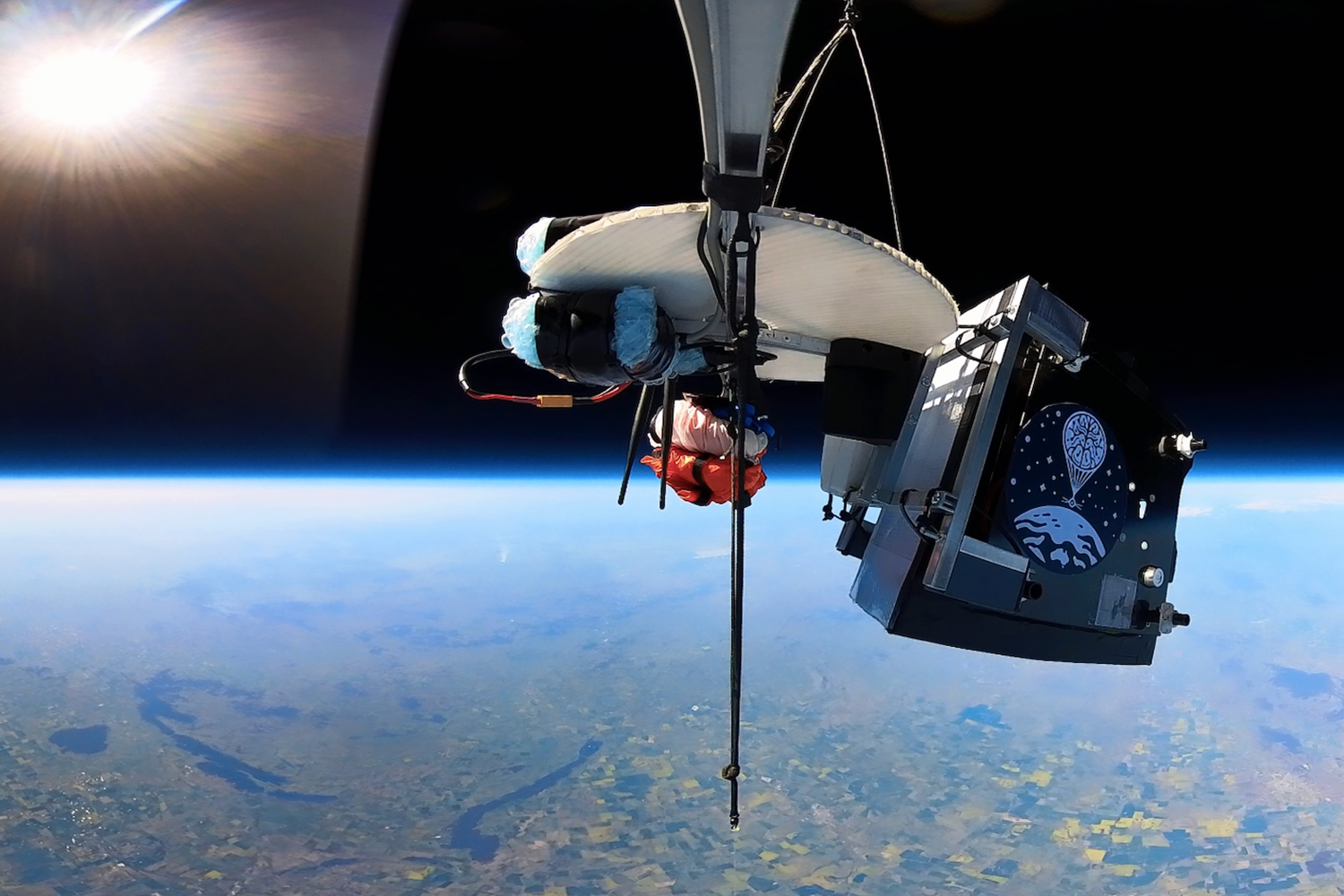
The Daedalus 3 neuromorphic sensing platform in the near-space domain at 33km altitude in 2024.
Meet the Academic | Dr Nick Ralph
Credit
Future-Makers is published for Western Sydney University by Nature Custom Media, part of Springer Nature.
©NG Images/Alamy