MECSH 2 to School

- parent responsivity
- child and family health and health promotion
- child language, development and behaviour
- the early learning environment, and
- linking families with informal and formal community-based supports, including early childhood education and care.
Variation for each family will support engagement with therapeutic interventions related to their and their child’s needs.
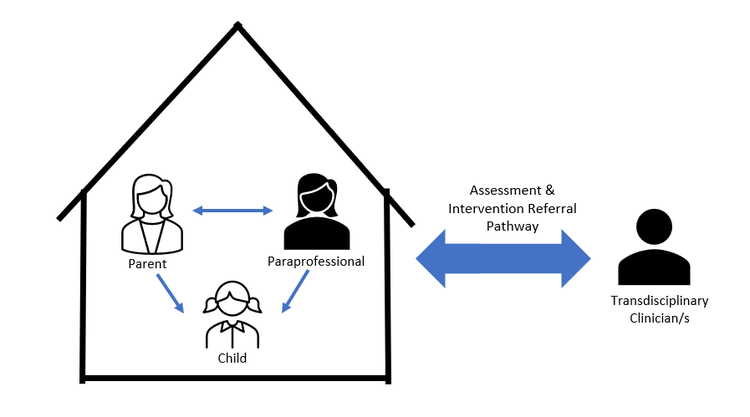
The paraprofessionals working with families will be supported by a lead professional. This may be a single transdisciplinary professional throughout the program who is the care lead and coordinator, or it may be a series of professionals related to the more significant need at the time, who coordinates care and additionally provides specialist therapy. The professional will conduct regular assessment of the family/child, refer to specialist intervention (and/or provide intervention where appropriate), and support the paraprofessional working with the family including training in maintenance of therapy within the home. This support recognizes that the provision of specialist services operates as a team around the triad (parent + child + paraprofessional).
The current research aims to:
- Develop the model, including staffing, training, content and resource components, through systematic reviews of literature.
- Explore the variations needed to ensure the model is able to be implemented in differing national and international contexts.
- Develop the protocol for a mixed-method feasibility study, in preparation for a randomised controlled effectiveness trial.
Research
-
- Feel the Magic: Supporting the wellbeing, development, and healing of children who experience bereavement
- Supporting School Readiness: Locating health and development screening services in local community sites (The CUBS project)
- Maternal Early Childhood Sustained Home Visiting (MECSH) Program
- SWSLHD Allied Health Service Redesign in Response to COVID-19 Impact evaluation
- CONNECT-ED Practitioner Research Project