Overcoming Procrastination
Procrastination is a common part of human behaviour. Procrastination is often misunderstood as laziness, whereby people may put off, postpone, delay, defer or leave tasks until the last minute. When at university, it is important to prioritise tasks and overcome procrastination to ensure their completion efficiently.
What is Procrastination?
Procrastination is the act of making a decision to delay or not complete a task that you have committed to for no valid reason and engaging in something of lesser importance. Despite there being no prominent negative consequences of procrastination and not following through with your intended task or goal, there is a lack of efficiency and responsibility associated with your actions. Procrastination is normal and extremely common, it can happen quickly, almost autonomously like a habit.
People can procrastinate in many different aspects of their lives. This can include tasks or goals related to work, households, studies, health, finances, social relationships, family, and self-development. Almost any task or problem we need to complete, or any goal we want to achieve, can be a source of procrastination. It is not uncommon for people to be able to follow through with certain areas of their lives, while they procrastinate in other areas.
The reason people procrastinate is generally because they hold unhelpful rules and assumptions about themselves and how the world works. These unhelpful rules and assumptions often generate some form of discomfort about doing a task or goal (e.g., anger, resentment, frustration, boredom, anxiety, etc.). The unhelpful rules and assumptions most often linked to procrastination are:
- Needing To Be in Charge
- Pleasure Seeking
- Fear Of Failure or Disapproval
- Fear Of Uncertainty or Catastrophe
- Low Self-Confidence
- Depleted Energy
Procrastination then becomes a strategy to avoid the discomfort and is categorised into procrastination activities and/or procrastination excuses:
- Procrastination activities are things you do as a diversion from the key task or goal you need to accomplish and are often more pleasurable such as watching movies and socialising with friends, or lower priority tasks such as tidying your room and/or checking emails.
- Procrastination excuses are made to avoid the guild associated with it, so we feel justified with putting things off. Some of these are ‘I’m too tired’, ‘it is better to do it when I am in the mood’.
Research
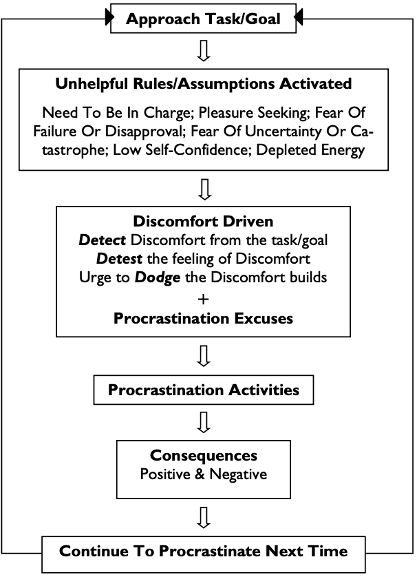
The procrastination cycle:
Procrastination is a pattern of behaviour people repeat when they delay unnecessary tasks, especially when they procrastinate for a certain reason and then procrastinate again for the same reason a certain number of times.
Procrastination cycles are highly problematic and there are many different types which differ from one another in terms of their causes:
- Emotional regulation procrastination cycles
- Low confidence and self-efficacy procrastination cycles
- Exhaustion procrastination cycles
- Sleep procrastination cycles
- Online procrastination cycles
These cycles can be complex and often people suffer from several procrastination cycles at a time. For a further explanation on the procrastination cycles and the different stages please visit this link.
Types of procrastinators:
Some researchers classify two types of procrastinators: passive and active procrastinators.
- Passive procrastinators:Delay the task because they have trouble making decisions and acting on them
- Active procrastinators: Delay the task purposefully because working under pressure allows them to "feel challenged and motivated"
Others define the types of procrastinators based on different behavioural styles of procrastination, including:
-
Perfectionist:Puts off tasks out of the fear of not being able to complete a task perfectly.
- Advice for a perfectionist is instead of letting your obsession with details take up all your time, be clear about the purpose of your tasks and assign a time limit.
-
Dreamer: Puts off tasks because they are not good at paying attention to detail
- Advice: To stop yourself from being carried away by your endless imagination, get your feet back on the ground by setting specific (and achievable) goals for each day based on the SMART framework. Set a goal and break down the plan into small tasks that you can act on right away.
-
Avoider/Self-Saboteur: The worriers are scared to take on tasks that they think they can’t manage. They would rather put off work than be judged by others when they end up making mistakes.
- Advice: Focus on the worst. Spend your morning working on what you find the most challenging. This will give you a sense of achievement, and it helps you build momentum for a productive day ahead. Try to break down your tasks into smaller sub-tasks. Understand how much time and energy is really needed for a given task and make realistic calculations.
-
The Crisis-Maker: The crisis-maker deliberately pushes back work until the last minute. They find deadlines (the crises) exciting and believe that they work best when working under pressure, which causes them to manage their time poorly.
- Advice: try using the Pomodoro technique, developed by Italian entrepreneur Francesco Cirillo. It focuses on working in short, intensely focused bursts, and then giving yourself a brief break to recover and start over.
-
The Busy Bee: They have trouble prioritising tasks because they either have too many of them or refuse to work on what they see as unworthy of their effort. Important tasks should take priority over urgent ones because “urgent” doesn’t always mean important. You only have so much time and energy, and you don’t want to waste that on things that don’t matter. Identify the purpose of your task and the expected outcome. Important tasks are the ones that add value in the long run.
Strategies to overcome procrastination
It is important to realise that procrastination is a habit, and like any habit it will take time, practice, persistence, and patience to change from ‘procrastinator’ to ‘doer’.
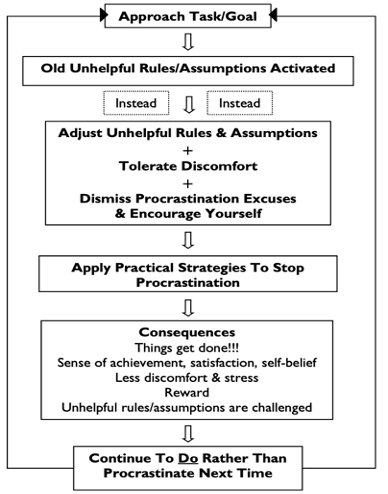
The Doing Cycle:
The Procrastination Cycle shows us that procrastination is like a vicious negative spiral that we get stuck in. The good thing about a cycle, is that usually we can reverse it from a negative cycle to a more positive cycle. The more positive “Doing Cycle” shows us that when faced with a task or goal you would usually procrastinate over, you need to:
- Adjust your unhelpful rules and assumptions
- Tolerate your discomfort
- Dismiss your procrastination excuses
- Be motivational towards yourself rather than critical
- Put into action practical strategies to stop procrastinating
Overcoming Procrastination and my studies
For students at university, procrastination can be the direct result of poor time management. In addition to this, students may find themselves indulging in procrastination, with common issues such as attempting to reach abstract goals, feeling overwhelmed, perfectionism, fear of failure, task aversion, resentment, a problematic work environment, and sensation seeking being experienced.
The following practical strategies can be adapted to overcome procrastination:
- Being aware – Reflect on the reasons why you procrastinate, your habits and thoughts that lead to procrastination.
- Assess – What feelings lead to procrastination, and how does it make you feel? Are these positive, productive feelings: do you want to change them?
- Outlook – Alter your perspective. Looking at a big task in terms of smaller pieces makes it less intimidating. Look for what's appealing about, or what you want to get out of an assignment beyond just the grade.
- Commit – If you feel stuck, start simply by committing to complete a small task, any task, and write it down. Finish it and reward yourself.
- Surroundings – When doing uni work, choose wisely where and with whom you are working. Repeatedly placing yourself in situations where you don't get much done - such as "studying" in your bed, at a cafe or with friends - can be a kind of procrastination, a method of avoiding work.
- Goals – Focus on what you want to do, not what you want to avoid. Think about the productive reasons for doing a task by setting positive, concrete, meaningful learning, and achievement goals for yourself.
- Be Realistic – Achieving goals and changing habits takes time and effort; don't sabotage yourself by having unrealistic expectations that you cannot meet.
- Self-talk – Notice how you are thinking and talking to yourself. Talk to yourself in ways that remind you of your goals.
- Un-schedule – If you feel stuck, you probably won't use a schedule that is a constant reminder of all that you have to do and is all work and no play. So, make a largely unstructured, flexible schedule in which you slot in only what is necessary.
- Swiss Cheese It – Breaking down big tasks into little ones is a good approach. A variation on this is devoting short chunks of time to a big task and doing as much as you can in that time with few expectations about what you will get done.
University Support
If you are experiencing barriers that may affect your study or you want support to optimise your study then the WSU Counselling Service, Disability Service, or Student Welfare Service may be able to help.
Students can access free, short term, confidential counselling services. Face to face, Zoom or phone appointments can be made by telephoning 1300 668 370. Our office hours are Monday to Friday 9:00am - 4:30pm. Alternatively, or email counselling@westernsydney.edu.au
The Disability Service is free to access with Disability Advisors assisting students to meet their full potential. If you have a diagnosed physical, psychological or medical condition that impacts on your studies, you may be eligible for an Academic Reasonable Adjustment Plan (ARAP), developed by the Disability Service. Contact the Disability Service on 1300 668 370, email disability@westernsydney.edu.au or make contact via WesternNow.
For assistance regarding academic, personal and financial hardship, international support or accommodation, call 1300 668 370 or make contact via WesternNow.
- Multifaith Chaplaincy
Multifaith Chaplaincy can provide confidential conversation and care and support for stress management and anxiety with links to religious groups and faith communities. For more information, please call Daniel Jantos on 0402 771 543 or email d.jantos@westernsydney.edu.au.
- WesternLife
WesternLife - Join thousands of students at Your Virtual Community to share experiences, learn new things, connect with new friends, and engage with events or discussions that interest you!
- Disruption to Studies
Consider applying for Disruption to Studies and Requests for Extension if you feel as though your studies have been significantly impacted.
- Deferred Exams
Deferred Exam – You can apply for a Deferred Exam no later than 5:00pm on the second working day after your scheduled exam if you are unable to attend a final exam due to serious illness, misadventure or other exceptional circumstances beyond your control. Submit a Student Form and attach supporting documents online for application.
- Withdrawal Without Academic Penalty
Withdrawal Without Academic Penalty is an option available after the Census Date of the teaching term provided that you meet eligibility.
- Leave of Absence
A Leave of Absence is a temporary break from studying. Once you have completed one or more subjects in your enrolled program, you can apply for a Leave of Absence. A Leave of Absence can be taken as either six or twelve months. The maximum amount of leave you can take during your program is twelve months. Please note, you must submit your application before the relevant census date
-
Also investigate these blogs created by WSU:
If you are considering any of these options, please reach out to the counselling service for support and guidance. If you are an international student, please make sure you seek advice particularly if you are considering withdrawing without penalty or taking a leave of absence as these may have implications for your visa conditions.
Community Support
- Lifeline - If you are really struggling during the night when completing assessments or feel most alone, contact Lifeline (24 hours crisis counselling) - 13 11 14 - Lifeline SMS Counselling Service - Between 6pm and midnight you can text 0477 13 11 14 and somebody will text you back!
- Mental Health Telephone Access Line - 1800 011 511 - This Mental Health Line is staffed by mental health professionals that can help and provide you advice about your needs and discuss referrals to local mental health services. It is available to everyone in NSW and operates 24 hours a day, 7 days a week.
- Be you – Beyond Blue: General information about building resilience and facing adversity.
- MyCompass - This free online treatment program has been developed by the Black Dog Institute to help people better self-manage mild-to-moderate symptoms of depression, anxiety and stress.
- Solving Procrastination - Here, you will find a collection of resources about procrastination, including articles, guides, and other tools that will help you understand what procrastination is, what causes it, and how to overcome it.
- Very Well Mind – provides information on symptoms, causes, treatment and coping with procrastination including 12 strategies to deal with chronic procrastination.
- Psychology of Procrastination – provides information, worksheet, and games on overcoming procrastination.
- ABC News – provides an article on tips to stop procrastinating and why procrastination occurs.
- Better up – provides an article on overcoming procrastination and 5 ways to stop putting off success.
- Tip Sheet – 20 strategies to overcome procrastination
Podcasts
Overcoming Procrastination
This podcast episode discusses procrastination and 5 tips to overcome it. Listen now on Spotify.
The Psychology of Procrastination
This podcast episode explores the psychology of procrastination. Why people may experience it, feelings you may experience along with it and strategies to overcome it. Listen now on Spotify.
Let’s Talk About…Procrastination
This episode explores procrastination and how to overcome it with simple strategies to practice in your everyday life. Listen now on Apple Podcasts or Spotify.
Videos
Ted Talks – Ted Talks inform and educate a global audience in an accessible way through scientists, researchers, technologists, business leaders, artists, designers, and other world experts to present ‘ideas worth spreading’. Several different videos are available on the topic of overcoming procrastination, and we highly recommend you explore the following:
- Talks for procrastinators
- This is the real reason you procrastinate and how to break it
- Tired of procrastinating? To overcome it, take time to understand
- Self-worth theory: the key to understanding and overcoming procrastination
- Why you procrastinate and how to get things done
- An end to procrastination
- The Surprising Habits Of Original Thinkers, by Adam Grant
- Why we procrastinate
- Trust the procrastinator
For further Ted Talk videos, please visit this link.
Apps
-
Talk Campus: There is a 24/7 support app called TalkCampus, which is free and available to download on iOS devices (App Store) and android devices (Google Play). WSU students can connect and talk with other students about anything.
-
Smiling Mind: Smiling Mind offers a free app to help you practice your daily meditation and mindfulness exercises from any device. There are dozens of exercises tailored to different demographics and desires. All the content and programs are free, which is the perfect app for beginners to try mindfulness. Free and available on the app store and google play.
-
Headspace: Learn to manage feelings and thoughts with the lifelong skill of everyday mindfulness, any time of the day. Free and available on the app store and google play.
-
Google Calendar: Available on IOS, Android, Webs Price: FREE/PRO, $6 a month. Google Calendar is perfect to manage your tasks and projects on a daily, weekly, and monthly basis. Google Calendar gives an overview of meetings, work, and more which helps to plan your tasks smartly and save time. ClickUp allows you to connect with your Google Calendar to give you a much clearer picture of your day.
-
Reminders: Available on IOS & iPad Price: Reminders is an amazing productivity apps that let you create your own personalised to-do list. You can create reminders with subtasks and attachments, and set alerts based on time and location.
-
Todoist: Available on IOS, Android, Webs Price: FREE/ RPO $3/month. Todoist is a task management app designed to help you record and organise all your tasks and activities The time management + digital to-do list app allows you to add tasks fast, prioritise the most important ones, break them down into sub-tasks, and add them to favorites or make them recurrent.
-
Forest: Available on IOS, Android, Webs Price: Forest is both a productivity and time management app that helps you stay focused and present. The app helps you pursue your tasks by keeping you away from your smartphone in a unique way. Instead of scrolling through your phone, the tool makes you plant a virtual seed in Forest then watch it grow into a full-grown tree within 30 minutes.
-
Block Site: Free and has a premium version. Chrome, Android, Firefox. What it does: blocks websites that you use to procrastinate.
- Special features: allows you to block sites either permanently or during specific times, allows you to designate distraction-free time slots, has a built-in Pomodoro timer.
-
App Block: Free and has a premium version. Android. What it does: blocks mobile apps that you use to procrastinate.
- Special features: lets you set time limits for the usage of specific apps, set specific locations where you want to block apps, and disable notifications while you’re working.
-
Screen Time: Free, built in iOS. Let's track and limit app use.
-
Trello: Free – for individuals or teams looking to start a project. Further costs if you wish to add more resources. App Store, Google Play, Microsoft. Trello works in a similar way to Todoist in that it can help you organise different tasks. Trello allows users to create 'cards' which can be added to 'boards' and assigned to different team members. You can add comments, attachments, photos and much more to the boards which all adds up to an immersive way of working that is great for people who work best with visuals.
-
White Noise Generator: Free, has in-app Android, White noise HQ available on iOS. What it does: generates background sounds of your choice which can help you focus on your work.
- Special features: has a comprehensive library of sounds together with a mixing ability, so you can find the exact sound that works for you.
-
Habitica: Free, with in-app Browser, Android and iOS. What it does: helps you be productive and improve your habits by gamifying your life in a fun, organised way, which will motivate you to achieve your goals.
- Special features: has an extensive in-game reward system for motivation, allows you to collaborate with others, and lets you track and manage your habits, daily goals, and to-do list.
Still struggling?
Asking for help is an important step in managing these feelings and realising your full potential!
If you are still struggling, reach out to the WSU counselling team for support and advice. If you prefer to seek support from a service outside of the university, it may be helpful to speak to your General Practitioner regarding a Mental Health Care Plan and referral to a psychologist, or you can speak to a counsellor or other health professional. Remember you are not alone and there will always be someone out there who is willing to stay with you through your hard times.