Domestic and intimate partner violence
Domestic violence, intimate partner violence, and domestic abuse all refer to a pattern of behaviour in a relationship where someone is violent, abusive, or intimidating to gain or maintain control over the other person. It can happen to anyone and there are many different kinds of domestic violence. Domestic abuse says nothing about the survivor, and everything about the abuser.
You are not alone. Help is available, and making the first call for help is a courageous step.
What is domestic and intimate partner violence?
Who can experience domestic violence?
Domestic violence or abuse can occur in a sexual or romantic relationship, which is what the term ‘intimate partner violence’ usually refers to. However, domestic violence can happen in any close relationship, including with:
- Boyfriends, girlfriends, partners, husbands or wives
- Ex-boyfriends, ex-girlfriends, ex-partners, ex-husbands or ex-wives
- Carers or paid support workers
- Parents, guardians or other family members
- Adult children
- Other people you live with or see often, whether inside or outside the home.
Domestic and intimate partner violence can happen regardless of age, gender, sexuality, race, culture, faith, level of income, or level of education. Men can experience domestic violence, however, most people impacted by domestic and intimate partner violence are women and children.
What are the types of domestic and intimate partner violence?
Domestic and intimate partner violence is when a person uses violence, abuse, or intimidation to gain or maintain control and power over someone else. There are several kinds of violence, not just physical, including:
- Psychological or emotional violence is when someone acts in a way that is intended to cause mental or emotional harm. This can include harassment, insulting or yelling at you, embarrassing you in front of other people, threatening to hurt you or other people or things that are important to you, or threatening to hurt themselves when they’re upset in order to manipulate you.
- Sexual violence is being forced, pressured or tricked into doing sexual things without your consent. Even if you are married to someone or are in a romantic relationship with someone, you still get to choose whether or not you want to do sexual things with someone.
- Financial abuse is sometimes also called economic abuse, and can involve controlling your money, stopping you from earning your own money, forcing you to take out loans you don’t want, or not letting you have access to enough money to buy basic things like food or medicine.
- Physical violence is when someone intentionally hurts your body or takes away control of your body. It can involve things like hitting, slapping, biting, choking or throwing things, but can also involve other things like threatening physical violence, restraining you, making you take alcohol or drugs, or denying you access to medications, food, or equipment you need like a wheelchair. You don’t have to have bruises or scratches for it to be physical abuse.
- Spiritual violence is sometimes also called religious violence. It’s when someone uses spiritual or religious beliefs to hurt, scare or control you, including when someone makes you participate in spiritual or religious practices that you don’t want to do, won’t let you take part in the practices that you want to, or uses spirituality or religion to try and justify other types of violence.
- Social violence is behaviour that aims to cut you off from other people or damage your relationship with others, including your family, friends and community. This might involve not letting you leave or see other people, needing to know everywhere you go and everyone you see, or telling lies about you to other people to make you look bad.
- Legal violence is when someone uses the law or legal threats to scare and control you. This can include making false reports to police or the courts, stopping you getting legal advice, or not following court orders.
- Reproductive violence is when someone stops you from making choices about your reproductive system. This can involve forcing or pressuring you to become pregnant or have an abortion, making you have unprotected sex, limiting access to birth control or doing things to stop it working, or not letting you access reproductive healthcare.
- Neglect is when someone denies you access to your basic needs like food, a safe place to live, clothes, hygiene, and privacy. This mostly affects people who need support with the things they do each day, such as children, people with disabilities, and elderly people who require support.
- Stalking is when someone repeatedly harasses you and won’t stop contacting you when you ask. This can include using phone or social media messages to harass you, following you or showing up uninvited at your home or places where you go without a good reason for them to be there, or finding information about you online, by going through your bins or hiring someone.
Warning signs of domestic and intimate partner violence
It can sometimes be hard to tell that you’re in an abusive relationship- it’s common to believe that the abuse is your fault in some way. ReachOut has a helpful guide of some warning signs that you might be in an abusive relationship:
Possessiveness
- They check on you all the time to see where you are, what you’re doing and who you’re with.
- They try to control where you go and who you see, and get angry if you don’t do what they say.
- They constantly send text messages and want to know what you are doing every moment of the day.
Jealousy
- They accuse you of being unfaithful or of flirting.
- They isolate you from family and friends, often by behaving rudely to them.
Put-downs
- They put you down, either publicly or privately, by attacking your intelligence, appearance, opinions, mental health or capabilities.
- They constantly compare you unfavourably to others.
- They blame you for all the problems in your relationship, and for their violent outbursts.
- They say things like, ‘No one else will want you.’
Threats
- They yell or sulk, and deliberately break things that you value.
- They threaten to use violence against you, your family, friends or a pet.
Physical and sexual violence
- They push, shove, hit or grab you, or make you have sex or do things you don’t want to do.
- They harm you, your family members or your pets.
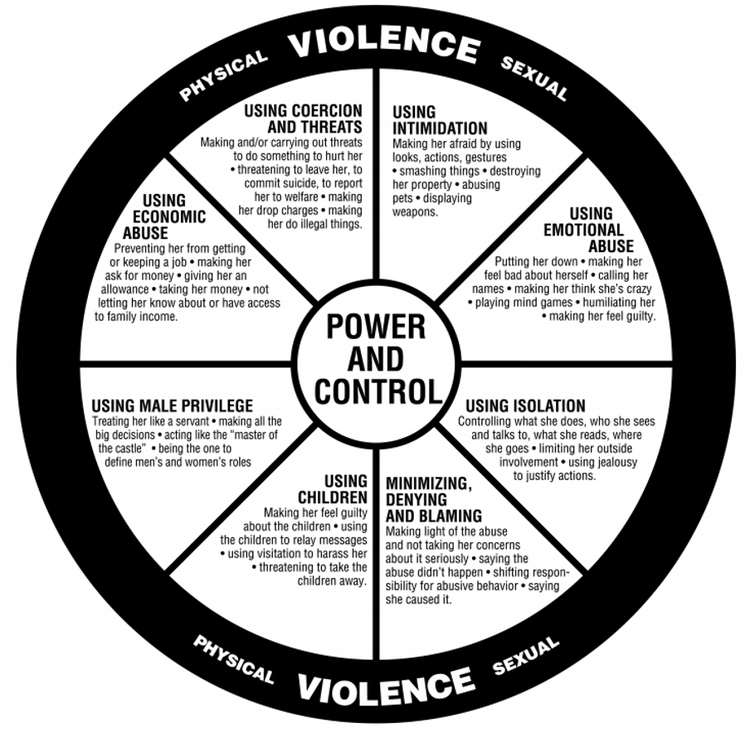
The Power and Control Wheel is a tool used to understand how abusers work and how they gain power and control over others in violent relationships involving a male abusing a female. It looks at eight different tactics that are used:
What can I do?
For Survivors
No one deserves to be abused. The abuse is not your fault. You are not alone.
If you are concerned about your or your children’s immediate safety, call 000.
Seek support - help is available, and the numbers below, as well as other resources in the Community Support section can provide support and information about what you can do next.
-
1800 RESPECT is 24-hour national domestic family and sexual violence counselling service. You can contact them via their online chat or call 1800 737 732.
- If English is not your first language, you can request support in a different language.
-
Contact Full Stop Australia who also provide 24/7 counselling service on 1800 385 578 for people who have been impacted by violence and abuse.
-
Contact Lifeline if you are experiencing a personal crisis at night (6pm-midnight) on 13 11 14, or you can contact them via text on 0477 13 11 14.
Safety planning
- Safety planning is thinking about things you can do to be safer when living with violence or abuse.
- Contacting one of the services above for support is the best way to make a safety plan, but you can also get support from trusted friends and family members.
How can you help survivors of domestic abuse?
1800Respect has a guide to supporting someone experiencing domestic and intimate partner violence which includes some suggested things to say to the person you’re concerned about.
They suggest the following ways you can help:
- In an emergency or if is someone is in danger now, call 000 immediately
- Believe them and take their fears seriously. This is important no matter what you think of the person or people who hurt them
- Listen without interrupting or judging
- Never blame the person experiencing the violence for what has happened to them. Violence is never OK
- Don’t make excuses for the person who has hurt them
- Understand that they may not be ready or it may not be safe to leave. Don’t try to force them to do what you think is best
- Remember that domestic and family violence is not just physical
- Help in practical ways, with transport, appointments, child minding, or a place to escape to
- Help explore options. You or the person you are supporting can call 1800RESPECT or visit our website for more information and support
Note: Keep in mind that a survivor often makes several attempts to leave the abusive relationship before succeeding.
Domestic and intimate partner violence and my studies
Western Sydney University is committed to supporting students experiencing domestic and intimate partner violence. Some of the supports available to students are explained in the domestic and family violence webpage and information sheet.
These explain some of the support options available which include options such as study breaks, extensions on assessments and special exam provisions. The university support section below explains more about some of the support services available including the counselling service who can help explain your study options and work with other university staff to reduce the stress of seeking academic support.
University Support
If you would like support or to talk to someone about domestic and intimate partner violence, the WSU Counselling Service, Disability Service, or Welfare Service may be able to help.
Students can access free, short term, confidential counselling services. Face to face, Zoom or phone appointments can be made by telephoning 1300 668 370. Our office hours are Monday to Friday 9:00am - 4:30pm. Alternatively, you can email counselling@westernsydney.edu.au
The Disability Service is free to access with Disability Advisors assisting students to meet their full potential. If you have a diagnosed physical, psychological or medical condition that impacts on your studies, you may be eligible for an Academic Reasonable Adjustment Plan, developed by the Disability Service. Contact the Disability Service on 1300 668 370, email disability@westernsydney.edu.au, or make contact via WesternNow.
- WSU Welfare Service
Find support for academic, personal and financial hardship, international support and accommodation by calling 1300 668 370 or making contact via WesternNow.
Multifaith Chaplaincy can provide confidential conversation and care and support for stress management and anxiety with links to religious groups and faith communities. For more information, please call Daniel Jantos on 0402771543 or email d.jantos@westernsydney.edu.au.
- Disruption to Studies
Consider applying for Disruption to Studies and Requests for Extension if you feel as though your studies have been significantly impacted.
Deferred Exam – You can apply for a Deferred Exam no later than 5:00 pm on the second working day after your scheduled exam if you are unable to attend a final exam due to serious illness, misadventure or other exceptional circumstances beyond your control. Submit a Student Form and attach supporting documents online for application.
Withdrawal Without Academic Penalty is an option available after the Census Date of the teaching term provided that you meet eligibility.
A Leave of Absence is a temporary break from studying. Once you have completed one or more subjects in your enrolled program, you can apply for a Leave of Absence. A Leave of Absence can be taken as either six or twelve months. The maximum amount of leave you can take during your program is twelve months. Please note, you must submit your application before the relevant census date
If you are considering any of these options, please reach out to the counselling service for support and guidance. If you are an international student, please make sure you seek advice particularly if you are considering withdrawing without penalty or taking a leave of absence as these may have implications for your visa conditions.
Community Support
If you need emergency assistance, call 000.
You can also contact Western Sydney University Campus Safety and Security on 1300 737 003.
- Full Stop Australia (NSW Sexual Violence Helpline) provides 24/7 telephone and online trauma counselling for anyone in NSW whose life has been impacted by sexual violence, including survivors, as well as their friends, families, and supporters. They also provide support to others who have been impacted by this violence, including professionals such as police or journalists.
- 1800respect is a national service providing counselling, information and support for those who have experienced domestic, family and sexual violence. They provide online chat, as well as a 24-hour phone service available at 1800 737 732. You can access this service through an interpreter via 13 14 50, or via the National Relay Service for people who are d/Deaf or hard of hearing on 1800 555 677.
- Lifeline - Lifeline (24 hours crisis counselling) - 13 11 14. Lifeline SMS Counselling Service - Between 6pm and midnight you can text 0477 13 11 14 to receive counselling via text. You can find more information here.
- Mental Health Telephone Access Line - Available 24/7 to everyone in NSW on 1800 011 511. Provides professional help and advice and referrals to local mental health services
- MensLine Australia – Can be contacted on 1300 78 99 78 and provides support for Australian men, including those who have experienced violence.
- Women’s Domestic Violence Court Advocacy Service NSW – Find a WDVCAS support in your area and get help. Support and advice on issues relation to domestic or family violence.
- Rainbow Door Sexual, Domestic and Family Violence Helpline – For anyone in the LGBTIQ+ community whose life has been impacted by sexual domestic and/or family violence. Available 10am to 5pm on 1800 729 367
Resources
Websites
How to stay safe is a NSW government resource page which links to guides on how to stay safe while in a violent relationship and how to leave a violent relationship safely.
Say It Out Loud provides information for LGBTQ+ people about relationships, including information about intimate partner violence.
The Immigrant Women’s Support Service provides information about domestic violence for women from non-English speaking backgrounds, including information in a variety of languages.
1800respect is a national service providing counselling, information and support for those who have experienced domestic, family and sexual violence.
Full Stop Australia provides support and information for anyone in NSW whose life has been impacted by domestic and family violence, including survivors, as well as their friends, families, and supporters.
Podcasts
Domestic Violence and how to get out of it
These podcast episodes are a 2 part series of the Divorce Course Podcast, an Australian law podcast which, in these two episodes, provides practical information and advice about domestic violence, what a domestic violence order is, and explains the court processes that might be encountered when applying for one. Listen to Part 1 and Part 2 on Spotify.
After Dark: Overcoming Domestic Violence
This podcast series which interviews survivors of domestic violence and provides stories of hope.
Videos
- 1800RESPECT - Support a friend
- 1800RESPECT - Domestic and family violence: how to make a plan to look after yourself
- Domestic Violence Prevention Centre - A series of videos about domestic violence with Auslan (Australian Sign Language) interpretation.
Apps
Daisy – A free app that connects women around Australia to services providing support for the impacts of sexual assault, family violence, and domestic violence. Available on the App Store and Google Play.
Emergency + - The Emergency+ app is a free app developed by Australia's emergency services and their government and industry partners.Available on the App Store and Google Play.
Sunny App - Sunny is 1800RESPECT’s app for women with disability who have experienced violence and abuse. Sunny has been co-designed with women with disability to make sure it provides the very best support for the people who use it. Available on the App Store and Google Play.
Still struggling?
If you are still struggling, reach out to the WSU counselling team for support and advice. If you prefer to seek support from a service outside of the university, it may be helpful to speak to your General Practitioner regarding a Mental Health Care Plan and referral to a psychologist, or you can speak to a counsellor or other health professional. Remember you are not alone and there will always be someone out there who is willing to stay with you through your hard times.