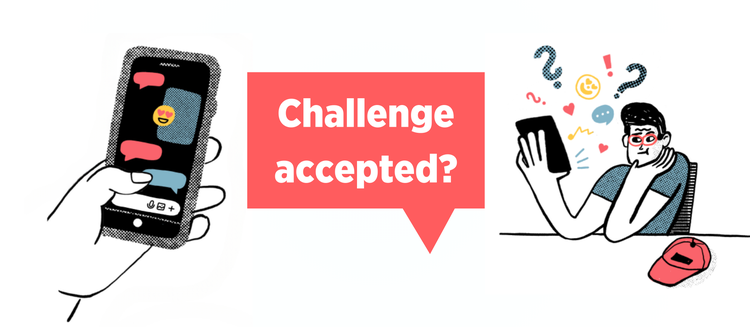
Challenge Accepted? Young people, online risks and supporting their safety
***An international exploration into online challenges and hoax challenges with young people and parents in Australia, Indonesia and Germany.*******
Our Vision
There is no shortage of short-form online video content today. Online challenges, often shared through social media platforms, are particularly popular, with young people in particular viewing or participating in trending challenges that might involve dancing, lip-syncing, recreating a recipe or craft, or eating certain foods. While most online challenges are entertaining and safe, some are potentially harmful.
Internationally, media reports consistently highlight how some challenges result in injuries and, in rare cases, death. The rise of challenges has been shadowed by another intriguing form of disinformation: hoax challenges. Like other forms of hoaxes, these are often designed to be frightening: the infamous ‘Blue Whale’ and ‘Momo’ challenges – now known to be hoaxes – were widely reported to have caused young people to suicide, causing many parents and decision-makers to question the online safety of children and young people
In a complicated and fast-paced digital environment, how do young people make sense of and respond to potentially harmful challenges and hoax challenges? How well equipped are they to make safe choices? We’re working to provide parents and decision-makers – across corporate, government and non-government sectors – with the information they need to support young people to participate in positive and safe online spaces.
Our Project Plan
In 2023, we collaborated with the SEJIWA Foundation and RightNow using our novel and award-winning Distributed Data Generation (DDG) methodology to gather insights through participatory workshops from 56 young people, aged 13 to 18 years in Australia, Indonesia and Germany. We also collected insights from interviews with 11 parents of teens.
Our team carried out secondary analysis of the survey data, collected by The Value Engineers, to identify areas for further investigation with qualitative methods, and to shed light on findings from the workshops.
Project History
This study builds on previous research findings from an international survey reported by Hilton et al., 2021.
What Impact will this research have?
The insights from this research will inform technology platform policies, services, and communication strategies. Other institutions and organisations, such as government, youth-facing organisations and schools, can also draw on the research to make sure young people are engaging in positive, safe online spaces.
Outputs
A report and youth-friendly research summary video will soon be available. Please contact the team if you would like to be informed when they are published.
Collaboration team
Internal collaborators:
- Professor Amanda Third
- Ms Louisa Welland
- Dr Shiva Chandra
- Dr Martyna Gliniecka
- Dr Pavithra Rajan
External collaborators/partners:
- Lea Fenner, Else Engle, Laura Sahm (RightNow)
- Cornelia Jonas and Sophie Pohle at Deutsches Kinderhilfswerk e.V.
- Diena Haryana, Andika Zakiy, Afriyani Rahmawati, Suwartiningsih and Maria Rosa at SEJIWA Foundation
Funding
This research was made possible with funding from TikTok.
Streams
Period
January 2023 – March 2024
Contact
If you would like to get in contact with the project team, please email Louisa Welland at l.welland@westernsydney.edu.au.