New report reveals hopes of young Australians and where governments are letting them down
SYDNEY, 13 January 2026. A new study exploring the aspirations of young Australians reveals that they are cautiously optimistic about the lives their generation can enjoy — but that optimism is undermined by serious concerns about issues such as housing, environmental degradation and growing social inequality.
The study, conducted by researchers at the Young & Resilient Research Centre at Western Sydney University, in partnership with the Alannah & Madeline Foundation and the Centre for Multicultural Youth, surveyed 1,038 12 – 19 year olds from a diverse range of backgrounds around Australia to explore the question - how hopeful are young Australians?
The study found that, overwhelmingly, access to secure and affordable housing is the number one issue that would make young people in Australia feel more hopeful about their futures, with children as young as 12 and 13 years old expressing concern about securing a roof over their head. As one 12-year-old female study participant said; “[I hope for] more houses to rent cheap” while another 13-year-old boy said; “I hope I can have a home in Australia.”
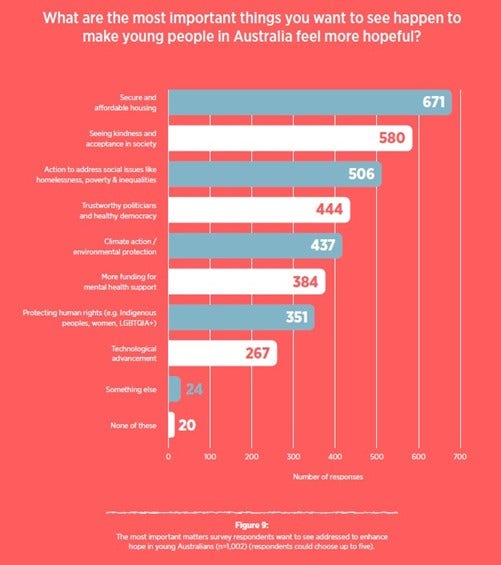
Graphic from the report which identifies that housing is the No 1 issue that young Australians would like to see an improvement in.
Interestingly, ensuring that politicians are trustworthy, and that Australia has a healthy democracy rated as a slightly higher priority than protecting the environment – though this was important for many, too. Frustration in our political process was reflected in other findings in the report: 44% of study participants feel it is extremely or somewhat unlikely they will live in a society where governments look after everyone, including the most disadvantaged.
The research also uncovered that young people’s sense of hope had a strong correlation to their ability to encounter, and then overcome, adversity and have some control and influence over the challenges that affect their lives.
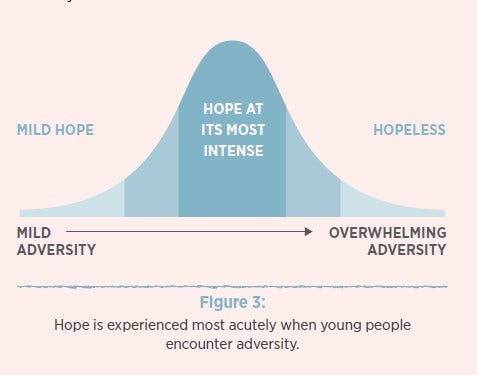
Graphic from the report which identifies the connection between hope and adversity.
As the report’s lead researcher, Prof Amanda Third explains; “Our research found that young people experience hope most acutely when they encounter adversity yet simultaneously have some ability to transform the conditions or effects of that adversity. By contrast, when young people confront forms of adversity but see no pathways to change, adversity becomes overwhelming and diminishes their hope”.
These findings are important when applied to young people’s involvement in civic participation. The report also found that young Australians would like to be actively involved in politics and decision-making so they can feel a greater sense of agency over the issues affecting their lives. As one 18-year-old female study participant said; “[There needs to be] [g]reater youth representation in decision-making (for Australia and the world)” while another 16-year-old male participant said; “Politicians should take under-18s seriously, even if we can’t vote. Just because we’re not legally allowed to choose leaders doesn’t mean we don’t have opinions or that the decisions they make won’t affect us.”
Sarah Davies AM, CEO of the Alannah & Madeline Foundation reflected this sentiment saying; “Children and young people are not just asking to be heard — they are asking to be part of the solution. Leaders must step up, or risk losing their trust – and their hope.”
In 2026, the message from young Australians is unmistakable: their hope is strong – but it depends on leaders listening, acting, and including them.
Click here to download a copy of the report.
Media enquires can be directed to Claire Absolum, Senior Communications Officer at c.absolum@westernsydney.edu.au.