Interview with Dr Benjamin Hanckel – On his new book "Researching with young people" and putting youth-centred ideas into practice
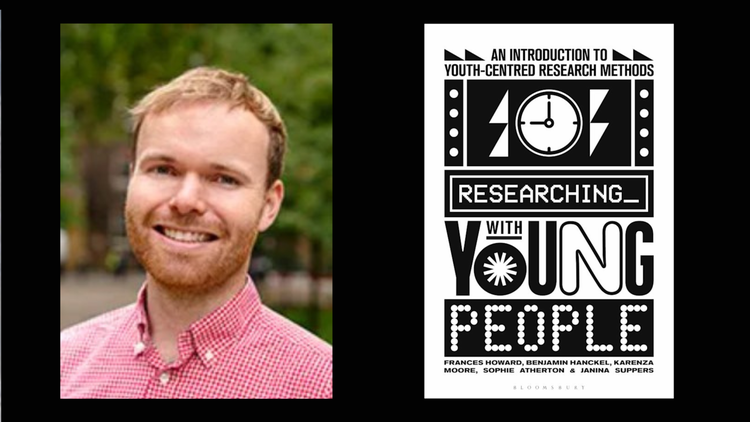
Tell us about your academic background Ben. What led you into this field of research?
When I was finishing my undergraduate degree in Sociology I worked with young people in and across a couple of spaces. There, I got really interested in the question of how we work and engage with young people - what that looks like and means. Then to fast forward, I ended up doing a PhD which focused on queer young people's experiences and how marginalised young people are carving out spaces in the world, but also how we do research with young people in those spaces. Then, increasingly a lot of my work has contributed to the space of youth studies more broadly. I've been on The Australian Sociological Association’s Sociology of Youth Thematic Group as a convener. I was also in London for a few years at King's College, and I was a British Sociological Association Youth Study Group convener as well. So through that, I met a lot of other great youth studies scholars including, obviously, some of the people at Young and Resilient and the network of people who are doing really interesting, engaging work with young people has increased. This book has emerged out of some of those discussions.
You’ve just released a new book called “Researching with young people: An introduction to researching with young people”. How did this project evolve, and what are your aims with it?
The book emerged during COVID, during the height of COVID and the lockdowns. So during that period, I was one of the British Sociological Association Youth Study Group conveners and we realised that there were a lot of youth researchers globally, but particularly, in the UK, who were talking about how they were adapting their research to respond to the current crisis, whilst also ensuring that young people's voices were heard. So this book pulls together some of those ideas and shares some of the ways that people were developing youth-centred research methods to work with young people in meaningful ways.
In the book there's some great case studies, which we've got in every chapter to show readers how to put the ideas into practice. For example, there's a great case study on podcasting with young people. The main aim of it is to be a practical guide for researchers, which outlines some tools, methods and guidance for researchers on how to do this work.
For a lay person who has no knowledge of this area, how well developed is the field of youth studies? Is it quite new and emerging or is it territory that has been explored for quite some time?
There’s two parts to that answer. The first I would say is the field itself is very interdisciplinary, it covers quite a large number of researchers and I think there is value in having the various groups coming together. Initially, I think what we found was, and this wouldn't be surprising to a lot of people in the field is that a lot of people are doing this work, but often in bespoke and ad hoc ways. It’s been going on for a number of years now but I think what's been missing is a consolidated resource that brings together some of these ideas and guidance in one location. There’s creative work with young people, emergent digital methods with young people to make sense of their lived experiences and how they're engaging in the world. I think what the gap that this book perhaps fills, is a guide on how to do some of this, and to bring together some of these really great methods and adaptations that are happening within the field.
I think that's been important for situating that within the field, but to help particularly across PhD students and early career researchers entering into this space, and students who are starting to try and make sense of and think about, how do we position young people, what types of methods might we want to use to best understand and meaningfully engage with young people?
Have you had any challenges when working with young people?
We could start with the challenges that a lot of researchers face which lies within the positioning of young people in research. So young people are often positioned as an object of research to be studied. They are often considered at risk or at deficit and researchers go in with certain stereotypes or assumptions, or what we might call ontologies, that situate the research in particular ways. What we've been trying to do with the book is to centre young people within the research. What does that mean? To co-create knowledge with them. You'll see this throughout the book. We ask how do you meaningfully engage with young people. How do you take into account the hierarchies of power that exists between the researcher and the young person? We try to be very reflective about some of those power hierarchies to ensure young people are included in the work that we do. But it's also about asking which young people get to be involved? Is it open to all young people? How are we making it open to all young people? Are there barriers in place that might constrain young people from being involved, and that could be anything from a practical thing, like a cost of a bus ticket to get to an event to thinking broadly about how we're how we're being inclusive about the types of young people who we engage with through the work that we do. So again it’s looking at how do we position young people, but then once young people are involved it is also thinking about the context and inclusion, how much they want to be involved and what types of ways do they want to be involved. Co-creation and co-production of knowledge with young people also means asking young people about the types of ways they want to be involved, what's important to them to ensure they have agency in the research process.
Some other things to think about are your own journey, if you’ve studied some of this work as a PhD student, you could have been younger then, but you're now older, so how do you position yourself in relation to your research participants because you're obviously changing and getting older too.
Which begs the question – how do you classify someone as a ‘young’ person?
It is an interesting question and you know, there's a running joke in youth studies that the age of young people has increased over time to try and accommodate the youth of researchers, but I think the more serious answer to that would be that it depends on the research work that you're doing and who is included. Part of that is recognising that being a young person is really about a life stage. It's often a transition from school to work to education or to something else, but also acknowledging that life stages also change. It’s become what researchers have called fuzzier over time. And by that, I mean it's become longer as well. So you go from what used to be, at least in the Global North, around the 20s, that transition from school to further education to work now takes place, perhaps much later. We're looking at young people into the early 30s, because they might be staying at home longer because of housing unaffordability and the varying intersecting crises and polycrises that they face. So it's actually shifted the age range, because the life course trajectory has also shifted as well. So recognizing that age group is quite difficult to do, but I would say a lot of my projects include young people who are early teenagers through to 30-year-olds, upwards even to 35-year-olds depending on where and when you're doing research and the research focus you have.
What are some of the key approaches that you suggest when working with young people?
In the book, we put forward five principles which underpin everything researchers can use to engage with young people. 1) First, there’s ensuring that you orient towards young people and privilege the co-creation of research with young people, 2) second, is ensuring that you're thinking about doing research in the spaces that young people are in, the spaces that they themselves are using and inhabit. 3) Third, it requires meaningfully listening in those spaces and also co-creating knowledge with young people in those spaces. This includes the spaces that they’re reimagining as well.
4) The fourth principle is about disseminating research with young people, whatever that looks like. That could be anything from kind of the more traditional research outputs, but we also talk in the book about co-authoring with young people in relation to zines, artwork, podcasts, the various types of spaces that we can participate in with young people. And then 5) the fifth principle is thinking about power redistribution, as I was talking about before to co-produce research with young people.
How much do you think Australian decision makers and policy makers consider and engage with young people?
Often young people are engaged in very consultative ways. At times, researchers go in to talk to young people, or policymakers go in to talk to young people with a preset list of questions, not recognising that [young people] might have other concerns. They might have other issues that they're prioritising and their lived experience or expertise doesn't actually match with the types of questions they're being asked. An example of that might be that researchers go in looking for risk, and that is the thing that directs the whole encounter. But young people might not actually be experiencing any risk in a particular space. That could be a digital space, and they're instead having great experiences because they've curated profiles that work for them and have a really careful engagement in the world that doesn't involve those forms of risks that are being sought out. So I guess there's discrepancies between the way that young people are often involved in quite tokenistic, consultative sort of ways, rather than the kind of meaningful, inclusive ways that could be used to take into account and acknowledge young people as experts in their own lives.
Who do you think will get the most benefit from the book?
We’d like it to be used as a tool, particularly for researchers who are just starting to do this kind of work and go, “Okay, I want to include young people in my research. Where do I start? Or I've got some ideas about what I would like to do, how can I meaningfully include young people?”
Our chapter on co-production looks at some of the ways you might include young people. We have a graphic there where we talk about thin participation and thick participation, and we talk about different projects and varying levels of participation for young people in projects. The aim is not to moralise and say there's one right answer, it's more about thinking about where do young people sit within your project, what resources do you have, and what does your university allow as well? So it's a space to work through some of those questions. We have questions at the end of each chapter as well. The book is for educators, but also scholars who are working in the field of youth studies, and we've tried to make it very applicable and useful for various stages in which people are working as well.
And what are the next steps for you? Where would you like to take your research after this?
I feel like we're at a point where there's a lot of innovation happening around youth research and engaging with young people, and I'm really keen to think through the various ways we can better include young people in the work that we do, but also really push back, perhaps, against some of the infrastructure of the university system that can make it quite hard to do research with young people.
Some of the ways that infrastructure is set up, where it's set up around risk and young people are viewed as being automatically risky, or as an object of study, and how we can actually better bring young people into a space where they're centred and we meaningfully involve them in our research. We make the point at the end of the book that this is just a starting point. We see there's lots of opportunities for creative work, for thinking and talking in alternative ways. I really enjoy the work that I do where I'm working with young people to reflect, share and think in various ways, whether that's through drawing, taking screenshots or taking pictures. I hope that continues. I really enjoy those aspects of thinking with young people and creating space and knowledge together. I really find that very valuable and critical for our research projects.
Researching with young people: An introduction to youth-centred research methods by Frances Howard (Author) , Benjamin Hanckel (Author) , Karenza Moore (Author) , Sophie Atherton (Author) and Janina Suppers (Author) can be purchased via this link.