Infinite Media: Death and Desensitisation in the Internet Age
by James de Fraine[[link]]
More tethered to social media than ever, the consequences of infinite scrolling are starting to show themselves in how we respond to violence and conflict in media.
“In my dream, I saw him, the man without a head. On my screen, I saw him, when I was four and ten.”[[link]]
In the midst of a punchy EDM trance, breakout Australian electronic producer Ninajirachi’s single Infohazard speaks to the now seemingly ubiquitous experience amongst young people today of being exposed to gore on the internet at quite a young age.
At some point, scrolling through endlessly refreshing feeds became more of a reflex than a habit; while eating a meal, on the train, waiting for the kettle to boil. Particularly in such a turbulent decade, rather than straight up gore, my feeds are full of wars and politics, an overflow of harrowing footage of tragedy locally and internationally that shows no sign of slowing down.
I never noticed how routine it had all become.
That’s not to say I stopped caring, footage of people dying is always upsetting to see. However, when that same footage is sandwiched between other tragedies, clickbait headlines, and AI-generated memes depicting the politicians involved all within the span of a few minutes, seeing a dead body on the internet becomes much less devastating of an experience than it probably should be.
This is perhaps how it feels to be “chronically online”, an expression coined jokingly to describe a person overly immersed in internet culture which has become representative of the lifestyle of an entire generation of young people. A generation that is now more informed and overstimulated than ever.
What does it mean to be chronically online?
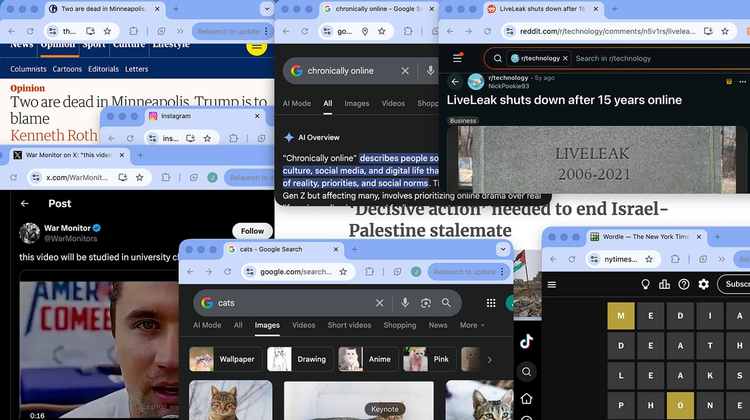
To be chronically online is to exist online, a constant speeding highway of news, culture, memes, and fandoms, without pause in between. The term, which appears to have emerged in the mid-2010s, refers to the twisting of a person’s worldviews detached from reality due to an overt amount of time consuming information and discourse online. This typically manifests itself in often warped takes and perspectives on the world, such as “drinking milk is inherently anti-feminist” or a hyper-awareness of the meaning behind a phrase like “6 7” which still evades me to this day.
What was once an extremity, however, has become increasingly normal for younger generations, as social life and status become more intrinsically linked with social media presence. We are constantly “plugged-in”.
Beyond the absurdity of niche internet discourse, “chronically online” worldviews can be shaped heavily by what people and social media algorithms choose to spread around, and when all one sees is doom and gloom, it reflects quite poorly on the world at large.
The Internet’s Appetite For Sharing Violence
I don’t remember actively seeking out violence online, but I do remember stumbling across it, or having it sent my way as a minor on the internet. One can’t really discuss this kind of content without discussing now defunct sites like LiveLeak which were notorious for hosting it, although the issue stems less from those platforms themselves than it does the content spreading onto more “safe” platforms faster than their moderation can handle it.
I recall in 2020 seeing a video spread like wildfire across TikTok of a man committing suicide with a shotgun. It was obviously in violation of the platform’s content restrictions, but posted and shared en masse far faster than moderation could delete them.
What was most unsettling to me however wasn’t the existence of the video, but the domino effect of its spread. Once it was out there, it was being saved, and I would hear frequently about it being spammed through private messages where moderation had even less power to stop it. I recall specifically returning to high school after the first round of COVID-19 lockdown and having another student attempt to show it to me on his phone.
It’s an incident that stayed with me because it spoke to how digital spaces have affected the relationship of my generation among others with extreme violence; no longer framed as exceptional but instead as disposable as any other piece of content, a meme to be shared in the schoolyard.
The pattern doesn’t stop at extreme footage from the depths of the internet however, as the mechanisms of social media sharing bleed into and govern everything that is spread on the internet, including the news itself.
The Bad News Epidemic
Looking at the news headlines of today, it’s no secret that we’re living in a time of international sociopolitical unrest. It’s easy to feel hopeless, although this negative outlook has just as much to do with algorithms as it does the reality of the situation. Social feeds are dominated by bad news, and statistically speaking, we’re more likely to look at it too.
I’m guilty of this myself, often falling down rabbit holes on X or Reddit or any number of other social media site designed to keep my eyes glued to the screen. The world seems so dreary when all these sites seem to spit out at me are war in the Middle East, or the latest escapades of the United States president, but I’m a bit of an addict. From locked away in my room, or inside a train carriage, the headlines look like all that the world has to offer.
When journalists are already fighting to grab the attention of readers, and platforms are designed to reward content that provokes strong reactions, distressing news headlines are shared and amplified while more positive stories struggle to surface. This creates an illusion of a never-ending crisis, an atmosphere of urgency and unease that while perhaps not always inaccurate, is psychologically a drain on mental health.
That’s, of course, not to say that it’s a bad thing to remain informed of the worst of what is going on in the world, but that perhaps the constant inflow of information skewed towards the negative is more than we are equipped to handle.
Mental quiet, or the lack thereof
Perhaps what this constant flow of information has taken most is mental quiet, the ability to sit with an idea and give it thought rather than being bombarded with something new almost immediately afterwards.
It’s a hard thing to hold onto, and I find it most noticeable when I try to step away from my phone. It’s uncomfortable to be unaware, and my attention span seems to be so fried that being bored for more than a few minutes is unbearable, so back I go again to the endless social highway.
Scrolling has filled all of the small pauses in my life, whether that be on the train, waiting for a coffee, laying in bed before going to sleep, stripping me of my ability to ponder and reflect on what I’ve seen or heard. The constant influx of information is routine, and in turn it’s created an uncomfortable sense of numbness to tragedy.
Memes in the face of conflict
One of the strangest phenomena to emerge in this age of information desensitisation is the speed at which world events are turned into content and memes. Scrolling through the replies of any news post on X, I almost expect to be bombarded with memes and ironic takes on breaking news rather than earnest attempts to engage with what is being reported. These memes are often how I’m first exposed to these international events, their weight flattened by humor before I even get the chance the process them.
This is visible across almost every topic, from the Israeli-Palestinian conflict to United States ICE raids.
It’s been exacerbated by the advent of AI, with image generation technology making it easier than ever to put prominent political figures into absurd memes and videos. Perhaps the most notable muse in this world of AI-generated memes is deceased right-wing political commentator Charlie Kirk, whose face can be found plastered and deepfaked across a seemingly infinite number of videos shared across social media following his assassination in September 2025.
A particularly notable video which I seem to come across every time I open X is of Charlie Kirk on the day of his assassination being saved by Jeffrey Epstein, before the crowd dances to a remix of the AI-generated song “We Are Charlie Kirk”.
Evidence of cruelty and indifference? Perhaps, but just as likely I think many users on the internet are fatigued with political unrest, and use humour as a method for coping and processing information. In a sense, memes could be considered a more “consumable” method of delivering shocking news, but in becoming consumable, it dulls the impact, and we become numb to its weight.
Logging Off (I Wish I Could)
In discussion around internet fatigue and emotional exhaustion, the most obvious solution, logging off, isn’t the most feasible. One needs to take into account the ways in which online spaces have embedded themselves so deeply into our individual lives. From the constant need to communicate through online chats and email, whether for work or simple socialisation. I probably couldn’t hold a job without being wired to a computer, at least a bit.
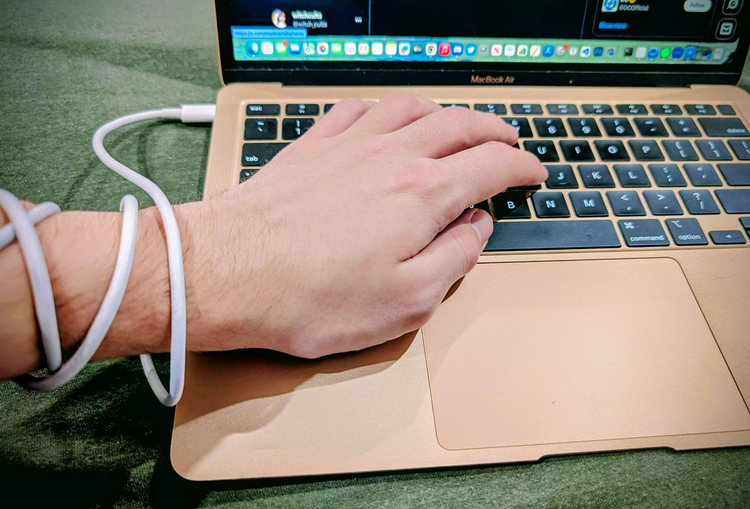
Once you’ve given that inch however, you’ve already given a mile as platforms are purposefully designed to keep you engaged through infinite feeds, push notifications, and intelligent algorithms that know exactly what to show you to keep you scrolling for more. It’s not impossible to stop engaging but it’s harder than it looks. I, for one, struggle to put my phone down for more than a couple of hours at most, and leaving it in another room feels almost unthinkable.
Conclusion: We Aren’t Meant to Carry the Mental Weight of the World
On the internet, the distance between us and the world around us has collapsed into a vacuum, and we are exposed to the struggles of far too many at far too quickly of a rate for us to process. Tragedy never gets the opportunity to land like it used to, violence is just content, and everything is fodder for a meme, no matter how taboo.
In this world of infinite media, it would seem as though empathy has gone extinct because caring about absolutely everything we are exposed to online is a weight too heavy for an individual person to carry.
It’s no good to feel miserable at the state of the world, but is it any better to feel nothing at all?