Who Is the Internet Built For?
By Josiane Akingeneye | Informed Future Generations | Rwanda
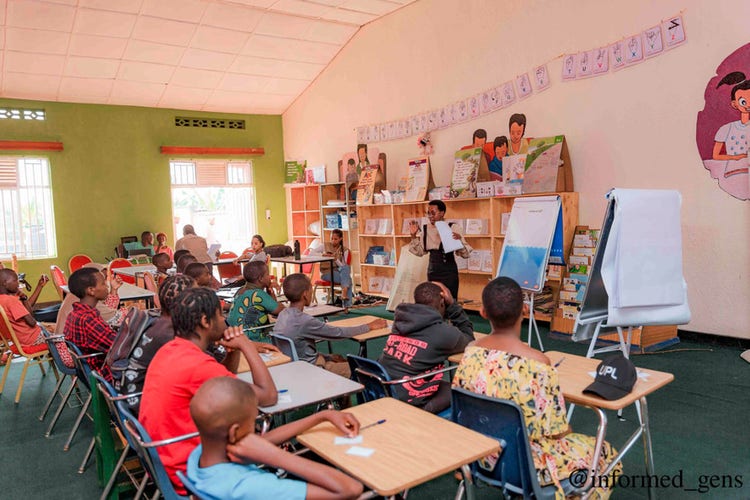
Young people taking part in a Decolonising Digital Design workshop in Gatsibo, Rwanda. Photo: Informed Future Generations.
Is the internet still a choice?
Today, we go online to stay close to family and friends, find jobs, work, study and access services. Around six billion people now use the internet, about three in four people on Earth, and 2.2 billion remain offline, 96 per cent of them in low- and middle-income countries (ITU, 2025). The UN Human Rights Council affirms that the rights people have offline must also be protected online (UN HRC, 2021). As education, health information and public services move online, being connected is no longer a luxury. It is becoming the way we exercise our rights.
Missing Voices in Internet Design
The deeper problem is not only who is offline, but who is missing when the internet is designed. Gaps in infrastructure, education, influence and political commitment have left the global South with little say in shaping the platforms, rules and technologies the whole world now uses. Children and young people have had even less. Social media, apps and artificial intelligence are built and governed mostly by adults in a few wealthy countries, rarely with a child in Rwanda in mind.
For me, decolonising digital design is more than giving everyone access. It means everyone having an equal opportunity to shape the internet that connects us, today and in the future, especially the voices most often left behind: communities across the global South, rural areas, and children and young people. It also means that every community's dignity, culture and language are visible and respected online.
Why an Inclusive Internet Matters in Rwanda
Rwanda shows why this matters. According to the 2022 national census, 72.1 per cent of Rwandans live in rural areas and 27.9 per cent in urban areas, and half of the population is under 20 (NISR, 2022 Census). Access to the internet is far from equal: 56 per cent of urban households have internet at home, compared with only 19 per cent of rural households (NISR, EICV7 2023/24). Rural communities face many barriers, from the cost of devices and data to weaker connectivity, and Rwanda's Ministry of ICT and Innovation has itself named access and affordability in rural communities as its primary challenges (TechCabal, 2025). This means most Rwandans, including most of our children and young people, are the most vulnerable to being left out, not only from using the internet, but from having a voice in how it is shaped.
Sources: NISR, 2022 Census; NISR, EICV7 2023/24.
Language and culture matter too. Kinyarwanda is spoken by more than 99.7 per cent of Rwandans (UNESCO World Atlas of Languages), and we share a common culture and heritage that create a strong bond among us. When the internet does not include our language and culture, we feel left out of a space that is shaping our future. Rwanda's Vision 2050 aims to build a knowledge-based economy, with digital transformation as a key priority (UNDP, 2026), and I see children and young people at the heart of that vision.
That is why Rwanda's participation in the Decolonising Digital Design project, through Informed Future Generations, matters beyond our borders. Kinyarwanda is also spoken in neighbouring parts of Uganda, the Democratic Republic of Congo and Tanzania, and is closely related to Kirundi in Burundi. As a member of the East African Community since 2007 (EAC), Rwanda also shares regional goals with its neighbours, so our voice in this project can help amplify the realities of the wider region.
My Experience as a Youth Co-Researcher
Before the project began, I had a real worry: how much could children aged nine to twelve, especially in rural areas, know about the internet? I was wrong to doubt them. Children today are already part of the digital world. There are clear gaps between rural and urban areas, but every child has some experience online.
I also saw that children and young people have brilliant ideas. They see the bigger picture, and where adults see problems that seem impossible, they see solutions. They are energetic, hopeful and clear about the world they want to live in. Watching young people help shape the rules of the future internet gave me hope for a world where everyone feels included, valued and respected.
A Call to Action
If we want a sustainable, safe and inclusive internet, we must involve children and young people. Adults can no longer simply think on their behalf or try to imagine themselves in their shoes. Children's digital life is not tomorrow. It is today.
“Listen to children and young people, and protect them online.”
That is my one request. Their safety and privacy must be built into digital platforms from the start, not added later. The internet will not become fair, safe and inclusive by itself. It is ours to shape, together.

ABOUT THE AUTHOR
Josiane Akingeneye is a data scientist and clinical researcher, and Director of MEAL and Research at Informed Future Generations. She brings over five years of experience leading and contributing to data-driven research and digital health initiatives across Africa, with UNICEF, WHO, Jhpiego Rwanda, WTO and the University of Rwanda. As a youth co-researcher with the Young and Resilient Research Centre, she contributed to the Decolonising Digital Design research project in Rwanda, giving children and young people a voice in shaping a safe, inclusive internet. Josiane is committed to strengthening health systems and advancing inclusive innovation across Africa.
References
- East African Community. Republic of Rwanda. https://eac.int/eac-partner-states/rwanda
- International Telecommunication Union (ITU) (2025). Facts and Figures 2025 press release. https://www.itu.int/en/mediacentre/Pages/PR-2025-11-17-facts-and-figures.aspx
- National Institute of Statistics of Rwanda (NISR) (2023). Fifth Population and Housing Census, 2022. https://statistics.gov.rw/node/87
- National Institute of Statistics of Rwanda (NISR) (2025). EICV7 Thematic Report: Utilities and Amenities 2023/24. https://statistics.gov.rw/node/583
- TechCabal (2025). Rwanda hits 38% internet penetration, but cost still keeps millions offline. https://techcabal.com/2025/06/12/rwanda-internet-penetration-rate/
- UN Human Rights Council (2021). Resolution 47/16: The promotion, protection and enjoyment of human rights on the Internet. https://documents.un.org/doc/undoc/gen/g21/198/31/pdf/g2119831.pdf
- UNDP (2026). Rwanda's Transition to a Knowledge-Based Economy: Pathways and Policy Priorities. https://www.undp.org/node/565786