Why industry can't get enough of these WSU grads.
Employability is one of the most important factors when students choose a path of study. Of course, interests, aptitudes and passion come into the decision-making process, but the dream of every graduate is to work in the field they’ve studied so hard for – which is one of the most exciting attractive about Western’s BSC (Environmental Health). Drs Maggie Davidson and Michelle Ryan, who both lecture in Environmental Health, find they are “bombarded” with requests from government and industry who are looking to employ Western graduates.
Western is the only institution in NSW, and one of only five nationally, offering an accredited undergraduate qualification in Environmental Health, and the only one accredited by Environmental Health Australia (EHA). “What the accreditation means to us is that our graduates are trained and have the knowledge that they need for industry,” said Dr. Ryan. “We’re very driven by what the industry needs in an Environmental Health Officer, so EHA makes sure that all the skills that are needed and base knowledge is met through us, so a graduate can go out and hit the ground running. We have a reputable degree that’s recognised worldwide.”
Graduates work within government, industry and regulators to ensure safe and healthy conditions are maintained in natural and built environments. Environmental Health Officers have responsibilities as wide-ranging as inspection of food premises and tattooing and piercing establishment, to overseeing the clean-up of fuel spills after road accidents and ensuring homes in which illegal drugs have been produced are free of toxicity and fit for habitation. “The environmental health program also very much embedded in community studies,” explained Dr. Davidson. “It often requires being the translator between the community and the government. Dr. Ryan and I are often brought in as independent scientists because we’re trusted to act as a mediator between government and community, and to explain things to both parties.” Many industries also rely on qualified Environmental Health Officers to ensure they are adhering to best practice in all aspects of chemical management for the safety of their workforce and the general public.
As well as their lecturing responsibilities, Dr. Davidson and Dr. Ryan are undertaking several research projects. Since the Black Summer bushfires in 2019/2020, Dr. Davidson has been researching air quality in the Blue Mountains and Lithgow with the local community, using solar powered air quality monitors at public schools to collate data on the air quality during fires and hazard reduction burns operations. Additionally, she is also researching occupational air quality in medicinal cannabis and hemp processing facilities, an industry where is potential risk of respiratory disease due to presence of organic dusts and volatile chemicals from the processes for it to be transformed into a range of commercially viable product including food, textiles and cosmetics. Dr Davidson was also recently awarded an icare grant to study the toxicology of artificial stone dust, which is linked to a current outbreak in accelerated silicosis amongst stoneworkers.
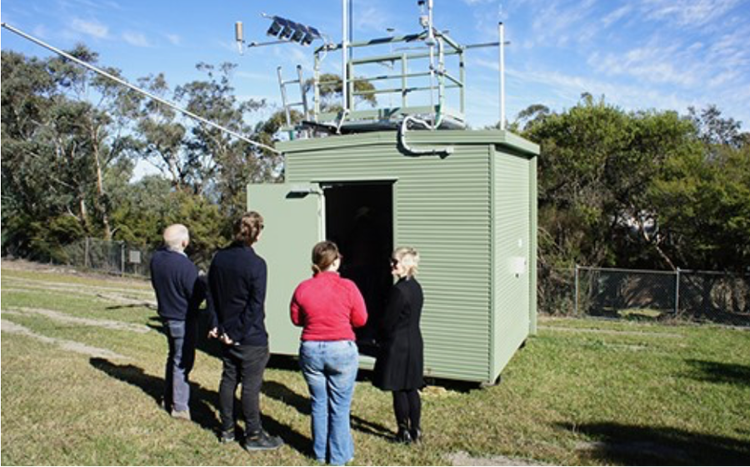
Image: Dr Davidson at one of the Blue Mountains air quality monitoring stations.
Dr. Ryan’s current research project into platypus habitats and water health has been ongoing for some years now, and has enabled several councils to gain a more accurate and detailed understanding of the water quality in different parts of the Hawkesbury-Nepean catchment. She is starting to document the health of the platypus population in the area by measuring body weight and general health of platypuses on a regular basis. In addition to this project, Dr. Ryan is also two years into a seven-year project measuring water health.
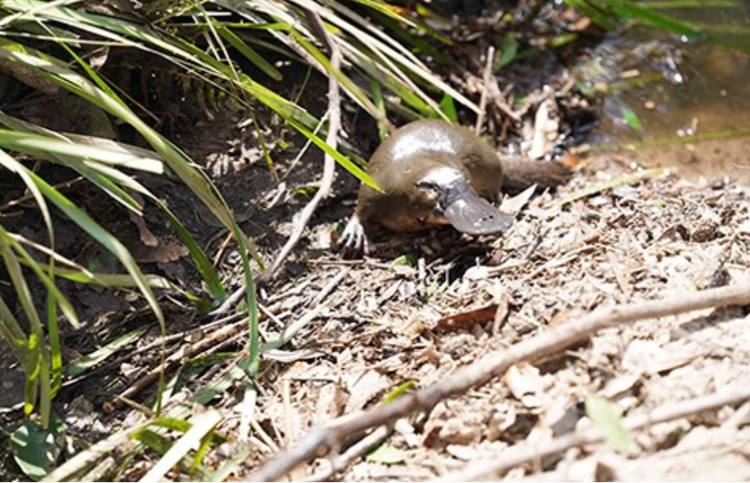
Image: One of Dr. Ryan’s research subjects in its natural habitat.
Coming out of Covid, both lecturers are hoping for a renewed interest in their field of study. “Covid’s actually been a positive thing for us,” said Dr. Ryan, “in that everyone suddenly realises the importance of environmental health.”
“This degree is very much about needs within society,” said Dr. Davidson of the Environmental Health qualification. “When we do our job well, nobody knows we’ve done it.”