The science of identifying human remains.
‘Ambiguous loss’ is the rather benign-sounding term for the ongoing grief that 2,000 Australian families carry with them every day. That’s the number of Australians who are currently missing, some of whom haven’t been seen by their loved ones in decades. Some of these missing persons are household names – the Beaumont children, Peter Falconio, Juanita Nelson – but many of them are forgotten by all but their families and police after new information slows to a halt and the news cycle moves on.
Currently, around 500 sets of unidentified human remains lie in mortuaries and burial places around Australia – people without a name or a story. It is highly likely that, should those remains be able to be identified, it would bring closure to some of the 2,000 families who live daily with their ‘ambiguous loss,’ but positive identification of these 500 John and Jane Does is a slow, expensive and painstaking process.
One team of Western researchers is hoping to help bridge that gap. Forensic anthropologist Dr. Hayley Green and microbiologists Dr. Oliver Morton and Dr. Thomas Jeffries are working on a project to bring more certainty to the science of identifying human remains, particularly those that have experienced significant decay. Drastically hampered by the local travel restrictions from Sydney’s recent Covid-19 lockdown, the team’s research came to a complete halt due to their inability to access laboratory equipment. However, they are now able to carry on their research thanks to a Researcher Development Award (Career Interruption) from Western Sydney University, which should see them able to move to the final stages of the project between now and Spring 2022.
Image: Dr Hayley Green, recipient of one of the University’s Researcher Development Awards.
By studying and recording the bacteria found in and around human remains after various periods of time and in varying environments, Dr. Green and her team are developing a clearer understanding of how bacterial growth and diversity can be used to give more accuracy to forensic practices that determine how long human remains have been in place. By being able to pinpoint the age of remains more accurately, investigators can focus their fields of inquiry on narrower date ranges, eliminating unproductive lines of inquiry.
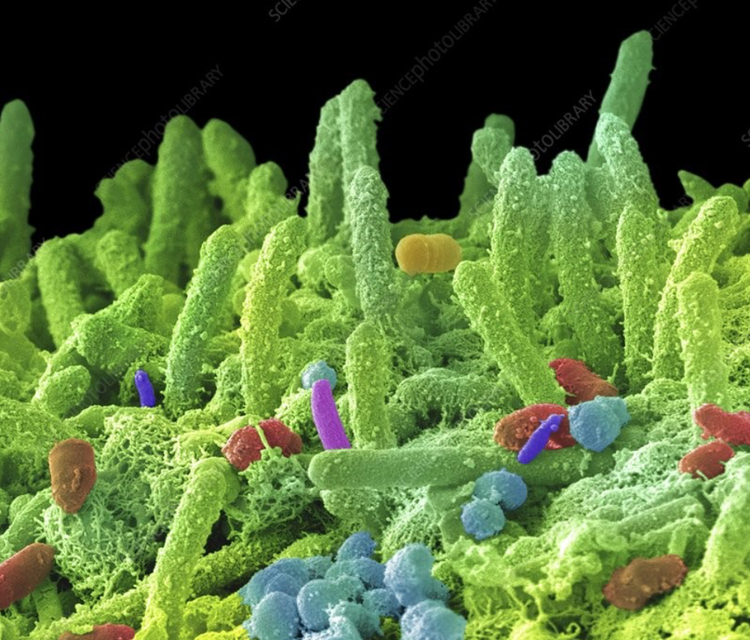
Image: Human oral bacteria. Image by Steve Gschmeissner.
Soil temperature, composition and moisture content can cause the microbiome to vary significantly, and as such Dr. Green’s work is specific to Western Sydney. However, once the team’s data is collected and analysed, the research could potentially be adapted to other parts of Australia and the world, advancing forensic practices universally. Forensic anthropology can be a field that is highly dependent on learned opinion, but in the legal sphere, that opinion can be challenged significantly. The quantitative data that Dr. Green and her team are collating will underpin the observed phenomena that forensic anthropologists use to formulate their conclusions, giving them more certainty in their findings and creating stronger cases for police and prosecutors.
The data Dr. Green and her team are compiling will give investigators another layer of evidence that can help shed light on individual cases. This painstaking and detailed research will inform future forensic practice, and provide investigators with an additional tool in collecting and compiling evidence, bringing families of missing loved ones one step closer to some much longed-for answers.