Salt of the earth.
The issue of salinization of the world’s agricultural land has been a growing problem for decades now. As the driest inhabited continent in the world, Australia is particularly at risk of this form of soil degradation as our water tables rise, and irrigated land becomes more saline. 30% of Australia’s irrigated land is affected to some extent by salinisation, and Australia’s harsh climate and vulnerability to climate change means that arable land is at a premium, so any loss in soil fertility is particularly problematic in our harsh climate. Western’s Dr. Jay Bose has worked in the area of salinity and salt-tolerant plants in India, Perth, Tasmania, Adelaide, and now joins Western to continue his work in addressing this serious global issue.

Image: Dr. Jay Bose.
Soil salinization threatens food security around the world, with some of the world’s lowest-income nations hardest hit (Figure 1). Among the nations hardest hit by salinisation of arable land are Argentina, Egypt and Iran, who each have around a third of their arable land affected by salinity, and approximately 2,000 to 4,000 hectares of farmland is lost to salinity every day. The issue of salinisation is a growing problem – increased demands for food result in a greater need for cleared land and irrigation practices, which are two of the primary causes of salinisation. When crop yields are inevitably reduced due to the salinisation caused by these practices, the demand for cleared land and irrigation increases, perpetuating the cycle.
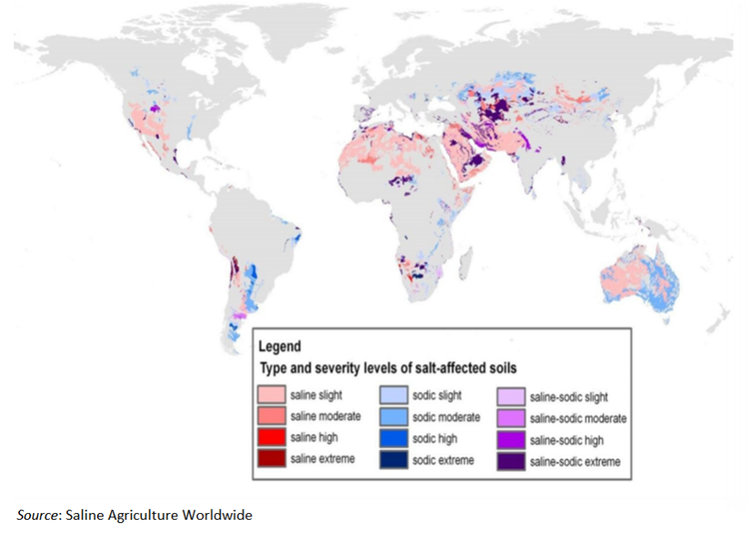
Figure 1: The type and prevalence of salinised soils globally.
Dr. Bose, recipient of an Australian Research Council Future Fellowship, joined Western in July this year and is tackling the problem of salinity in a unique way. Rather than focusing solely on rehabilitating salt-degraded soil, Dr. Bose is attempting to increase the salt tolerance of some of the world’s most popular food crops such as wheat, barley and canola. Until recently, the focus of Dr. Bose’s research was to isolate the salt-tolerant genes in plants such as saltbush, pigface and quinoa that make them not only tolerate, but thrive in saline conditions. Contrary to most plant species, these plants require salt water to survive, and are usually found in coastal areas where they are partly irrigated by salt water splash from oceans.
The next phase of Dr. Bose’s work, and the focus of his ARC Future Fellowship, is to attempt to modify the genetic structure of common food crops to make them more resilient to salty conditions. Dr. Bose explains that the next phase in his research “is about identifying why certain plants are salt tolerant, and how salt-loving plants protect the chloroplasts so they can keep photosynthesising even though they are experiencing salt stress.”
The ramifications of Dr. Bose’s work could be far-reaching. The United Nations has predicted that global food production needs to increase by 70% by 2050 in order to provide enough nutrition for the world’s population, a target which is threatened by, among other things, the increasing salinisation of the world’s arable lands. If Dr. Bose’s research is able to produce salt-tolerant varieties of wheat, barley, rice and canola, food production could thrive on land that has previously become hostile to food crops.
Not only is Dr. Bose’s work promising in terms of its potential to increase utilisation of poor quality soils, but it could also help the issue of salinity from another angle. Salt tolerant plants have the capacity to draw salt into their structures, and store it in a unique way that other forms of vegetation cannot. “Too much salt is bad for us, but we can eat a little bit. Plants can do exactly that. It’s about storing the salt in unwanted places, like the stem or vascular tissue, so they are protecting the functional (i.e. food producing) areas of the crop.” An additional benefit the salt-tolerant crops Dr. Bose is developing is that they will be useful in removing salt from agricultural land, rehabilitating it so it can then be useful for a wider variety of food crops.
While the rehabilitation of salinised land is still an ongoing and necessary field of work that is being addressed by numerous bodies in Australia, the task is time consuming and expensive. Dr. Jay Bose’s research, if successful, will provide a cheaper, faster solution that will provide both immediate and long-term benefits to the agricultural sector worldwide. “By 2050 we will have an additional 2.7 billion people,” said Dr. Bose. “Essentially, we’re all trying to solve food insecurity.”