The anatomy of a teacher.
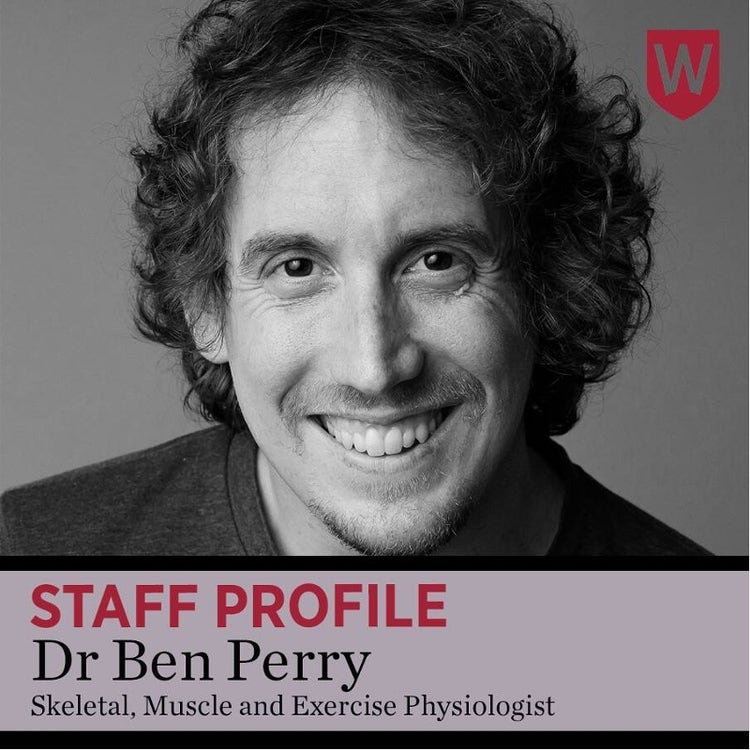
How Dr Ben Perry creates understanding, not just knowledge.
What would happen to your body if, somehow, all of your blood vessels were suddenly replaced with PVC pipe? It’s not a question most of us have ever thought about, but for Dr. Ben Perry, it was a hypothetical he posed to his second-year students in order to help them not just know about the human cardiovascular system, but to fully understand it.
Dr Perry was recently awarded the School of Science’s 2021 Teaching Excellence Award for his planning and execution of the new Human Systems Physiology 1 subject. The subject teaches human physiology from a systems perspective – teaching each system in the human body, how it works, and how it relates to other systems. But for Dr Perry, simply knowing the facts about each system wasn’t enough – he wanted his students to really understand the symbiotic nature of physiological systems, and why they do what they do. “Physiology can be quite an intimidating subject for a lot of students,” he said. “It can seem quite abstract and it can be something which students attempt to rote learn, without understanding the mechanisms of how each system actually works. If we give them a diagram of something, a lot of time students will just try and learn every single step on the diagram without any context, so I wanted to use more problem-based learning tasks.”
The problems Dr Perry present to his students, like the PVC question, are designed to encourage students to investigate a problem, talk about it with Dr. Perry and their peers, and then work out a solution. “Students had to actually talk about the problem and work through it together,” he told us. “I’m really looking forward to being able to do this on campus because so far, the subject has mostly been delivered online. I was worried that online we wouldn't get the same group cohesion, but some of our groups were really interactive, and it seemed to be really helpful in their learning.”
When planning lectures and learning workshops, Dr Perry tries to look at subject matter from a student’s perspective, to work out what they need to learn in order to put all the pieces of a complex subject, like physiology together into a coherent understanding. “I like to make my content very approachable,” he explained, “I like to give examples and bring the subject back to basics because if a student doesn't understand the basics, they can’t understand the subject properly.”
For Dr Perry, students gaining an understanding human physiology is a far more desirable outcome than them simply memorising information. “I’d rather they can tell me how blood goes through the heart even if they get their terminologies mixed up,” he said. “A student can learn the names of things later, but I've had students who can learn all the anatomical names and list them in order, but they just don't understand how they all fit together.”
Dr Perry believes it’s worth educators’ time to ensure students understand the basics of complex subjects. “Sometimes people conflate approachability with simplicity. But I think if a teacher goes straight into the advanced subject matter, they’ll leave lots of students behind. It doesn’t take long to go over the fundamentals, and it ensures that students don’t have any gaps in their knowledge.”
Dr Perry learned the importance of establishing the fundamentals of a subject from a former co-worker. “We did detailed research into how proteins interact to cause muscle atrophy, and it’s very detailed work, but this colleague would always start off by explaining why muscle atrophy is bad. He explained it at a high school or even a primary school level, but by taking that philosophy he ensured that everyone was on the same page. It’s like an inverted pyramid, you start with a very broad base of knowledge, and then you start to narrow it down to specific functioning. I wish some of my lecturers at uni had taken that approach!”
Dr Perry’s popularity among his students comes not only from his teaching style, but also his passion for his subject matter. “If someone mentions muscle physiology, I won’t stop talking about it,” he said. “I try to keep that passion in my teaching, and pass that on to students. That, and always staying approachable and interacting with students as much as possible.”
Dr Perry will be teaching Human Systems Physiology 1 again in 2022, at both the Parramatta South and Campbelltown campuses.