MdDS research.
For most of the 1.2 million Australians who set sail every year, the term ‘cruise holiday’ conjures up images of ocean vistas, tropical islands, bad Hawaiian shirts, and perhaps decadent cocktails enjoyed on a sun lounge. But for some unlucky travellers, their cruise holiday throws them a curveball that can impact them for decades.
A rare and often misdiagnosed condition called Mal de Débarquement Syndrome (MdDS) can affect a small number of cruise passengers after they return to land. Also caused by plane travel, car, and train travel and, rarely, virtual reality headsets, childbirth, surgery, the condition is theorised to disrupt the vestibulo-ocular reflex which controls reflexive eye adjustments and balance. Sufferers report dizziness, imbalance and a phantom perception of self-motion – in other words, the world is moving while they’re perfectly still. The condition can last from a few years to decades and can be extremely debilitating.
It was after her own diagnosis of MdDS in 2016 that Western’s Dr. Cherylea Browne started investigating treatments for the rare condition. At the time, the only treatment available was at Mt. Sinai Hospital in New York City. Despite the distance, expense, and only 75% success rate of the Mt Sinai treatment, Dr. Browne was determined to try it. Developed by Assistant Professor of Neurology at Mt Sinai, Dr. Mingjia Dai, the treatment involved treatments on five consecutive days in a small cylindrical chamber where a combination of moving panels of light and gentle head movement was employed to re-train Dr. Browne’s vestibulo-ocular reflex system to work as it should.
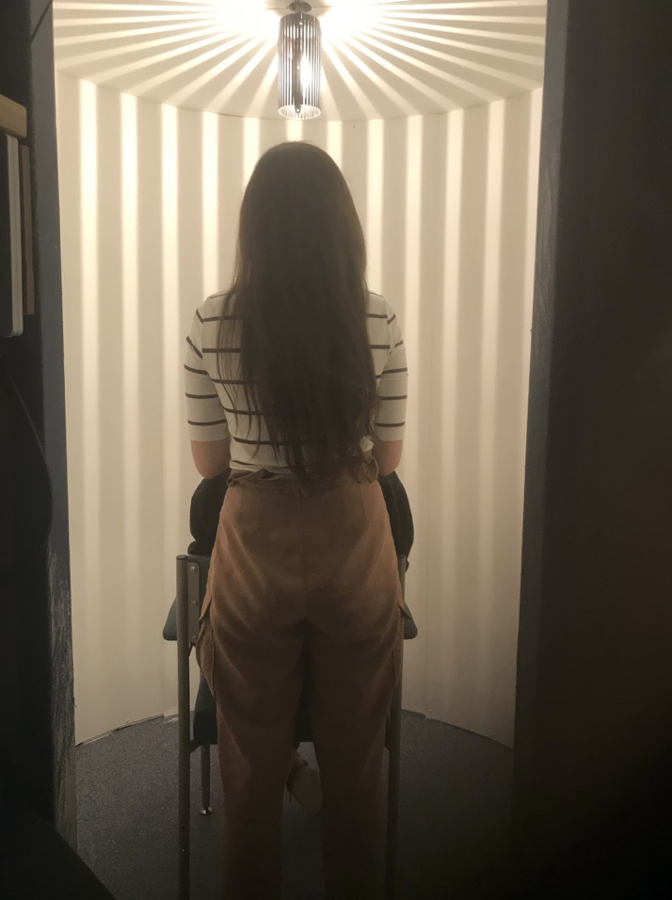
Image: Cherylea treating a patient inside the MdDS chamber. Photo: Supplied.
The treatment relieved Dr. Browne’s symptoms, however, Mt Sinai’s MdDS therapy was forced to shut down after Dr. Dai’s unfortunate death in early 2019. By that time. Dr. Browne’s own research into improving Dr. Dai’s therapy was well underway. After constructing a replica chamber to the one used in New York, Dr. Browne’s study was due to begin in March 2020 – the same month that the Covid-19 crisis came to Australia. Forced into a hiatus, Dr. Browne and her collaborator, Mr. Rocco Cavaleri (Health Sciences), were not able to test their therapy on patients until the beginning of 2021.
Where Dr. Browne’s therapy differs from that of Dr. Dai’s is the addition of neurological stimulation before the chamber treatment. Dr. Browne is testing the hypothesis that by stimulating the brain using Theta Burst Stimulation, the brain’s vestibulo-ocular reflex becomes more adaptable, and responds to the chamber treatment more effectively. While all of the patients in the study undergo four consecutive mornings of chamber therapy, half are given a neurological stimulation before each treatment, and half are given a sham stimulation. So far, the results of Dr. Browne’s study are promising, with a significant improvement in patients in the experimental group. “Some people have benefited incredibly on the first day,” said Dr. Browne. “There have been people telling me their life is completely changed. People are contacting me from all over Australia saying they want to be involved in the study.”
Between the resumption of the trial in December 2020, and Sydney’s latest Covid-19 lockdown, Dr. Browne and Mr. Cavaleri were able to treat fourteen of twenty patients required for the study. Thanks to a career interruption grant from Western, the trial is now able to continue when in-person patient contact is allowed once more. Should the remaining six patients in the trial be allowed to participate in the study, Dr. Browne is hopeful that her research will be finalised in Spring 2022.