Introducing Dr Alicia Haines.
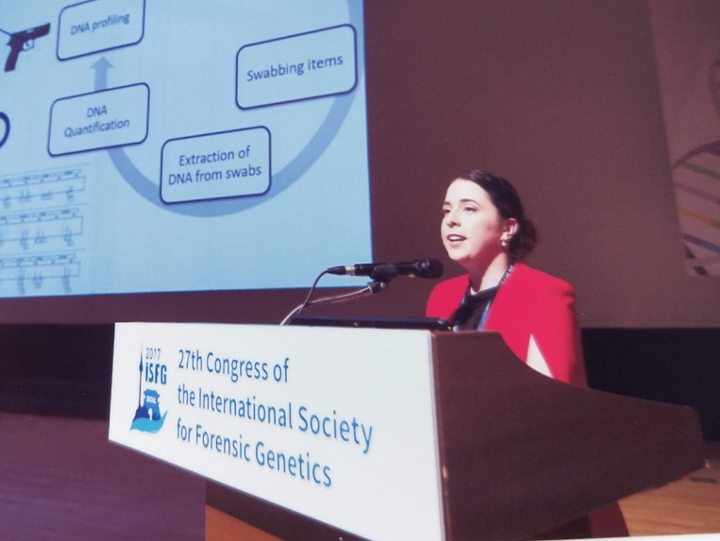
Image: Dr Alicia Haines.
Thanks to popular culture, forensic science is a field that enjoys enormous interest from the general public, but what most people outside the scientific community don’t know is that it’s also a field that is evolving at a remarkable pace. One scientist whose work has contributed significantly to the ever-growing arsenal of tools available to forensic investigators is Western’s Dr. Alicia Haines, who has recently moved to Western Sydney after working for 3 ½ years as a front-end forensic technician in New Zealand.
During her PhD research at Flinders University in Adelaide, Dr. Haines investigated the use of intercalating dyes to pinpoint the location of DNA samples left at crime scenes. By evaluating different dyes for toxicity, fluorescence and their ability to bind to DNA particles, Dr. Haines was able to isolate dyes that can be sprayed on various surfaces in crime scenes. “The dye gives off a fluorescent signal that you can visualise with a fluorescent light source and goggles, so you can actually see the presence of DNA on surfaces,” said Dr. Haines. “So it’s used to target the exact location of DNA so it can then be collected for extraction.” This eliminates much of the educated guesswork that investigators previously relied on, making crime scene analysis more efficient and accurate.
Dr. Haine’s recent experience on the front lines of forensic investigation will enable her to offer her first-year Forensic Science and third-year Forensic Biology students exposure to contemporary front-end lab work, practices and technologies. Her move to academia will also enable her to pursue lines of research that aren’t possible in a front-line investigation setting.
The University’s strong focus on research was the strongest contributing factor in Dr. Haines’ decision to join Western. She is hoping to combine her previous research into intercalating dyes with analysis of front-line forensic practices to come up with techniques that enable crime scene investigators to collect a higher number of high-quality DNA samples at active crime scenes, improving their ability to definitively identify and prosecute criminals. “Having a strong relationship with industry is good for informing research to make sure the research is applicable to the field,” said Dr. Haines. “Research is also important in a university in that it informs teaching. A lot of universities have research but it’s not necessarily a prime focal point like it is at Western Sydney.”