Behavioural Neuroscience Facility
Professor Tim Karl runs the recently established Behavioural Neuroscience Facility (BNF) at the School of Medicine (WSU). The BNF is PC2-approved and a state-of-the-art $1M mouse phenotyping facility, which was purpose-built for Tim’s research focus to facilitate the comprehensive, multi-tiered testing of genetic, environmental, and pharmacological mouse models for human brain disorders.
This facility contains six test units which allow the simultaneous running of various experimental protocols. All equipment is set up to allow comprehensive, multi-tiered, high throughput screening of mouse models. High throughput screening is absolutely essential when dealing with multi-factorial research projects and when testing therapeutic dose responses (i.e. large number of mice to be tested). Supporting this facility is a PC2 wet lab and procedures area (not shown) to allow for the analysis of disease-relevant brain pathology (e.g. protein quantification, measurement of brain chemicals, etc.) and to carry out surgeries (e.g. for inducible knockout mice and drug self-administration).
The test equipment available to analyse behavioural domains is relevant to, for example, schizophrenia, dementia, amyotrophic lateral sclerosis, autism, addiction and anxiety disorder.
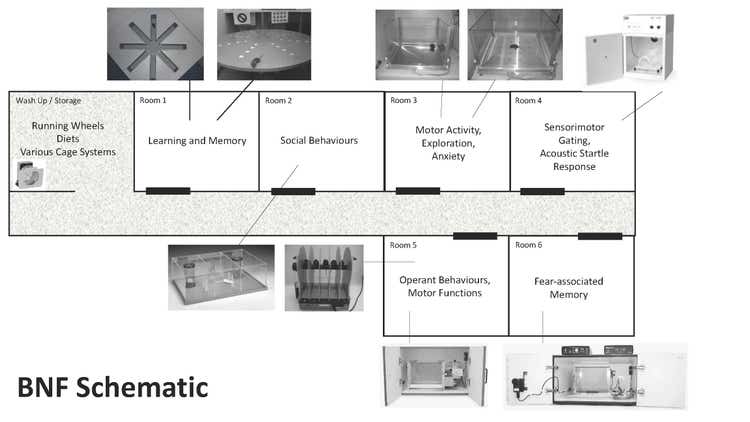
Test equipment examples:
- Physical examination (e.g. analysis of sensory abilities and neurological reflexes)
- Motor function (e.g. rotarod, pole test, grip strength, beam walking)
- Locomotion and explorative behaviours (e.g. open field, hole board)
- Anxiety (e.g. open field, light dark, elevated plus maze)
- Social behaviours (e.g. social interaction, resident-intruder aggression, social preference)
- Cognition (e.g. variety of tests for spatial memory, recognition memory, operant behaviours including fear-associated memory)
- Sensorimotor gating (i.e. acoustic startle response, startle habituation and prepulse inhibition)
- Repetitive behaviours (e.g. marble burying, stereotypies)
- Drug-taking behaviours (e.g. drug self-administration, conditioned place preference)
Cage Types Tecniplast:
IVC GreenLine gm500
Open filter top 1284
Running wheel open filter top 1290