Young Australians are getting news from AI as often as news websites, with calls for improved media literacy

A new report reveals more than one third of young Australians aged 10-17 are using Generative AI as a source of news, on par with news websites and apps.
With social media recognised as the second most preferred source of news, the report raises questions about whether young people are being prepared to not only use these emerging digital tools, but to critically evaluate the news and information they present.
Less than half of young people feel confident they can tell fact from fiction online, and nearly one third of young people who shared a news story online in the past six months later found out a story they had shared was false.
The News and Young Australians in 2026 report— a collaboration between researchers from Western Sydney University, Queensland University of Technology and University of Canberra – showcases the results from the fourth survey of more than 1000 young people aged 10-17 across Australia, as part of a longitudinal project that commenced in 2017.
Lead author Professor Tanya Notley, from Western Sydney University’s School of Arts and Institute for Culture and Society, said this points to an urgent need for enhanced news media literacy education in school that develops young people’s critical capacity to navigate the platforms they rely on most for news.
“Young people who receive more news media literacy lessons in school demonstrate greater digital media knowledge but there is still a disconnect between what young people know and how they actually behave,” said Professor Notley.
“While many young people can correctly identify how a search engine or a social media algorithm works, this technical knowledge does not necessarily result in them reporting that they take steps to verify information and sources online.
“News media literacy education needs to support young people to move beyond ‘how it works’ to ‘how to act’.”
Across nearly every indicator, young people are less engaged with news in 2026 than they were in the study’s previous survey in 2023. The report suggests this is likely linked to the social media ban and a widespread feeling among young people that news is not made about them, is not for them, and is too negative in its focus.
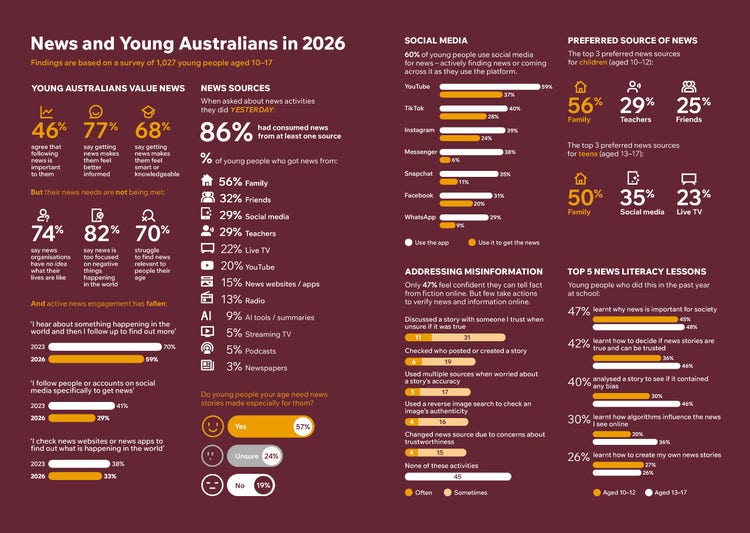
Three-quarters of young Australians believe news organisations have ‘no idea’ what their lives are like. Report co-author Dr Simon Chambers, from the MARCS Institute at Western Sydney University, said as a society we can do better to include young Australians in the conversations that matter most to them.
“Young Australians want news that speaks to their experiences and the issues they care about. When they feel overlooked or misunderstood, trust in news inevitably declines,” said Dr Chambers.
The findings also show that 10-to-12-year-olds most often rely on teachers and parents to get news, but as they enter their teenage years they move toward independent and digital news engagement.
“It’s important we develop young people’s understanding of digital media environments during their pre-teen years, before they begin navigating news online on their own,” said Dr Chambers.
“Rather than viewing children and young people as separate from the broader news environment, we need to better understand the issues they care about and include their perspectives in the news they consume.”
For more information, read the News and Young Australians in 2026 report.
The 2026 survey has been funded by ABC Education and Western Sydney University.
ENDS.
31 August 2026
Photo credit: Vlad Deep via Unsplash
Lauren Coskerie, Senior Media and PR Advisor