Western Sydney University launches national centre to accelerate net-zero building innovation
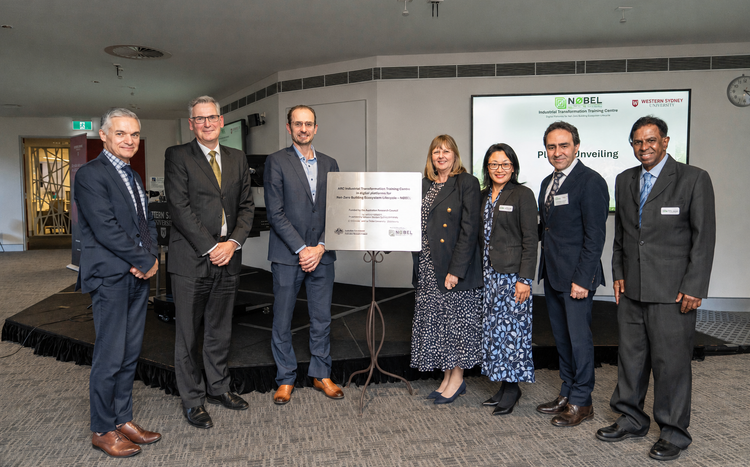
(L-R) Western Sydney University, Executive Dean, Faculty of Engineering, Computing and Science, Distinguished Professor Brian Falzon; NSW Net Zero Commission, Chair, Mr Nicholas Rowley; Australian Research Council, Deputy CEO, Anthony Murfett; Western Sydney University, Provost, Professor Deborah Sweeney; Western Sydney University, ARC ITTC NØBEL, Director, Distinguished Professor Vivian Tam; Western Sydney University, ARC ITTC NØBEL, Deputy Director, Professor Pejman Sharafi; and University of Melbourne, ARC ITTC NØBEL, Deputy Director, Professor Priyan Mendis
Australia's transition to net-zero buildings will receive a major boost with the launch of a new national centre at Western Sydney University focused on helping the construction industry deliver smarter, lower-carbon buildings.
The Centre comes as Australia works to decarbonise the built environment while delivering major housing and infrastructure projects. The built environment accounts for around 31 per cent of Australia's greenhouse gas emissions, the construction sector employs more than 1.3 million Australians, and the nation generates approximately 26.8 million tonnes of construction and demolition waste each year.
Based at the University’s Kingswood campus, the Australian Research Council Industrial Transformation Training Centre in Digital Platforms for Net-Zero Building Ecosystem Lifecycle (ARC ITTC NØBEL) will bring together researchers, industry, peak bodies, small to medium enterprises (SMEs), and start-ups to transform Australia's building and construction sector.
The NØBEL Centre is the first ARC Industrial Transformation Training Centre dedicated to digital platforms for a net-zero building ecosystem lifecycle, bringing together digital technologies, low-carbon materials, and industry training.
The Centre is developing digital tools to support advanced manufacturing technologies and sustainable construction, enabling mass production of high-performance buildings and supporting net-zero project delivery. It will build on existing research breakthroughs including CO2 Concrete, an innovative technology that permanently stores carbon dioxide in recycled construction materials, transforming construction waste into high-performance, low-carbon concrete for the built environment.
Low-emission building technologies offer significant economic opportunities where Australia has a comparative advantage in low-emission materials. These innovations are expected to strengthen the competitiveness of Australia’s building and construction industry, generating $135 billion annually.
The Centre was officially launched by Australian Research Council Deputy Chief Executive Officer, Mr Anthony Murfett, alongside Western Sydney University, Provost, Professor Deborah Sweeney.
Special guests included Net Zero Commission Chair, NSW, Mr Nicholas Rowley; Deputy Vice-Chancellor Planning, Research and Innovation at De Montfort University (DMU), UK, Professor Mike Kagioglou; and representatives from the Centre’s research and industry partners.
The Centre's work will span the building lifecycle across five themes – industrialisation, resilience, decarbonisation, digitalisation and integration – to improve productivity, reduce carbon emissions, and support the adoption of new construction technologies.
It will also support PhD candidates and higher degree researchers through opportunities to work with industry partners on real-world challenges in low-carbon construction, digital building technologies and advanced manufacturing.
Director of ARC ITTC NØBEL, Distinguished Professor Vivian Tam, said the launch of the Centre marks the beginning of a major initiative bringing together universities and industry to drive digital innovation, advanced manufacturing, and net-zero outcomes.
“NØBEL is focused on accelerating the transition to net-zero buildings through digital platforms, advanced manufacturing, and sustainable construction practices,” said Distinguished Professor Tam.
“Our vision is to build an ecosystem where net-zero project delivery, platform-based methodologies, and sustainable materials become standard practice in construction.
"By bringing together researchers and industry, we can accelerate the adoption of practical net-zero solutions that improve productivity, reduce emissions, and strengthen Australia's construction sector."
The launch concluded with an academic and industry panel discussion exploring the opportunities and challenges facing the future of net-zero construction.
Find out more about the Centre here.
ENDS.
22 July 2026
Media Unit