Western Sydney University embraces Microsoft Copilot for all staff
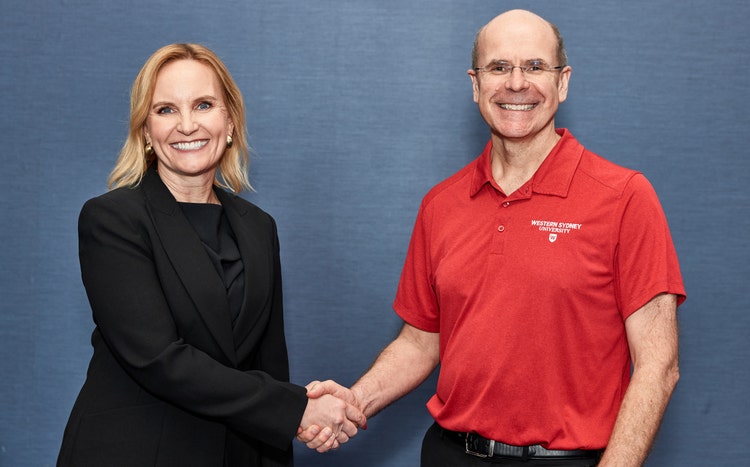
President, Microsoft Australia and New Zealand, Jane Livesey, pictured with Vice-Chancellor and President, Distinguished Professor George Williams AO
Landmark initiative equips every staff member and Higher Degree Research student with access to enterprise grade Microsoft 365 Copilot, advancing student success and the future of work.
Western Sydney University has given every staff member access to enterprise grade Microsoft 365 Copilot, becoming the first university in NSW and the second in Australia to do so and marking a decisive step in the University’s commitment to preparing its people and students for a rapidly changing future.
From 16 July, every staff member, including casuals, and Higher Degree Research candidates has had access to Copilot, integrating AI securely into their everyday systems and day to day work. This means more time and capacity to focus on what matters most: students.
The rollout follows a successful 100-user pilot trial, which demonstrated how Copilot can help minimise the time staff spent on repetitive and low value tasks, freeing them up to work on more high value and meaningful work.
Vice-Chancellor and President, Distinguished Professor George Williams AO, said: "We're not adopting AI for its own sake. We're doing it because it helps us better deliver on our core purpose - student success.”
"A student starting with us today will graduate into a workforce that looks very different from the one we know now. It's our responsibility to make sure they're ready for that world - and that starts with making sure our staff are equipped to lead the way."
With Copilot staff can draft documents, summarise meeting outcomes, analyse information, create presentations and spend less time on routine tasks, allowing more time to focus on higher-value teaching, research and professional work.
The partnership builds on a Memorandum of Understanding signed with Microsoft in late 2025 and reflects Western Sydney University’s human-centred approach to AI adoption.
The initiative forms part of the University’s focus on digital equity and preparing graduates for the future of work. By providing staff with access to AI tools and training, the University is ensuring that the benefits of AI are responsibly embedded in our community and student experience.
“Our students are telling us they want the people who teach and support them to be proficient in AI. They know these technologies are the future of work and expect their university experience to prepare them for that reality,” Professor Williams said.
“By providing every staff member with access to Microsoft Copilot, we’re ensuring our people have the skills and confidence to use AI effectively and securely. When we free our educators from time-consuming, repetitive tasks, we give them back what matters most: time with their students."
“AI is changing how Australians learn and work, and our universities have a defining role in preparing people for that future," said Jane Livesey, President, Microsoft Australia and New Zealand. "Western Sydney University is showing what genuine ambition looks like, giving every staff member and its Higher Degree Research students the tools, the training and the confidence to use AI well."
“This places Western Sydney University among a leading group of universities worldwide leading the way in bringing Copilot to all staff, and it reflects what we value most at Microsoft: keeping people at the centre of AI, empowering them to lead the change, and building the future of work together. We're proud to be their partner on that journey."
Alongside the University's investment, Microsoft will provide additional support, assisting with staff training and effective adoption - including capability development in areas such as agentic AI, curriculum design and student engagement.
The University’s human centred approach to AI will be reflected in the design of training programs supporting the Copilot rollout, which will include the development of a community of practice to share knowledge and learning across the institution.
The initiative ensures equitable access across the University, and builds on work already underway, with educators across the University reimagining teaching, learning and assessment through AI and digital innovation.

Across Western Sydney University, academics are using generative AI to rethink how they teach. Read their stories.
Picture a classroom of law students locked in a live debate with Socrates, racing classmates to the right answer, or testing the accuracy of AI generated responses. That’s what Dr Armin Alimardani at Western Sydney University’s School of Law is exploring through a pilot project.
Dr Alimardani and colleagues grew frustrated with the commercial learning platforms available to them - expensive, rigid, and not built for the realities facing today’s law students. So, they built their own, using generative AI to design a suite of educational games from scratch.
The result is three tools that look nothing like a typical law lecture. And early testing with students has received positive feedback.
In Hallucination Lab, students are challenged to spot errors and false information generated by AI - sharpening exactly the kind of critical thinking a good lawyer needs when the world is increasingly shaped by artificial intelligence.
In The Arena, students are dropped into a live debate. They must argue a legal case from a philosopher's perspective - say, Aristotle or Kant - and receive feedback delivered back to them in that philosopher's own voice and style.
In HomeRun, the classroom becomes a race. Students compete head-to-head in real time, moving a character toward the correct answer faster than their classmates.
"Legal educators are often required to work within the constraints of commercial platforms that don't fully align with how or what we teach," said Dr Alimardani. "This is about what becomes possible when academics design learning tools themselves – using AI appropriately and guided by research and classroom experience."
“This is what we refer to as 'personalised teaching': teaching in a way that maximises a teacher’s capacity and, in turn, enhances students’ learning.”
Because the tools are built in-house leveraging AI, they can be updated as student feedback comes in and curriculum needs change - something no commercial platform can offer at the same speed or cost.
Dr Alimardani leads the project alongside colleagues Dr Jacinta Sassine, Dr Sophia Bai, Dr Bradley Gooding, Dr Shreeya Smith, Dr Kaitlyn Poole and Professor Juliette Overland.
Pathophysiology is a complex subject, requiring students to hold anatomy, physiology, pharmacology, even chemistry and electrophysiology in their heads all at once. Traditionally, assessments in this area have relied on long, dense pieces of writing – often thousands of words – that didn’t reflect what truly matters in real healthcare practice.
With the emergence of generative AI, Dr Joan Nguyen has led a rethink of assessment design, not only in terms of what is assessed, but why. Her work explores how assessments can be designed that leverage AI meaningfully while preserving learning integrity and creating opportunities for students to demonstrate not just knowledge, but the capacity to think, reason, and communicate in the language of their discipline.
“Rather than doubling down on the old ways, we've asked the question: What is the real expertise we want our healthcare professionals to have? And the answer isn't ‘who can memorise every human disease in detail’ because not even the experts can do that.”
“What truly matters is their humanness: their ability to see how all that hard sciences connects to the real people they will care for. Their ability to look at a patient or client and think, ‘How does all this knowledge and information help me understand you?’”
As a result, assessments have been redesigned. Instead of asking students to produce a 3,500-word essay, they are now asked to apply scientific understanding to authentic, person-centred scenarios inspired by real members of their community. Dr Nguyen asks exactly how will they be of service to their community.
“Our job is to help future health professionals understand how their knowledge serves their patients, their communities. No technology can replace that. For us, AI is not a shortcut, but an opportunity to put people even more firmly at the centre of learning.”
ENDS.
22 July 2026
Media Unit