Western Sydney University device rings in new hope for dementia care
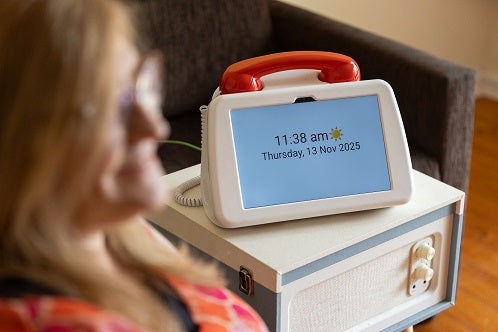
The familiar act of picking up a traditional handset phone is at the heart of a new piece of technology delivering positive results when it comes to caring for people living with dementia.
Set to launch to the public this year, the ‘MemoryAid’ device, developed by a team from Western Sydney University and Deakin University, is a home assistance device resembling a traditional telephone, which allows people living with dementia to maintain their independence for as long as possible.
Project lead Associate Professor Celia Harris from Western Sydney University’s MARCS Institute for Brain, Behaviour and Development explained that the brightly coloured handset resting on top of the device allows users to simply pick up the handset when it rings, a familiar action from a lifetime of practice.
“The idea for MemoryAid was to imagine new kinds of technologies that are empowering and intuitive for people with dementia and other older people; it’s a digital device that you can use to keep in touch with loved ones via video calls and receive prompts and reminders for daily routines, but you use it like a familiar handset phone. When it rings, you pick it up, and everything works from there. You just look at it, and you know what to do with it, using skills you’ve practiced over a lifetime,” Professor Harris said.
“What’s exciting about seeing people use MemoryAid at home is that they use it in completely different ways, for different things, depending on what is most important to them. It might be as mundane as support with drinking enough water, but also reminders for picking up the grandchildren, doing some exercise, or setting up one-off appointments day-to-day. We wanted MemoryAid to be flexible enough so that people can choose what they use it for, based on what matters most to them, rather than us deciding that for them.”
Designed by experts and working with an advisory group of people with lived experience, the innovative device has received positive feedback while being trialled. MemoryAid test user Richard, a 65-year-old man from Sydney who has been living with younger-onset dementia since 2020, said that using MemoryAid has brought him a newfound sense of routine, supporting his day-to-day and his ability to go out and about in the community.
“Genuinely, for me, the device has been the best thing since baked bread - it’s been so good for my independence. MemoryAid reminds me to do basic things like take my pills, which is really important because I was missing three or four days of pills a week. Not once in the whole time of having the device have I forgotten my pills,” said Richard.
“I've always had an analytical brain and been able to sort things out. But since the dementia, it's almost like the connections have been severed. MemoryAid has helped me to put those connections back again and it makes a huge difference. It's offering a routine, and it's clarifying that routine. It provides a sense of wellbeing because I am doing what I am meant to be doing.”
The device is currently a finalist in the running to win the Longitude Prize on Dementia, a global prize which funds and supports assistive technologies that use AI and machine learning to help people living with dementia. The prize is funded by Alzheimer’s Society and Innovate UK and delivered by Challenge Works.
The only Australian finalist out of five projects, the MemoryAid team received $150,000 in 2023 to develop their ideas into real-world technology. The overall winner which will be announced on 19 March 2026 will receive an additional $2 million to fast-track development and bring their product to market sooner.
CEO of Dementia Australia, Professor Tanya Buchanan highlighted that in 2026, an estimated 446,500 Australians are living with dementia, and which is now the leading cause of death nationwide.
“This scale of impact highlights the urgent need for dementia support which includes technological solutions that are person-centred and focused on helping people living with dementia to be empowered and to maintain independence for as long as possible,” Professor Buchanan said.
Without a significant intervention, the number of Australians living with dementia is expected to increase to more than 1 million by 2065.
With MemoryAid in the final stages of development and people able to join a waitlist, Associate Professor Harris is looking forward to the device being available to assist people in the wider community.
“We have seen from our trials that MemoryAid can make a big difference to independence and helps people with dementia and their families to focus on all the things they can still do, with a little support where needed,” she said.
“We truly appreciate the support we have received from Longitude Prize as it has given us an imperative to work as hard as we can to get MemoryAid out into the world so that people can benefit from it.”
More information on MemoryAid is available, here.
To arrange an interview or case study, please email media@westernsydney.edu.au
ENDS.
13 March 2026
Emily Neville, Senior Media and PR Advisor