Western Sydney is among Australia’s worst overheating urban regions, Western Sydney University researchers are working to change that
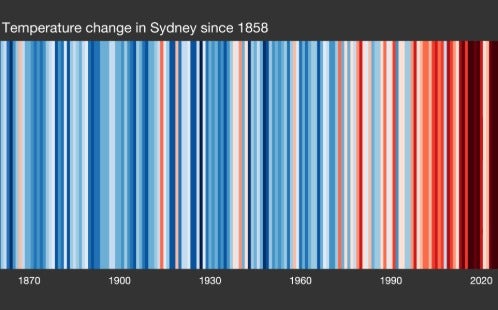
Sydney annual mean temperature anomaly· Inspired by #ShowYourStripes (showyourstripes.info)
Western Sydney could face up to 46 days a year above 35°C by 2090, as climate change and urban heat intensify across Australia’s fastest-growing regions.
Western Sydney already has one of the most severe urban heat island effects across the country. During heatwaves, temperatures can be 8–10°C higher than Sydney’s eastern suburbs, and the region currently experiences an average of 15.4 days per year above 35°C.
On Show Your Stripes Day, 20 June, a global call to action highlighting rising temperatures, Western Sydney University researchers are spotlighting both the urgency of the challenge and the solutions underway to cool our communities, protect health and build climate resilience.
The “warming stripes” graphic, developed by climate scientist Professor Ed Hawkins, uses a simple bar of colour, from blue to red to show how average temperatures have shifted year by year. For Sydney, the stripes tell a stark story. For Western Sydney, the trend is even more acute.
Western Sydney’s inland location limits sea breezes that cool the eastern suburbs, while the Blue Mountains trap hot air to the west. Dense concrete, dark roofs, and limited green space further amplify heat. The result is one of Australia's most severe cases of urban overheating.
In January 2020, Penrith recorded 48.9°C, making it the hottest place on Earth that day.
Western Sydney University is uniquely placed to address this challenge. Spanning the Sydney Basin from Parramatta to Penrith, Campbelltown to the Hawkesbury, the University sits at the heart of the communities most affected by extreme heat. This on-the-ground presence, combined with strong community partnerships, means the university researchers are not just studying the problem from a distance. They are working directly with residents, councils, and housing providers to understand how heat affects daily life and to develop practical, place-based solutions that improve urban planning and reduce risk for those who need it most.
New research published in January 2026, involving Western Sydney University's Professor Sebastian Pfautsch from the Urban Transformations Research Centre, found that Australian heatwaves are now five times more likely than before industrialisation. Events that once occurred roughly every 25 years now occur every five years – and that frequency is set to increase.
"As extreme heat becomes normal, so must adaptation to it – from homes to streets and entire suburbs," said Professor Pfautsch. "Heat-smart design is no longer a choice but a necessity. Treeless suburbs with dark roofs and driveways only amplify heat."
Western Sydney University is responding to this challenge across several major research projects:
- Living with Urban Heat: Becoming Climate-Ready in Social Housing (2023–2026) – Working with culturally diverse social housing residents to develop practical, low-cost cooling strategies. Using participatory action research, the project partners with Bridge Housing, Link-Wentworth, St George Community Housing, Faith Housing Alliance, and UCA-Parramatta Nepean Presbytery to deliver immediate, household-level solutions that reduce heat risk. While generating new knowledge about equitable heat adaptive practices and building civic capacity for a hotter urban future.
- Unlocking Sustainability Bonds for Urban Green Infrastructure – Investigating how sustainability bonds can finance the parks, tree canopy, and open space Western Sydney needs to reduce heat. Current funding models capped council rates, short-term grants and limited developer contributions – leave councils unable to deliver the scale of green infrastructure required for cooling and liveability.
- Managing Resilient Urban Green Spaces in Australian Cities (2024-2027) – Developing and managing public and private green spaces in a warming climate is increasingly complex. The university researchers are producing ‘Better Practice Guides’ for industry and government to strengthen the resilience of public and private green spaces to extreme heat, flooding, and fire, ensuring they continue to deliver cooling and community benefits.
These projects sit alongside ongoing research that measures and maps heat across Greater Sydney, providing the evidence base for targeted, place-based action by councils, planners and policymakers.
#ShowYourStripes Day is an opportunity to make that evidence visible. The stripes for Sydney run from blue to red. Western Sydney's are among the most vivid.
Local action – from starting conversations with your neighbours, your housing provider, and your local council about heat risk – will play an important role in protecting our communities.
ENDS.
19 June 2026
Media Unit