The students taking Australian robot soccer to the world stage
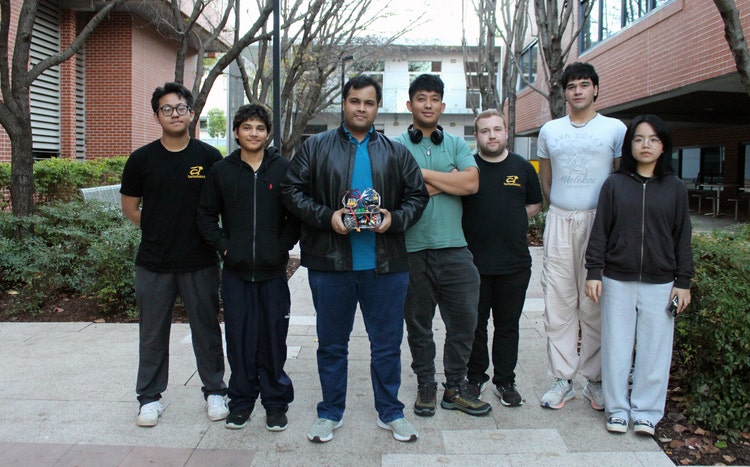
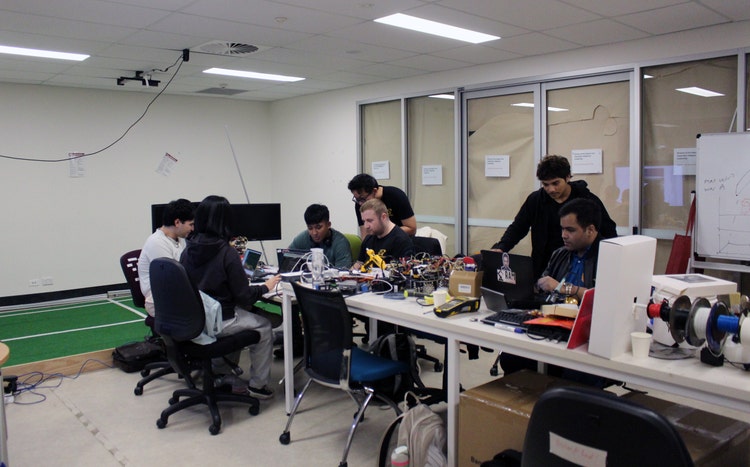
It’s been a long day in the lab - debugging, building components, and finding solutions to why a robot isn’t working the way it’s meant to.
There are plenty of late nights, plenty of coffee. And, according to team members, there are usually noodles afterwards.
Later this month, the Western Sydney University students behind team ‘TurtleRabbit’ will compete in the world’s largest and most prestigious robotics and artificial intelligence competition in South Korea.
The event will be the University’s robot soccer team’s second appearance in the competition, following their debut two years ago, which marked the first time an Australian team had competed in over two decades.
The 20-student team based at the University’s Parramatta South campus has spent more than 300 hours per student per robot in developing and testing its six robots, and is preparing to travel ahead of the competition, which begins 30 June in Incheon.
Designed with cost-effectiveness in mind, the team’s robots are built on an open-source Small Size League (SSL) platform with custom-developed software, using off-the-shelf electronics, 'hobby' BLDC motors, 3D printing, and CNC milled components.
A team built like a startup
Tharunimm Jamal (TJ), President and Team Lead of Turtle Rabbit and Bachelor of Engineering (Honours) (Robotics and Mechatronics) student from Parramatta, said preparing for RoboCup is like running a small startup.
“We have students working on software, electronics, mechanical systems, strategy, sponsorship, logistics, and project management all at the same time. There are plenty of late nights, lots of coffee. But that's also what makes it rewarding,” said TJ.
TJ says most people see a few robots playing football and think that's the entire competition.
“What they don't see is the countless hours spent debugging code, redesigning components, and testing systems.”
“Every challenge solved is something new learned, and every improvement brings us one step closer to competing with some of the best robotics teams in the world.”
What a robot soccer player actually is
According to Darpan Gurung, Hardware Lead for the team and Robotics and Mechatronics Engineering student from Kingswood, the robots on the team are very simple in principle.
“Think of it like a soccer player and what those players need to actually play the game,” he said.
“First, they need to move, so we have the omnidirectional wheels, which, as the name implies, allow the robots to move in all directions. A player also needs a brain, so we have a Raspberry Pi 4 that serves as the main brains behind the operation, taking in commands and telling the rest of the robot what to do.”
Once the team has a moving player with a brain, they can begin adding the functions needed to play the game, including kicking, dribbling and ball control.
But what makes TurtleRabbit different is that the robots aren't controlled by humans during a match.
“Autonomy is the name of the game, once a match starts, no one is driving these robots with a controller.”
“It's kind of like a queen bee controlling its workers. The server is constantly thinking about where everyone should be, who should have the ball, and what the next move is, then passing those instructions down to each robot. The robots carry out their jobs, the server watches what happens, and the whole cycle repeats many times a second, which is what lets the team react and play on its own without any human input.”
A team backed by culture
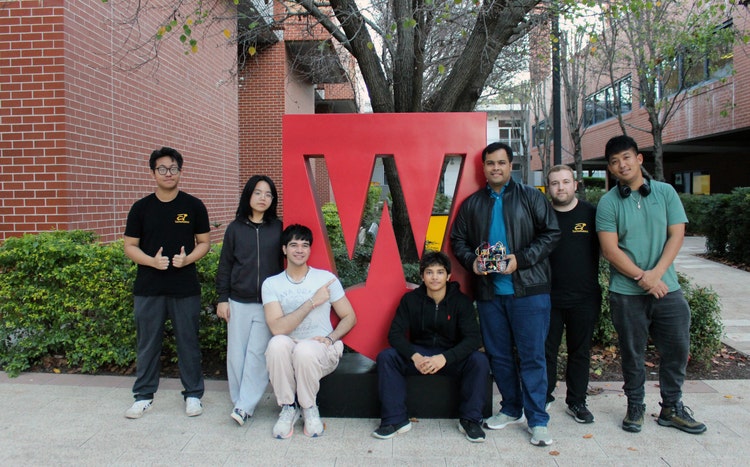
The team sits within the Robotics, Automation and Manufacturing (RAM) Club within the Faculty of Engineering, Computing and Science at Western Sydney University, which has close to 300 members.
TurtleRabbit brings together students from a range of disciplines, including Mechanical Engineering, Electrical Engineering, Mechatronics and Robotics, Computer Science, Software Engineering, and Data Science. For many, TurtleRabbit is their first deep exposure to autonomous robotics.
Software team member and RAM Club Secretary, Naomi Luyen, who is studying the Bachelor of Data Science, also from Parramatta, says the experience has been transformative.
“It means a lot to me and to everyone in TurtleRabbit. It's not only an exciting opportunity for us to showcase our work on an international stage and learn from other teams around the world, but also a recognition of so much hard work that our team has put into this project,” said Naomi.
“We have a great learning culture. Most of us joined barely knowing anything about the game or what the different roles even involved, and it can feel overwhelming at first. But as long as you're eager to learn, you'll be fine as everyone is very friendly and always happy to answer any question you throw at them.”
“For me personally, what makes it even better is getting to work with people who are not just talented but also willing to share what they know. That kind of environment naturally pushes you to grow, and you end up picking up a lot more than you'd expect just by being part of the team.”
RoboCup 2026 will take place from 30 June to 6 July, at Songdo Convensia in Incheon, and is expected to bring together more than 3,000 competitors, researchers, students, and professionals from dozens of countries.
While the robots are what draw attention, Darpan says the team itself is just as important.
“Beyond the engineering, we've built a tight community of like-minded people, and after a long day in the lab you'll usually find us out getting noodles together, maybe even playing pool.”
ENDS.
23 June 2026
Ali Sardyga, Senior Media and PR Advisor