Spot a blue Bogong moth? Help scientists track the migration in the Blue Mountains
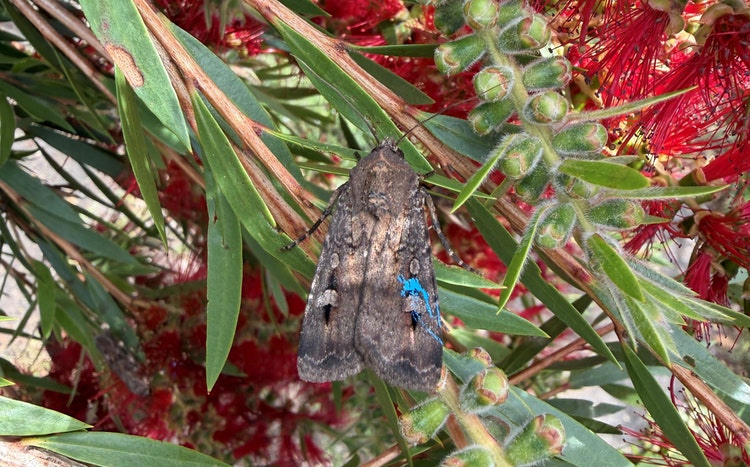
Western Sydney University and Invertebrates Australia are asking the public to look out for Bogong moths marked with small blue paint dots in the Blue Mountains, helping researchers track where the insects are migrating.
Following a major Bogong moth migration, billions of Bogongs are currently migrating hundreds to thousands of kilometres from their breeding grounds to the high alpine caves where they’ll spend the hottest part of the summer. Understanding the migration pathway of these insects is crucial to future conservation work protecting these flyways.
The Bogong moth is an endangered species and is of profound cultural, ecological and economic importance to Australians. Although iconic and famous for their epic migration to the Australian Alps, the Bogong moth’s distribution and flyways remain largely unknown, making it difficult to develop effective conservation actions.
To better understand where the moths are going, a research team led by Associate Professor Kate Umbers from Western Sydney University’s School of Science and Hawkesbury Institute for the Environment is adding small, non-toxic blue paint marks in the Blue Mountains. Researchers are now asking the public to look out for the marked moths and report where they are spotted.
The Blue Mountains was selected as a marking location as it’s likely to be towards the eastern edge of the migration, so may capture moths near the start of their journey west. Marking later in the year will focus on the alpine areas, so researchers can try to understand both the migration up into the mountains, and the return migration back to the breeding grounds.
“Seeing so many moths this migration is wonderful. Understanding exactly which routes they are taking is the first step to ensuring this migration can be conserved for future generations,” said Dr Eleanor Drinkwater, entomologist at Western Sydney University.
“So far, 500 moths have been marked with blue paint dots in the Blue Mountains, if you see a blue paint mark on a Bogong, we would love to know!” said Linnea Emneby, Head of Bogong Watch at Invertebrates Australia.
“Citizen science is key to mapping a migratory species like the Bogong moth. We need everyone looking out for marked moths to help us understand where they’re going,” said Associate Professor Kate Umbers.
If you see a moth with a blue paint mark, please don’t disturb it, but take a photo if you can and report your sighting at Bogong.org.
The sightings will contribute to the broader Bogong Watch project, helping researchers understand the moths’ migration patterns and breeding locations, which is essential to conservation efforts for Bogong moths and the species that depend on their arrival in the Alps.
ENDS.
6 October 2026
Ali Sardyga, Senior Media and PR Advisor