New study reveals how phosphorus changes the way eucalypt forests respond to rising CO₂
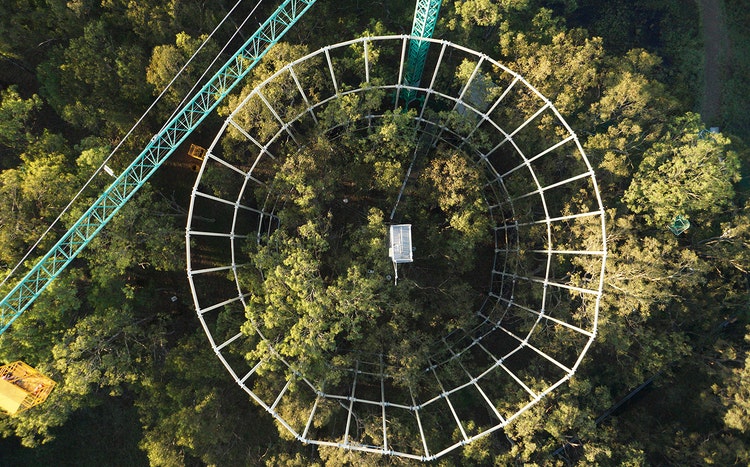
Photo credit: Craig McNamara
Western Sydney University researchers have led an international team in the first ecosystem-scale study to investigate how phosphorus availability affects the response of a mature eucalyptus woodland to elevated carbon dioxide (CO₂).
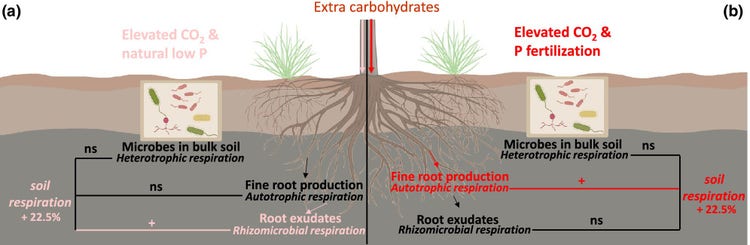
Published in New Phytologist, the research findings show that when phosphorus is added, trees still respond to rising CO₂ by directing a strong flow of carbon to the soil. However, instead of stimulating carbon release from roots, they invested the extra carbon into growing more fine roots.
The research was conducted at Western Sydney University’s Eucalyptus Free Air CO2 Enrichment (EucFACE) facility, Australia's largest climate change research experiment. The site features mature trees up to 25 metres in height, with elevated CO2 added through a computer-controlled open-air system.
Lead author Dr Min Zhao, who conducted the research as a PhD candidate at Western Sydney University's Hawkesbury Institute for the Environment, and is now a postdoctoral researcher at Zhejiang University, said the findings reveal that phosphorus availability changes how trees use the extra carbon gained under elevated CO₂.
“Rather than losing this carbon through soil microbial respiration, trees can redirect it towards fine root growth, reshaping their nutrient acquisition strategies and potentially supporting future growth,” said Dr Zhao.
Senior author Distinguished Professor Belinda Medlyn, also from the Hawkesbury Institute for the Environment, said the findings provide early insight into how nutrient availability is impacting forest carbon cycling under elevated CO₂.
“Understanding how the soil nutrient availability affects forests under elevated CO₂, is critical for managing forests to increase their capacity to store carbon. We know that limited phosphorus requires plants to invest additional fixed carbon belowground, which then returns to the atmosphere via soil respiration. Until now, however, the extent and pathways of this response have remained unclear,” said Distinguished Professor Medlyn.
“The effects on the ecosystem as a whole are still emerging, so we can’t yet say how phosphorus fertilisation will change total forest carbon storage, but we can see that there are significant shifts in what’s happening below ground.”
Within nine months of phosphorus addition, the researchers observed evidence that trees had shifted their strategy for getting phosphorus from soil under elevated CO₂.
As part of the study, the team quantified soil respiration before and after phosphorus fertilisation. Respiration is needed for all life, including life in the soil. Elevated CO₂ increased this respiration by 22.5 per cent regardless of phosphorus availability. However, the portion of respiration coming from fine roots was stimulated by elevated CO₂ after phosphorus addition, suggesting that this fertilisation triggered a change in how plants interact with soil micro-organisms and acquire phosphorus from soil.
As the first ecosystem-scale study on the interactive effects of elevated CO₂ and soil phosphorus, this research improves understanding of short-term belowground responses and provides insight for future studies of forest carbon cycling.
“Current projections of future climate change make the optimistic assumption that forest ecosystems will continue to soak up a large fraction of the CO2 we emit over the next few decades. Better understanding of plant-soil interactions under rising CO2 is urgently needed to evaluate whether the future will be even warmer than we currently think,” said Distinguished Professor Medlyn.
For more information, read ‘Phosphorus addition shifts elevated CO2 effects on soil respiration from rhizosphere to root pathways in a mature eucalypt woodland’ here.
ENDS.
4 August 2026
Media Unit