New research reveals hidden survival tactic in passerine birds
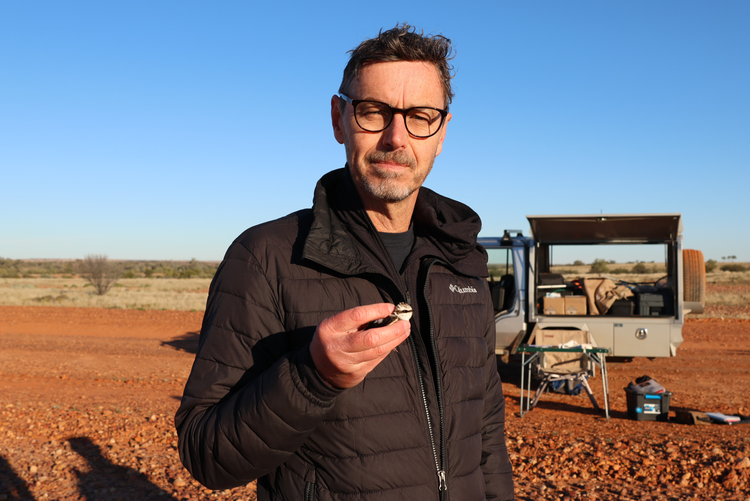
Senior author, Associate Professor Christopher Turbill, from the University’s School of Science, with a white-backed swallow
New research today reveals that the largest group of bird species can enter deep torpor – a power saving mode of reduced body temperature and metabolism – overturning a long-held understanding of their limits.
Passerine (perching) birds make up 60 per cent of all bird species, including some familiar Australian favourites, like the superb fairy-wren and willie wagtail. Until now, they were believed to only be capable of shallow reductions in body temperature, with deeper and longer torpor restricted to a few non-passerine bird groups, such as hummingbirds and nightjars.
Published in Current Biology, the Western Sydney University-led study measured the thermal physiology of free-living white-backed swallows over two Australian winters in the stunning but unforgiving arid environment of Sturt National Park, near Tibooburra, in central Australia.
During and after two major inland rain events, resulting in local flooding, the birds entered deep torpor and remained sheltered in burrows to ride out the extreme conditions.
The depth of torpor – reaching a skin temperature as low as 18.7°C – and extension of torpor beyond the nocturnal rest phase to a maximum of 17.5 hours, exceeded previously known capabilities.
Lead researcher and PhD Candidate Alice Barratt, from the University’s Hawkesbury Institute for the Environment, said the discovery of deep torpor in the most diverse bird order was important because it suggests that torpor is a more widespread and important adaptation for survival across the birds than previously recognised.
“This is an important adaptation for swallows, in particular, as it reduces their starvation risk when unusually cold conditions reduce the activity of their flying insect prey,” said Ms Barratt.
“We know that extreme weather events are hard on wildlife, and due to climate change, we are seeing these events more frequently, and often more severely, so it is important to understand the adaptions of animals that can help them survive these difficult environmental conditions.
“Recent advances in biologging, which involves attaching miniature electronic devices to animals, is allowing us to measure the physiology of even very small animals, like these swallows, while they are free-living in the wild. Unfortunately, wild animals are sometimes exposed to extreme conditions, but now we can start to understand how they respond to these natural challenges.”
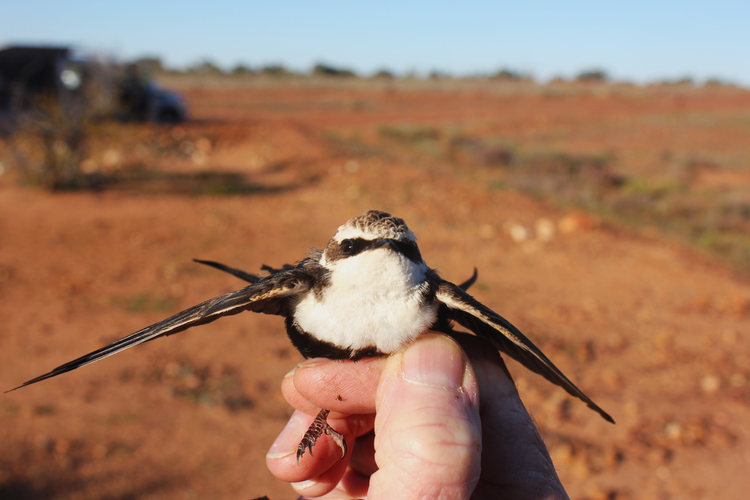
Senior author, Associate Professor Christopher Turbill, from the University’s School of Science, added that the findings highlight how much we still don’t know about the use of torpor by wild-living birds:
“This is a surprising discovery of resilience and another example of how biologging is providing a new wave of fundamental advancements in our knowledge of animal physiology.”
The findings have implications for understanding avian thermoregulatory strategies, the evolution of torpor, and how endothermic animals (birds and mammals) cope with extreme weather events.
Read the full paper, ‘Torpor in a passerine bird expands the scope of avian heterothermy’ here.
The team acknowledges and pays their respect to the traditional owners of the land where this field work took place, the Wongkumara, Wadigali, and Malyangapa peoples.
ENDS.
3 February 2026
Lauren Coskerie, Senior Media and PR Advisor