From the Himalayas to Hawkesbury: PhD researcher investigates changing fire regimes
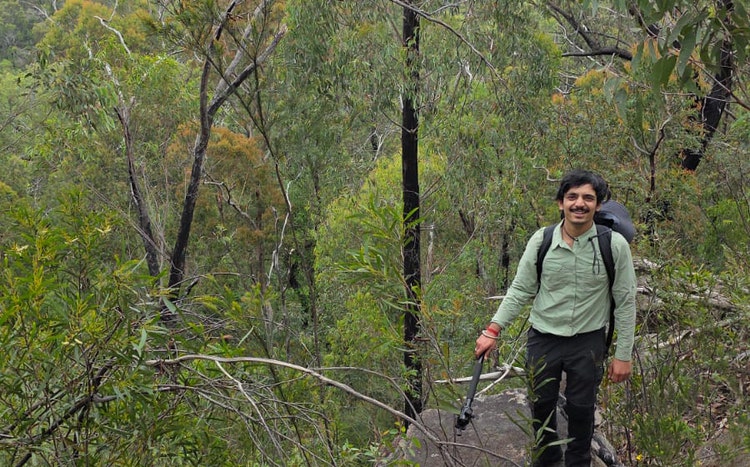
Vijay Kumar was born and brought up in a rural village in Himachal Pradesh in the Western Himalayas, India.
Since childhood he lived close to forest ecosystems, observing firsthand how forests and communities exist in harmony. But he has also witnessed how forests are affected by disturbances, including fires.
This early exposure sparked a lifelong passion for forests for the 26-year-old, which led him to pursue forestry as a field of study. During his academic journey, Vijay began to notice that fire patterns were not the same as what we observed during our childhood, they were changing.
“What we are seeing now is very different from what we observed during our childhood,” he said.
Now a PhD candidate at Western Sydney University’s Hawkesbury Institute for the Environment, Vijay is investigating how changes in fire regimes such as shifts in frequency, severity, and timing affect the resistance and resilience of forest ecosystems.
A dual PhD opportunity between India and Australia has provided a unique platform to build both local and global understanding of fire ecology. He is supervised by Rachael Nolan, Associate Professor in Fire and Plant Ecology, whose expertise in fire ecology supports his research.
“The dual PhD has allowed me to think beyond a single region and explore how different forests respond to similar disturbances.”
“Australia, with its advanced research in fire ecology, has always been my first preference for pursuing research in this field, particularly because of its strong focus on ecosystem resilience and fire dynamics.”
Recent events such as the 2019-20 Black Summer bushfires in Australia have highlighted the increasing severity of fire activity. Similarly, in the Himalayan region, climate-driven changes such as reduced snowfall, erratic monsoon patterns, rising temperatures, and dry winds, all contributing to more frequent and intense fires.
Vijay’s research focuses on understanding how changing fire regimes such as shifts in fire frequency, severity, and timing are affecting the resistance and resilience of forest ecosystems.
“Fire is not a new phenomenon. Historically, it has been a natural and recurring ecological process that has shaped forest structure, composition, and function for thousands of years.”
“Many forest ecosystems evolved under specific fire regimes and developed adaptations that allow them to either withstand fire (resistance) or recover after fire (resilience). However, with climate change, these historical fire regimes are being disrupted.”
“We are now seeing more frequent, larger, and more severe fires, which are pushing these ecosystems beyond their natural adaptive capacity. This is leading to increased tree mortality, poor regeneration, and long-term ecological changes.”
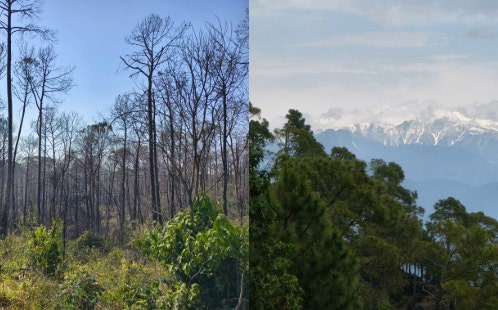
His research compares two contrasting yet fire-prone ecosystems: chir pine forests in the Western Himalayas and eucalypt forests in south-eastern Australia.
“While both are adapted to fire, they exhibit contrasting survival and recovery strategies. Chir pine forests rely primarily on fire resistance and seed-based regeneration, whereas eucalypt forests depend strongly on resprouting and reseeding mechanisms.”
By studying these ecosystems across different climatic and ecological contexts, Vijay aims to understand how changing fire regimes interact with plant traits to influence forest recovery.
This comparative approach is key to developing region-specific fire management and forest conservation strategies under a changing climate. Despite the geographical distance, Vijay has observed important similarities between forests in India and Australia.
“Both countries support a wide diversity of forest ecosystems from mangroves and rainforests to subtropical, arid, and even temperate or alpine systems. There is a long-standing relationship between people and forests in both regions.”
“Indigenous communities in Australia have historically managed landscapes using fire and lived in harmony with forests, and similarly in India, many tribal communities have closely depended on and sustainably interacted with forest ecosystems. More specifically related to my research, both chir pine forests in the Himalayas and eucalypt forests in Australia are fire-adapted ecosystems.”
“Fire has historically been a natural and recurring process in both systems, and species have evolved traits to cope with it. However, in both regions, changing fire regimes due to climate change are leading to increased fire frequency and severity, resulting in higher tree mortality and challenges in regeneration.”
However, he highlights that the differences are equally striking and scientifically important.
“The Himalayan mountains are geologically younger, and we see very sharp changes in vegetation with elevation-from subtropical forests to alpine meadows. In contrast, Australian landscapes are much older, and I have not observed such drastic elevational shifts in vegetation over short distances.”
“More directly related to my work, the key difference lies in post-fire recovery strategies. Eucalypt forests have a strong resprouting ability, which allows them to recover quickly even after high-severity fires. In contrast, chir pine forests rely more on seed-based regeneration, making their recovery slower and more dependent on favourable post-fire conditions.”
Vijay’s research is part of the New South Wales Bushfire and Natural Hazards Research Centre based at Western Sydney University, where he collaborates with a network of researchers and practitioners working on bushfire and natural hazard challenges.
ENDS.
2 April 2026
Media Unit