Chancellor's Address: ANZAC Day Service at Hawkesbury campus
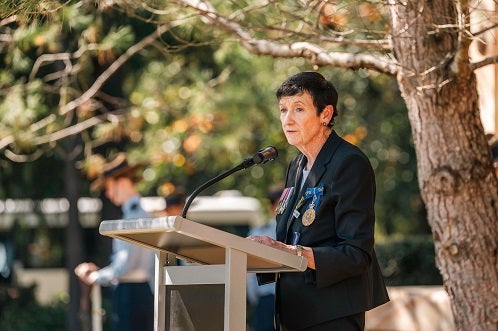
The following address was delivered by Western Sydney University Chancellor, Professor Jennifer Westacott AC at the Hawkesbury campus ANZAC Day Service on Saturday, 25 April 2026 (please check against delivery).
Good morning and thank you for joining us.
I too would like to acknowledge the traditional custodians of the land we meet on today. The people of the Darug Nation.
I pay my respects to Elders past and present, and I extend that respect to all Aboriginal and Torres Strait Islander people who are here today.
As Chancellor of Western Sydney University, it is both an honour and a privilege to participate in this morning’s ANZAC Day Service – and to join you on our beautiful and historic Hawkesbury Campus.
On ANZAC Day, we come together to honour and remember all:
- those who have served
- those who continue to serve, and
- the families and communities who support them.
We reflect on their collective sacrifices and what their service continues to mean to our nation, our university and to us personally.
ANZAC Day reminds us of our nation’s unwavering commitment to fight against tyranny and to protect freedom and liberty.
Gallipoli and other theatres of war in World War One were a defining moment for our country. The world could see our national character of courage and camaraderie. What we now call mateship.
ANZAC Day is incredibly important to this campus and the Hawkesbury Agricultural College as it was then known.
It is etched into our collective being.
You only have to look around at:
- the Memorial Hall
- the Memorial Library
- the War Memorial - where we now stand now - and
- the Honour Rolls in the Memorial Library.
In World War One more than 750 of our students and staff enlisted.
135 of them never returned
That’s more than 1 in 5 people lost forever from this community.
46 students who fought in the Great War then enlisted again to fight in World War Two.
Our students and staff fought across all theatres of war including:
- Gallipoli
- the Western Front, and
- the Middle East.
They served across multiple divisions including
- The veterinary corps
- The air corps
- The navy and
- The camel corps
Whole classes including lecturers enlisted together.
One group of 51 enlisted together just 2 weeks after the start of World War One.
The majority came from rural backgrounds.
Today across hundreds of regional communities people will lay wreaths to honour their fallen.
Many were naturally accomplished horsemen, making up a large contingent of the 1st Light Horse regiment and 1st light Horse ambulance brigade.
Their contributions were immense, and they suffered significant losses.
At the University’s 100th anniversary dinner held more than a decade ago, in Memorial Hall – vacant seats were placed at the tables, representing those souls who never returned.
To this day, we are forever grateful.
We will always remember them.
Today is also personal for many of us here. I am wearing the medals of my late uncle, John Kethel Hardman. A man of:
- Humility and humour
- Courage and compassion
- The man who taught me to fish
Uncle spent much of World War Two as a POW on the Thai Burma Railway and in the notorious Changi Prison.
He witnessed and endured unspeakable cruelty. He rarely talked about the trauma he suffered but when he did, it reminds us that war is personal and it is devastating.
Today as we witness the shocking events unfolding around us, we reflect on the cruelty, the suffering and the loss of innocent lives in war.
Uncle told me to go to university because it would change my life.
I did and it did.
Today I stand before you as the Chancellor of a leading university.
In a country that treasures democracy, the rule of law, respect and tolerance and caring for others.
Today we are able to uphold these values because of the sacrifice of others. That sacrifice must not be in vain.
We are forever a grateful nation.
Lest we forget.
ENDS.
30 April 2026
Media Unit
Photo credit: Kyisoe Han