Bogong moths are on the move, navigating by the Milky Way – and you can help
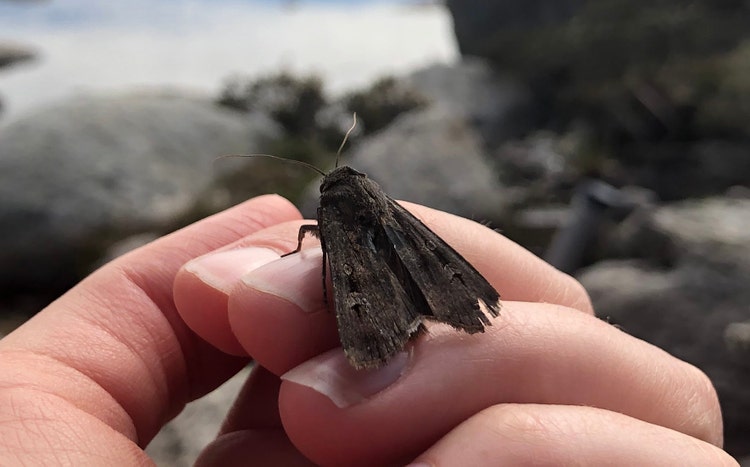
Photo credit: Kate Umbers, Bogong at Charlotte Pass Snowy River
Dr Eleanor Drinkwater of Western Sydney University’s School of Science says Bogong moths have begun their annual migration to the Australian Alps, travelling hundreds of kilometres to high alpine caves for summer.
The remarkable insects use the Milky Way and the Earth’s magnetic field to help guide their journey over hundreds of kilometres as they move from their lowland breeding areas to high alpine caves where they provide an important food source for the endangered mountain pygmy possums.
“Bogong moths are making their way across the country, travelling hundreds of kilometres to get up to the high alpine caves, where they’re going to spend the hottest parts of the summer,” said Dr Drinkwater.
“Even on the coast, some of these insects we believe are travelling enormous distances to get all the way up into the mountains. So, if you see one of these wonderful animals in your garden, you know they're on an amazing journey at the moment.”
Dr Drinkwater highlighted research by Professor Eric Warrant, which found that Bogong moths use the Milky Way to help guide themselves.
“This is extraordinary because these insects will only make this journey to and from the mountains once, so it's not like they can learn how to do this. It’s all built into these wonderful insects’ brains already. They use the stars, and the earth’s magnetic field to make a journey to and from the mountains that each individual will only perform once in its lifetime. It’s incredibly complex navigation that they’re using to travel these huge distances.”
The annual migration also provides an important food source for mountain pygmy possums in the mountains.
“We know that the possums eat these, particularly the females eat them when they're pregnant. So hopefully there'll be a lot of fat little baby possums as well with so many moths getting up there. It's definitely a great year for the mountain pygmy possums for sure.”
But the moths face challenges along their journey, including potential impacts from light pollution. Dr Drinkwater said the full impact of light pollution on Bogong moths was not yet known.
“We know we’ve seen lots of pictures of them getting caught in people’s houses and things like that. They’ve been doing this migration for thousands of years, and suddenly we’ve built cities on their migration routes, but don’t worry they’ll move through soon and are completely harmless to people.”
Dr Drinkwater is also involved in the Bogong moth tagging research, with another Bogong Watch ‘tag-a-thon’ planned for February.
“We're planning to have another tag-a-thon probably sometime in February. So some of the individuals doing the migration this way, we're hoping to see them up in the mountains and hopefully tag them in February to look at them as they travel back to their original home grounds as well.”
The research team will be looking for more people who want to get involved in looking for tagged Bogongs next year, if you are interested please go along to https://www.bogong.org/ to find out more.
As well as tagging, the research team is also asking the public to help identify which plants Bogong moths feed on during their migration.
“One of the things that we’re really keen on at the moment is working out how we can make our gardens better for Bogong moths as they move through the landscape.”
“We don’t currently know what they’re enjoying feeding on, so if you are in your garden and you see a Bogong moth feeding on something, please take a photo of it feeding on the plant that it’s feeding off and put it on iNaturalist.”
“We would love it if you have the chance to take a photo of these guys, particularly on plants. That will help us get an idea about what kind of things they’re using on their migration. And then, in turn, we can use that to give people advice if they want to make a more Bogong-friendly garden, what kind to plant.”
And if you think you’ve spotted a Bogong moth, Dr Drinkwater says there are some features to look out for.
“Some of the pictures I’ve been sent are actually of granny’s cloak moths, because these kind of guys seem to have popped up at about the same time.”
“The key thing to look for is a stripe down the wing, so they have a very specific dark stripe, a round blob at the top and something that looks like a bean at the bottom.”
ENDS.
29 September 2026
Media Unit