Why student success means meeting students at the coalface…and on social media
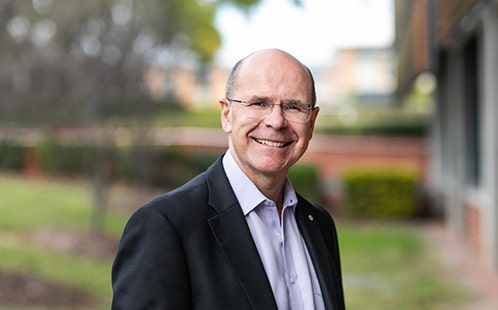
Western Sydney University Vice-Chancellor, Distinguished Professor George Williams AO, has shared his thoughts on the importance of listening to students and championing them for success – including engaging with them on social media.
In the latest episode of the HEDx podcast series(opens in a new window), Professor Williams joined host Martin Betts along with fellow higher education leaders Dr Tim Renick from Georgia State University and Veronica Pritchard from the University of Queensland to share their insights and perspectives on best practice for student support and student success.
The panel discussion was part of the ‘Higher Education in the Age of AI’ HEDx conference held recently in Melbourne.
Professor Williams spoke with his fellow panellists about how the university sector too often makes study too hard for students in the way it structures the student experience – putting bureaucratic and process barriers in the way to study, particularly for students who are first in family or from low SES backgrounds.
He also reflected on the external societal pressures that also have a profound impact on students being able to continue with their studies, including issues such as the cost of living.
He said at Western Sydney University for example, one in two students have reported experiencing food insecurity.
“So it’s often as basic as I need the food to continue to study,” said Professor Williams, who added these issues impacting student retention also impact the wider community.
“Those are the students who ultimately build social cohesion, who build a sense of community and moving forward [as a country] in the powerful, important ways we want to do.”
Professor Williams and fellow panellists discussed the types of student-centric decisions that put students first.
“I think the challenge for me as a university leader is what does it actually mean to have a university that makes decisions with the students at the heart of it,” said Professor Williams.
“As a sector we often talk about student-centric universities, but what does it actually mean? For me, that’s basic things, like timetabling – actually having a timetabling system where you are serving student needs.
“For us it’s a data driven approach but it’s also the qualitative as well – it’s about engagement with students. Part of that is using social media. That’s where we need to reach our students. We can’t assume students will come to us – they don’t.”
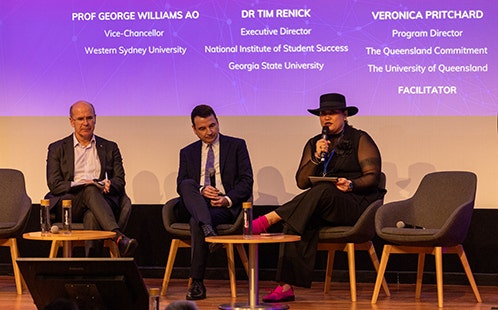
The Vice-Chancellor spoke of participating in recent Tik Tok live sessions, where over 1,000 students jumped online for half an hour to ask some 200 questions.
Professor Williams said social media is a powerful tool, given the current generation of students are often willing to open up on social media, but are perhaps more reluctant to open up when face-to-face. He said this type of engagement shows that the University cares about its students.
“Social media is an opportunity to answer their queries on mass, and help. And it’s working. As I walk around campus I often have students coming up and saying hello and asking questions, because they are seeing the Tik Tok engagement,” he said.
“Connection, purpose, belonging – for us, you’ve got to be where the students are. As leaders and as a community we’ve got to get out of our comfort zone, and go to students, and listen with humility, and then on the basis of that, we act.”
Professor Williams said among the most impactful things he’s done since taking on the Vice-Chancellor role has also been spending time in the University’s student services hub and volunteering at the University’s food pantry where he listened and engaged directly with students and staff and heard their powerful stories.
He said the opportunity to spend time at the coalface is invaluable for University leaders and gives them insights to help address issues and make improvements. He plans to teach in the classroom later in the year to see the classroom experience first-hand, as well as navigate some of the systems that go along with that for students and staff.
Discussing the current challenges facing the sector, including international student caps, Professor Williams expressed concern for the impact the decision is having on international students’ mental health and wellbeing.
He said the focus for universities continues to be striving to improve student outcomes, including utilising AI tools to improve efficiencies and free up staff to focus on the human work they do best – supporting students.
“Success I measure in pretty simple ways. Our bottom line isn’t dollars, it’s graduation. Success is going to graduation, watching the happy, amazed students going up to receive their degree. Two thirds of our students are first in family at our university – that’s success. The more of that, the better.
“We talk about AI-first universities, but for us that’s completely wrong. It’s about student-first universities – what are the tools that we’re going to use to actually improve the [student] experience, the research and community outcomes.
“I am so fortunate, I’ve never worked in an organisation with such passion and commitment to students and community as I have as Western Sydney University. It’s our secret power – so for me, my job is to help harness it and help people on the journey they are already on. AI is a great tool for that, but it’s just a tool. Staying true to our mission is how we get things done.”
You can watch the full discussion below or listen wherever you get your podcasts.
ENDS
2 May 2025
Latest News
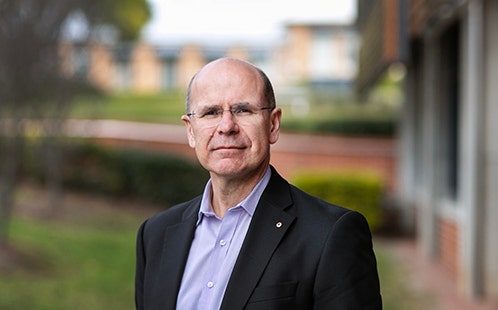
ABC RN transcript: Vice-Chancellor Professor George Williams discusses higher education sector, student support, and the impact of AI
The following is a transcript of an interview that aired on ABC Radio National Saturday Extra between presenter, Nick Bryant and Vice-Chancellor, Distinguished Professor George Williams AO.
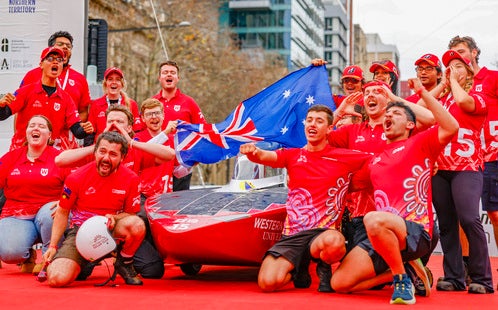
Western Sydney University are the number one Australian solar car team at the 2025 Bridgestone World Solar Challenge
Western Sydney Solar Car team has crossed the finish line placing preliminarily sixth in the world overall, and the number one Australian team in the world’s most prestigious solar car challenge.
Western Sydney University Statement on Cyber Incidents
Western Sydney University has issued an update to its community following confirmation that previously stolen personal information was published online, including on the dark web.