Western awarded $5.9 million to restore native ground cover and combat future drought
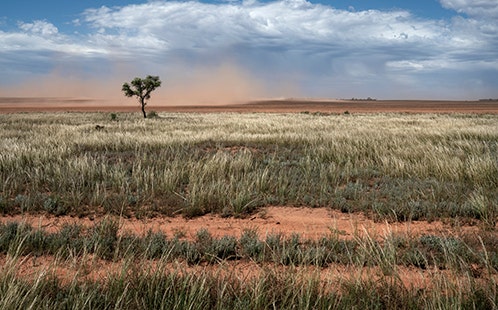
Western Sydney University has secured more than $5.9 million through the Department of Agriculture, Fisheries and Forestry’s Future Drought Fund for the project Seeding diverse native ground cover on farms for drought and climate resilience.
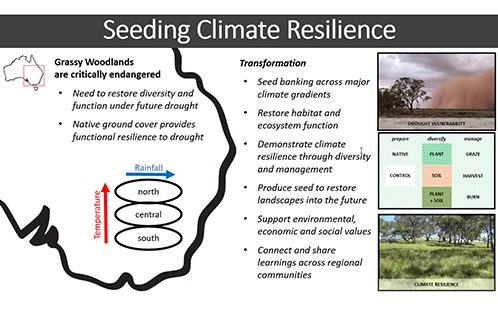
Across NSW land-use change and degradation of open grassy woodlands is leading to ecosystem collapse and drought vulnerability in regional communities. To combat this, the research team led by Associate Professor Paul Rymer from Western’s Hawkesbury Institute for the Environment (HIE) will create resources to deliver diverse, climate-ready seed for revegetation; drought-tolerant ground cover; nature positive biodiversity and soil carbon enhancement; and landscape connections that support ecological, social and cultural values.
“Grassy woodlands across NSW are at a tipping point,” said Associate Professor Paul Rymer. “With this funding, we can build capacity to restore these critical ecosystems and equip farming communities with the tools and knowledge they need to thrive in a changing climate.”
Pro Vice-Chancellor (Research), Professor Ian Anderson congratulated the multi-disciplinary team from Western’s HIE and Centre for Western Sydney – including Professors Sally Power, Uffe Nielsen, and Neil Perry, and Dr Eleonora Egidi.
“This funding success speaks to Western’s commitment to transformative research – research that starts with our communities and generates real outcomes,” said Professor Anderson.
“Paul and his team are the reason Western is a world leader in sustainable development.”
This project brings significant co-investment from university, government, Landcare and Aboriginal organisations from across NSW. The 16-strong team (including Charles Sturt University; University of New England; the NSW Department of Climate Change, Energy, the Environment and Water; NSW Local Land Services; several Landcare and First Nations organisations; and regional farmers) will establish a whole-of-system approach in three regional (southern, central and northern) nodes delivering enduring outcomes designed to transform the capacity for regional communities to cope with future droughts.
This project supports the Future Drought Fund Resilient Landscapes Program objectives to achieve and measure transformational change and impact at landscape scale, identify tipping points or thresholds, and demonstrate approaches that improve management of natural capital and enable farmers to have the capacity to respond to future drought.
ENDS
17 June 2025
Latest News
ABC RN transcript: Vice-Chancellor Professor George Williams discusses higher education sector, student support, and the impact of AI
The following is a transcript of an interview that aired on ABC Radio National Saturday Extra between presenter, Nick Bryant and Vice-Chancellor, Distinguished Professor George Williams AO.

Western Sydney University are the number one Australian solar car team at the 2025 Bridgestone World Solar Challenge
Western Sydney Solar Car team has crossed the finish line placing preliminarily sixth in the world overall, and the number one Australian team in the world’s most prestigious solar car challenge.

Western Sydney University Statement on Cyber Incidents
Western Sydney University has issued an update to its community following confirmation that previously stolen personal information was published online, including on the dark web.