Trees in Australia’s forests are dying faster as the climate warms
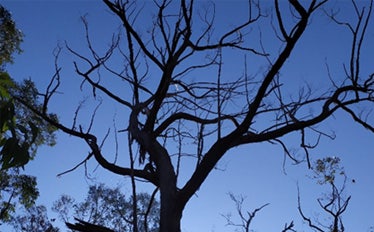
A major new study led by Western Sydney University has revealed that forests across Australia are losing trees at accelerating rates, marking a continent-wide shift in vegetation dynamics in response to a rapidly warming climate.
Published today in Nature Plants, the study draws on 83 years of records from more than 2,700 forest plots around Australia. It provides the first comprehensive, continent-wide synthesis of background tree mortality – tree loss not caused by fire, clearing or logging – across Australia’s diverse forest ecosystems, including tropical rainforests, savannas, and temperate eucalypt forests.
The research shows a persistent increase in background mortality since the 1940s. The pattern is strikingly consistent across forest types. Over the same period, tree growth has remained the same or slowed, indicating that the increase in mortality is not part of a natural cycle of renewal but evidence of an emerging imbalance between tree growth and tree loss.
The decades-long rise in tree mortality closely tracks Australia’s warming and drying climate. Rising temperatures are the dominant driver of change. Tree mortality has increased most rapidly in hot, dry regions and in dense forests where competition for water and light exacerbates stress.
Senior author Distinguished Professor Belinda Medlyn from the University’s Hawkesbury Institute for the Environment, said the increasing tree mortality rates point to growing stress in Australia’s forests.
“Australians rely on their forests for a wide range of ecosystem services, from cultural values and recreation to timber for houses. Increasing tree mortality in our unique forests will affect all of these. A particular worry is that the forests’ ability to store carbon will decline. This has significant implications for Australia’s net carbon balance,” said Distinguished Professor Medlyn.
“Forests worldwide absorb about one-third of human carbon dioxide emissions. If mortality continues to rise while growth stagnates, that buffering capacity will erode. Recent evidence from northern Australia’s tropical rainforests shows this process already unfolding, with the rainforests shifting from being net absorbers of carbon to net producers of carbon. This will weaken the planet’s ability to absorb emissions and amplify existing climate feedbacks, further narrowing the window for stabilising the global climate.”
Together, these findings indicate a fundamental shift in vegetation dynamics, with rising mortality and stagnant growth signalling a decline in the resilience of Australian forests.
There are many opportunities to adapt forest management to help safeguard forest health. However, understanding how forests respond to these management approaches requires a commitment to long-term monitoring of forest function. Over the past quarter century, the number of forest plots being monitored has fallen sharply, undermining our capacity to detect and respond to these accelerating changes.
“Our results highlight the critical need for ongoing forest monitoring that is designed to detect long-term trends, in order to guide effective forest management for the future,” added Distinguished Professor Medlyn.
For more information, read Pervasive increase in tree mortality across the Australian continent, here.
ENDS
7 January 2026
Ali Sardyga, Senior Media and PR Advisor
Latest News

ABC RN transcript: Vice-Chancellor Professor George Williams discusses higher education sector, student support, and the impact of AI
The following is a transcript of an interview that aired on ABC Radio National Saturday Extra between presenter, Nick Bryant and Vice-Chancellor, Distinguished Professor George Williams AO.

Western Sydney University are the number one Australian solar car team at the 2025 Bridgestone World Solar Challenge
Western Sydney Solar Car team has crossed the finish line placing preliminarily sixth in the world overall, and the number one Australian team in the world’s most prestigious solar car challenge.

Western Sydney University Statement on Cyber Incidents
Western Sydney University has issued an update to its community following confirmation that previously stolen personal information was published online, including on the dark web.