Leading forensic expert guides students through real-world research at Australia’s only ‘Body Farm’

Dr Hayley Green with Master of Research candidate Natasha Robinson
Dr Hayley Green from Western Sydney University’s School of Science is leading groundbreaking forensic research that’s changing how investigators understand human decomposition in Australian conditions.
Dr Green is one of the researchers working at AFTER (Australian Facility for Taphonomic Experimental Research) – commonly referred to as the “body farm" – a one-of-a-kind research facility in the Southern Hemisphere located near Western’s Hawkesbury campus. The facility is dedicated to studying how environmental factors influence human remains from the time of death to their discovery.
“It's incredibly rewarding to be working on projects with real-world impact,” said Dr Green. “AFTER is a research facility dedicated to advancing our understanding of influences on human remains between death and discovery. Our research team’s most recent investigations have focused on temporal changes in the soil microbiome in response to decomposing bodies on the soil surface.”
A collaboration between the University of Technology Sydney – who manage the facility – and Western Sydney University, AFTER provides expert knowledge to support death investigations, including missing persons, time since death estimations, homicides and mass disasters.
Dr Green’s work is helping build knowledge of how bodies decompose in Australian climates, previously only studied in detail in the US. Her findings will help inform methods of estimating the time since death in Australia to assist local law enforcement.
Her research also explores the ability to determine human from non-human skeletal remains, an important capability for remains found in bushland scenarios or mass disaster such as bushfires. She is also studying how freezing impacts the decomposition process and postmortem interval estimation methods, which is important in cases where people go missing in extreme cold environments and/or homicide cases involving frozen remains.
Dr Green is currently collaborating with School of Science soil expert Dr Jason Reynolds and microbiology expert Dr Tom Jeffries, experts in her School to examine the interaction between the environment (soil) and bone during decomposition to address the limitations we found in postmortem interval methods in previous research projects.
In addition to her research, Dr Green supervises a number of Higher Degree Research (HDR) students at Western Sydney University who are contributing to the field using data collected from AFTER.
One of these students is Natasha Robinson, a Master of Research candidate at the Hawkesbury campus. With a background in forensic science, Natasha was inspired to pursue postgraduate study after attending a guest lecture by Dr Green during her undergraduate degree.
“I’ve been interested in forensic science for many years. In the second year of my undergraduate degree, I attended a lecture by Dr Green that sparked my interest in forensic anthropology. I reached out to her about supervising my postgraduate research, and she agreed – which led me to study at Western Sydney University,” said Natasha.
Natasha’s research area focuses on aspects of forensic taphonomy and anthropology. The 24-year-old's project investigates the effect of soil type and burial depth.
“There are many unanswered questions in forensic taphonomy which involves observing the decomposition of human remains. My project is examining the effect of soil type and burial depth as a model for human decomposition, using a combination of microbiological and chemical analytical techniques.”
Natasha has benefited greatly from her experience at Western, including support from university scholarships and access to world-class facilities.
“I have received a lot of support from the University and have benefited from the aid of scholarships. As a postgraduate student, I have had the chance to visit the incredible AFTER facility, which provided a rare opportunity to observe the many existing experiments running there. I have also had the opportunity to work with the Advanced Materials Characterisation Facility (AMCF) at the Parramatta South campus where I have been trained on and used several of their instruments for sample analysis.”
“Last year, we were able to have several samples analysed by the Australian Nuclear Science and Technology Organisation (ANSTO) at Lucas Heights, and I was able to visit their facilities and see some of their exceptional equipment.”
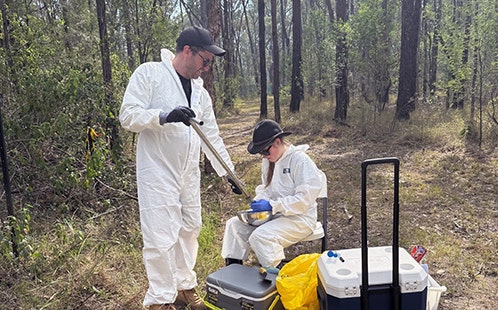
Natasha Robinson with Dr Jason Reynolds
ENDS
3 July 2025
World Class Facilities
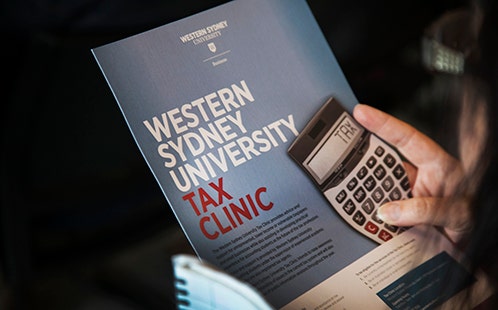
Western Sydney University’s Tax Clinic: Real-world experience for future accountants
Accounting students at Western Sydney University are gaining hands-on experience while making a difference in the community through the university’s Tax Clinic, which offers free support to vulnerable taxpayers and small businesses.

World-class facilities helping Western Sydney University students succeed
From high-tech nursing and midwifery labs to simulated courtrooms, a dedicated Tax Clinic, and cutting-edge research facilities, Western Sydney University offers students access to world-class spaces that bring learning to life.
Leading forensic expert guides students through real-world research at Australia’s only ‘Body Farm’
Dr Hayley Green from Western Sydney University’s School of Science is leading groundbreaking forensic research that’s changing how investigators understand human decomposition in Australian conditions.
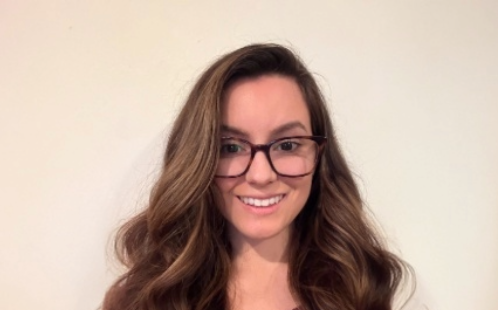
Law students excel on global mooting stage safeguarding children’s rights
Western Sydney University’s School of Law continues to shape the next generation of legal professionals by providing students with practical, hands-on experience in advocacy and legal reasoning.
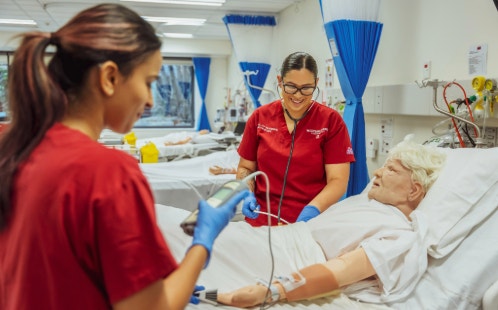
State-of-the-art nursing and midwifery facilities enhancing job readiness
Western Sydney University’s School of Nursing and Midwifery is setting students up for success with state-of-the-art facilities to enhance learning and job readiness.