Expert calls for participation in Climate Action Week Sydney, ‘nearly all predictions that professional climate scientists made for the past 25 years have come true’
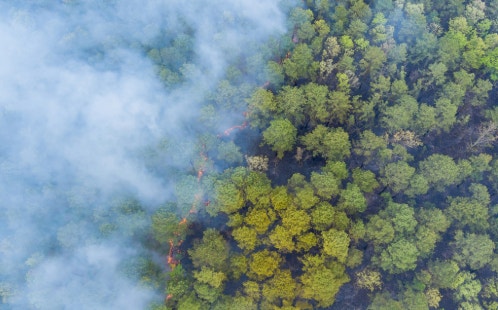
This Climate Action Week Sydney (CAWS) from 10-16 March, Western Sydney University expert Professor Sebastian Pfautsch, from the School of Social Sciences and Urban Transformations Research Centre, reflects on the state of the worlds climate.
“Nearly all predictions that professional climate scientists made for the past 25 years have come true. We have now squarely arrived in the age of the Anthropocene – the first age for at least a million years where humans, not the natural oscillation of glacial and inter-glacial, determine what does and does not live on this planet,” said Professor Pfautsch.
“This is a good time to reflect if and what kind of action is really needed to change the direction this planet is heading. What we need are transformative solutions that work at scale - big change - not more KeepCups.
“CAWS is a series of community-led events showcasing all aspects of the climate action ecosystem and gives us an opportunity to change the tone of the discussion around our climate. We can learn more about the positive developments and steps in the right direction, whether it be regenerative cities, intersections of traditional knowledge and climate change science, or sustainable futures.
“From solutions on how to downsize without experiencing social isolation, emission free, affordable and reliable public transport, growing coral reefs in acidifying oceans, tourism, transport, your own consumerism, everything is on the table.
“It promises to be another tumultuous year for the planet, its people and life support systems, but with events like Climate Action Week Sydney we can dose up on knowledge and solutions.”
Read Professor Pfautsch’s latest study, that paints a picture of summers to come in Western Sydney, ‘Spatiotemporal variation of intra-urban heat and heatwaves across Greater Sydney, Australia’ (opens in a new window).
Other recent studies include thermal safety of outdoor playgrounds (opens in a new window), residents’ perceptions of urban street trees (opens in a new window), and mapping summer microclimates in the City of Sydney (opens in a new window).
Professor Pfautsch is a Professor of Urban Planning and Management in the School of Social Sciences and co-lead in People-centred Sustainable Precinct Design at the Urban Transformations Research Centre. In his interdisciplinary research he collaborates with colleagues at the Hawkesbury Institute for the Environment, School of Computer, Data and Mathematical Sciences, School of Education, Institute for Culture and Society, and others.
He is the Director of SIMPaCT, a large-scale research project that will result in AI-operated park irrigation systems for optimal cooling during hot summers. He sits on the panel of Greening our City, works as independent advisor for the NSW Chief Scientist and Engineer and co-developed the first Handbook for Urban Green Infrastructure (UGI) for Standards Australia.
ENDS
13 March 2025
Lauren Coskerie, Senior Media Officer
Photo credit: Adobe Stock
Latest News
ABC RN transcript: Vice-Chancellor Professor George Williams discusses higher education sector, student support, and the impact of AI
The following is a transcript of an interview that aired on ABC Radio National Saturday Extra between presenter, Nick Bryant and Vice-Chancellor, Distinguished Professor George Williams AO.

Western Sydney University are the number one Australian solar car team at the 2025 Bridgestone World Solar Challenge
Western Sydney Solar Car team has crossed the finish line placing preliminarily sixth in the world overall, and the number one Australian team in the world’s most prestigious solar car challenge.

Western Sydney University Statement on Cyber Incidents
Western Sydney University has issued an update to its community following confirmation that previously stolen personal information was published online, including on the dark web.