New research reveals 97 per cent of adult Australians have poor or limited ability to verify information online
A new report, jointly released today by the University of Canberra (UC), Western Sydney University, QUT and RMIT University, reveals that 97 per cent of adult Australians have poor or limited ability to verify information online.
The report (opens in a new window) also found that more than three-quarters (78 per cent) of research participants reported encountering misinformation during a one-week diary study. Of those who did see misinformation, they encountered on average 7.5 examples of misinformation per week.
Lead author Professor Sora Park, from UC’s News and Media Research Centre, said the findings reveal a concerning situation – Australians are encountering large volumes of misinformation every week, but few have the skills to fact-check what they’re seeing.
“The sheer volume of information online and the speed at which new information travels can be overwhelming and very difficult to navigate,” Professor Park said.
In the study, participants were presented with a four-part test of their ability to verify the information in four pieces of media: two social media posts and two website pages.
“Of our research participants, 45 per cent showed no ability at all to identify misinformation, and 52 per cent had emerging ability. Only 3 per cent of those studied could be classed as having a more developed ability,” Professor Park said.
“Even among those who felt confident that they could check if information they found online is true, a large proportion got all the answers wrong across all four tasks.”
Education was an important factor related to the respondents’ ability to verify information online, as was news and information consumption habits.
Those with a high level of education – a bachelor’s degree and above – were more likely to score higher than those with medium or low education attainment levels.
“Heavy news consumers are more likely to have the ability to verify information: only 36 per cent of heavy news consumers showed no ability to verify information, compared to 59 per cent of those who are non-news consumers,” Professor Park said.
Importantly, the study found that the ability to verify information is low across all age groups.
The findings also reveal common strategies employed by the participants that prevented them from making informed judgements about dubious information.
These include making decisions about the veracity of the content based on existing beliefs, rather than scrutinising claims made in the post, and making snap judgements based on past experiences with content producers or actors featured in the post.
The report is part of a national project, Addressing Misinformation Using Media Literacy with Public Cultural Institutions led by Associate Professor Tanya Notley from Western Sydney University, to determine current media literacy capability in Australia and inform the development of evidence-based education campaigns and interventions.
Unlike many advanced democracies, Australia does not have a national media literacy policy or strategy.
“Accessing reliable and trustworthy information enables citizens’ everyday decision-making about everything from voting, to making purchases, to staying safe online, to accessing health advice and services,” Associate Professor Notley said.
“There is strong appetite for this skillset, 93 per cent of study participants believe people need to be taught how to identify misinformation and eight in ten (82 per cent) Australians agree that adults need access to media literacy education.”
The researchers will now work alongside project partners: ABC Education, National Film and Sound Archive of Australia (NFSA), Australian Library and Information Association (ALIA) and Museum of Australian Democracy at Old Parliament House (MoAD) to develop evidence-informed initiatives to address the challenges and needs highlighted by this research.
For more information, read and download the report here (opens in a new window).
ENDS
3 December 2024
Latest News
ABC RN transcript: Vice-Chancellor Professor George Williams discusses higher education sector, student support, and the impact of AI
The following is a transcript of an interview that aired on ABC Radio National Saturday Extra between presenter, Nick Bryant and Vice-Chancellor, Distinguished Professor George Williams AO.
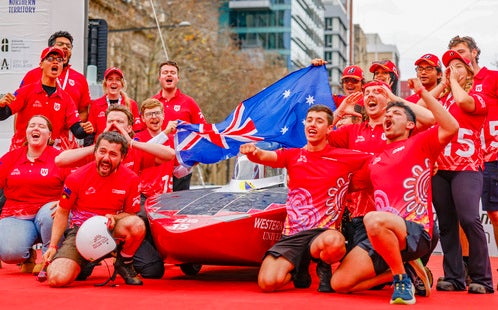
Western Sydney University are the number one Australian solar car team at the 2025 Bridgestone World Solar Challenge
Western Sydney Solar Car team has crossed the finish line placing preliminarily sixth in the world overall, and the number one Australian team in the world’s most prestigious solar car challenge.
Western Sydney University Statement on Cyber Incidents
Western Sydney University has issued an update to its community following confirmation that previously stolen personal information was published online, including on the dark web.