High-tech spy gear to uncover the secrets of Bumble bees in Tasmania
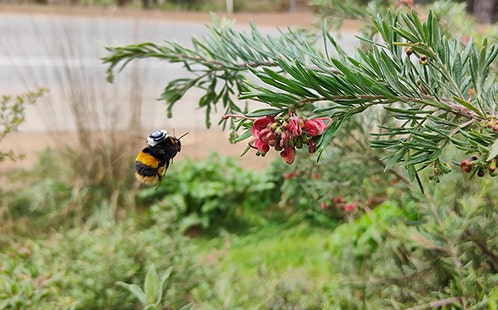
Bumble bees in Tasmania are being geared up with micro radio transmitters and cameras to help scientists uncover their environmental impact and crucial role in crop pollination.
Delivered through Hort Innovation’s Frontiers investment program (opens in a new window) and led by Western Sydney University, the $3.3M initiative will produce a comprehensive large-scale study of the Buff-tailed Bumble bee.
The program will use various cutting-edge technological solutions to efficiently generate a large volume of unique and rigorously collected data.
Hort Innovation chief executive officer Brett Fifield said this investment forms part of a multi-pronged approach to ensure the horticulture sector is prepared for the future.
“This investment is a prime example of using breakthrough research to strengthen industry’s readiness for existing and emerging opportunities and threats,” Mr Fifield said.
“With the arrival of Varroa mite to the Australian mainland, there is a sense of urgency for industry to explore other potential options for safeguarding crop pollination services across the country. This research will expand our knowledge of Bumble bees in Tasmania, giving growers another tool in their toolkit.”
Western Sydney University postdoctoral researcher Dr James Makinson, from the Hawkesbury Institute for the Environment, said incorporating state-of-the-art technology will result in significantly more comprehensive insights than previously possible.
“Radio transmitters will allow us to discover the daily foraging habits of Bumble bee queens in different agricultural and natural landscapes and allow us to follow bees back to their nests. Transmitters can be easily recovered, allowing us to track dozens of individuals across multiple field sites in a single season,” Dr Makinson said.
“The automated real-time analysis of video footage from our audiovisual monitors will allow us to collect long-term continuous data of the foraging activity of wild Bumble bee and managed Honey bee colonies, saving 100s of hours of fieldwork and data analysis.”
“Monitoring cameras can be placed in the field and left alone, allowing a single researcher to monitor multiple locations of interest, passively collecting data for multiple experiments.”
Fruit Growers Tasmania chief executive officer Peter Cornish said the insights will help the Tasmanian horticulture industry plan effectively for the future.
“This research will answer important questions about Bumble bees as pollinators. What are Bumble bees doing in Tasmanian ecosystems? How are they interacting with different commercially-important crops? Can their populations be naturally manipulated to achieve conservation or pollination service goals?” Mr Cornish said.
“The findings will inform future decision-making for our industry on how to best balance the risks and opportunities posed by Bumble bee pollination services in Tasmania.”
Tasmanian tomato grower Anthony Brandsema said local growers welcome the start of this research.
“The insights generated by this research will be invaluable to growers across Tasmania looking to boost pollination on their farms,” Mr Brandsema said.
This program is funded through Hort Innovation's Frontiers investment program, with co-investment from Western Sydney University, the Rubus R&D levy and contributions from the Australian Government. Collaborating partners include the University of Tasmania and James Cook University.
ENDS
18 September 2024
Latest News


ABC RN transcript: Vice-Chancellor Professor George Williams discusses higher education sector, student support, and the impact of AI
The following is a transcript of an interview that aired on ABC Radio National Saturday Extra between presenter, Nick Bryant and Vice-Chancellor, Distinguished Professor George Williams AO.
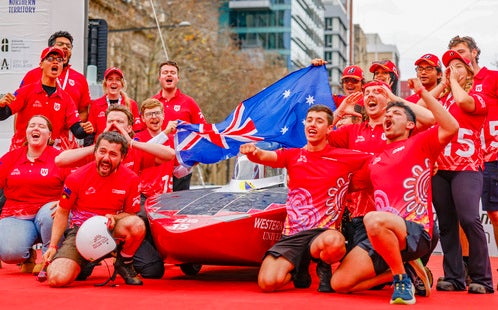
Western Sydney University are the number one Australian solar car team at the 2025 Bridgestone World Solar Challenge
Western Sydney Solar Car team has crossed the finish line placing preliminarily sixth in the world overall, and the number one Australian team in the world’s most prestigious solar car challenge.

Western Sydney University Statement on Cyber Incidents
Western Sydney University has issued an update to its community following confirmation that previously stolen personal information was published online, including on the dark web.