Campus Review Q&A: Vice-Chancellor on caps, cuts and community
Q&A published by Campus Review (opens in a new window) between Erin Morley and Vice-Chancellor and President, Distinguished Professor George Williams AO, on Wednesday, 20 November 2024.
Distinguished Professor George Williams is four months into his role as Vice-Chancellor of Western Sydney University, and is on a mission to put student needs first. Read about what he has learned so far, and what's in store for Western Sydney University in the future.
Campus Review: Q&A: VC George Williams (opens in a new window)
Q: What has been your initial reaction to the Coalition opposing the international student cap legislation? Why do you think the opposition has turned around and said, "We're not going to support this," after saying they would support it?
Professor Williams: I guess the first thing is, the Coalition has raised legitimate problems with what's being done. That includes [the fact that] the Bill is poorly drafted, there's some significant flaws, and also the fact that the implementation has been rushed.
It says a lot, that here we are in this chaotic state where the Bill hasn't even been passed and universities have already closed doors to international students, in reference to a policy that doesn't exist because the numbers were rushed through.
In our case, and in other cases, people were given a cap without any consultation. That meant getting a cap with a policy preferable to housing, and yet [at Western] we have a bed for every single international student. We've got 20 per cent spare capacity at colleges, and we're building another 500 beds. So we ended up with a really raw outcome that was divorced from the policy goal. So on that front, on the law and also the implementation, the Coalition is on strong ground to be concerned.
I have felt strongly that if this was to be done, 2026 was the right time. It couldn't be done well in the time available without having exactly what we're seeing now happen. And, even if it went through, we'd still have a host of problems.
And the second reason, of course, is just the politics. We're six months out from an election. At that point, you have to look through everything through a political lens, and I imagine the opposition has decided there's more political upside than downside in taking this path, and that would have been part of their calculation.
Q: So what happens now? Where can unis look for some clarity on international students in the coming years?
Professor Williams: There is no clarity. And that's because the fate of the Bill will be determined soon, but what will be the next bill? And will it be the current government? Will it be a Coalition government?
We've got an intervening election, so we don't know. And that's a really difficult problem for universities that need to plan years in advance, and where the pipeline for enrolling students can be 18 months or more in length. So there is no clarity.
At most, we can say if the Bill doesn't pass, you'd expect there'd be no caps for 2025, but that actually isn't the main indicator anyway. We've still got Ministerial Direction 107. That's a big impediment, and we've seen a big decrease in numbers from that.
They've also increased the visa processing fees (opens in a new window) by more than double. The government could also just simply go slow on processing. So there are other mechanisms, and we don't know whether [the government] will use those levers.
If we don't have caps, are we going to have the equivalent of caps via other means? And to what extent and how will it be implemented? We are weeks away from 2025 in a sea of uncertainty, and it's causing enormous damage across the sector in terms of our ability to plan to look after our people. And enormous damage to international students who are considering studying here. So, it's very hard to know what we should do.
We get about 24 cents in every dollar from international students supports. Things that [might be impacted] include our Western pantry, we give out a lot of free food because one in two of our students are telling us they are food insecure, and can't have enough meals. They come into class hungry. International student fees fund free rice, oats, fresh fruit, veggies, breakfast and dinners for struggling domestic students.
We have to weigh up what we can afford in that area to keep our domestic students in study. And other universities have really problematic dropout rates, and a key reason for that is financial problems. We need income to support our students to get them through their degrees. So that's where we are, on the front end of equity, asking, "How are we going to manage looking after our students with this loss of income?"
Q: There are opinions out there that say universities should have diversified their financial portfolios instead of just relying on international students. What do you say to that?
Professor Williams: Yeah, it's difficult. Firstly, on the diversity measure, we were told diversification was important, particularly amongst international students, and that's what we've done. We don't have any cohort of international students above 20 per cent. You will not go into a class here where there's a majority of any group.
Then when it comes to other funding sources, yes, we're looking at things like micro credentials, business investment and all of those things. But the reality is, they don't return the level of income needed to support domestic students, because the government funding is not enough to support equity students in particular, who have higher needs and higher costs, food being an obvious example, not to mention extra study support.
Maybe diversification would have made more sense if the government said, "We'll give you three years [before we implement a cap.]" But, bringing it in this quickly, with next year looming, you can't diversify in that period of time. Because it came out of the blue, it is not possible. That's why there's been such hurt and concern across the sector.
Q: Staying on uni finances, lots of universities are currently restructuring, and that's led to quite a few job cuts across the sector. How can universities ensure stability for staff during this time? A lot of staff are nervous as we get to the end of the year about these cuts.
Professor Williams: It's really sad. I suppose my first reaction is that these are good people that build careers in universities. And, you look at the other universities, and you can see that their careers have been supported by the income international students bring in, and if that income isn't there, it's difficult for those unis.
But it's not just them, I mean, we focus too much on uni sometimes. I'm actually seeing impacts in small business (opens in a new window), even in some larger businesses. We have many small business owners who are dependent upon international students. Either people will lose their jobs, or their businesses will go under – food outlets, hairdressers, you name it – around campus.
The job losses are deep and significant in the broader community, and the impact on economic growth will be significant. So it's not just a uni focus for me, it's a community focus, we're just part of that community.
I can say, fortunately, we have not had to make those job cuts. We're, of course, looking at cost savings – it could be travel, consultants, a lot of things we're rightly focusing on to be more efficient – but it may be we're just a bit for more fortunate. For us, it's more about what we can't spend money on in the coming years, particularly our equity students, as opposed to what's happening at other unis.
Q: On that topic of community focus, that has been a big focus for you over the past few months. You've been outspoken about students, your food pantry and also about nurses in Western Sydney. Why is that?
Professor Williams: I think it's just talking about the things that matter. I think they're the right things to talk about. Too often, we're talking about the wrong things.
Our core mission is to give people a great education and do impactful research that improves lives. And, in our case, it's also been a uni that Western Sydney needs and deserves. There is a problem with social license in this country, and it's important that [universities] demonstrate our worth through our actions, but also through our words. And so I'm focusing on what matters.
It's a pity we're not having more conversations about the fact that so many students are living in poverty. That's the main game for a lot of students: $46 a day for youth allowance is not enough to survive at university, living away from home.
A $50,000 Arts degree (opens in a new window) is completely unfair when those students have the lowest earning potential, and tend to be low SES, Indigenous and female students. There are deep inequities in our system that I think should be highlighted. Universities define themselves by who they fight for and what they stand for. I think we should stand for our students.
Q: You've been quite outspoken about the job-ready graduates funding scheme, especially about Arts students who are paying $40,000 to $50,000 for a three-year undergraduate degree. Why have you been so outspoken about that?
Professor Williams: There's a couple of reasons. One is, it's just unfair. We're meant to have a system where fees are aligned to income earning, and that is the lowest-earning degree with the highest fees. We are seeing students who are not studying at university as a result, and they're typically the equity students. These are often first-in-family students who are concerned they will never get a home loan [because of a HECS debt]. We have a broken system that is working against the most disadvantaged people in our community.
Another reason is, it's bad for society. We live in an age of misinformation, where critical thinking is a priority. We need more philosophers, historians and creative writers in this world. We desperately need people who can make sense of the world around us.
An Arts degree is a highly valuable degree with great job prospects. I love vocational degrees –engineering, law and all those things – but philosophy, history and the like are vital skills. I think we've taken a wrong turning, as a society, to actively disincentivise those. And again, I think unis should stand up for students. This is an area where we need to.
Q: I'm wondering why Arts degrees are the degrees of choice for disadvantaged students. What is in the content there that is attractive?
Professor Williams: It's a degree that offers a variety of pathways. If you think about people who have parents that went to university, those students often have more certainty about the sort of career they want. But, often, people from other backgrounds, who have zero experience of university and no family in university, an Arts degree offers an entry point to a variety of careers.
It's also the case a lower ATAR is needed, and these are people who don't go to private schools. Getting 95 ATAR or above is almost impossible in many schools that are public. This is an accessible degree that gives them options for life. With the highest fees and the lowest earnings after graduation.
Q: To finish up, how have your first few months as a vice-chancellor been? What have you learned? What's been challenging about the job?
Professor Williams: I've loved it, and I feel really privileged. It's a real privilege to be able to lead an institution that's so focused on the community and speaks on the behalf of students.
I've loved meeting people in the community. I don't think there's a university in this country with a clearer or more compelling mission. We have 10 per cent of the Australian population as our catchment – 2.7 million people – and we have the most diverse communities in the country.
Two-thirds of our students are first-in-family, and we have the highest number of low-SES and the highest number of non-English speaking background students of any university. So, I feel really grateful in this role because I feel like I can make a difference. How often do you have that in life, when you can be connected to an institution that's so impactful?
There are difficult things happening, but Western Sydney University has the best potential of any uni in the country, and I don't think we need to follow a Group of Eight path, we're going to invent our own path, a better path, that's right for us and our community.
With these regulatory changes, there's opportunities for unis to do things differently, and be focused on students and community service. It's been challenging, interesting and difficult. There are many things I wish hadn't happened over the past period, but I feel really fortunate.
Q: And what's next for you? I don't want to ask too much of a pointed question, but is there another university that's doing something that you admire, or would want Western Sydney University to undertake?
Professor Williams: There's lots of unis that I admire: Arizona State University and it's online programs, and some of the research programs in big universities in this country. There's many, but there's no one university that's laid our path. Partly that's because Western Sydney is so distinctive: we're a community-based university with 10 per cent of the Australian population to serve; we have the biggest infrastructure investment in the country with the new airport going in. We need to tread our own path, but we will always learn from others.
ENDS
21 November 2024
Latest News
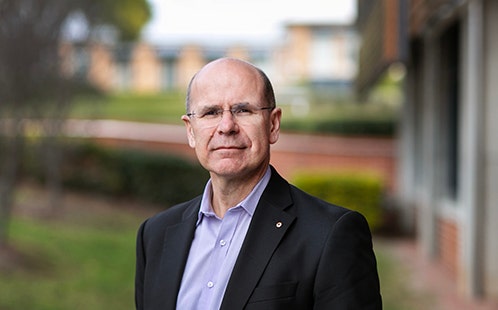
ABC RN transcript: Vice-Chancellor Professor George Williams discusses higher education sector, student support, and the impact of AI
The following is a transcript of an interview that aired on ABC Radio National Saturday Extra between presenter, Nick Bryant and Vice-Chancellor, Distinguished Professor George Williams AO.
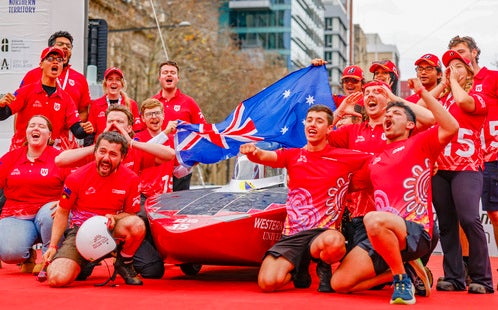
Western Sydney University are the number one Australian solar car team at the 2025 Bridgestone World Solar Challenge
Western Sydney Solar Car team has crossed the finish line placing preliminarily sixth in the world overall, and the number one Australian team in the world’s most prestigious solar car challenge.
Western Sydney University Statement on Cyber Incidents
Western Sydney University has issued an update to its community following confirmation that previously stolen personal information was published online, including on the dark web.