Book explores Australia’s referendum record and why constitutional change is challenging, but not impossible
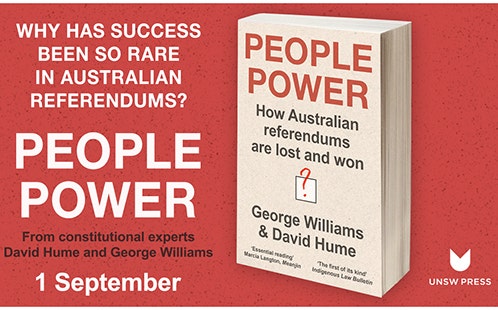
It has been almost 50 years since the nation last said “yes” to approving a change to the Constitution. A new book co-authored by Western Sydney University Vice-Chancellor, Distinguished Professor George Williams AO, explores why success has been so rare in Australian referendums.
People Power: How Australian referendums are lost and won, has been written by leading constitutional law experts George Williams and David Hume, Barrister and Fellow of the Gilbert + Tobin Centre of Public Law.
The only full history of constitutional change in Australia, the book meticulously examines our nation’s referendum record.
From the failed attempt to ban communism in 1951 to the unsuccessful Voice referendum in 2023, the authors outline how Australians have been cautious about constitutional change – voting ‘Yes’ to only eight out of 45 referendum proposals.
For the book, Professor Williams and Mr Hume interviewed leading proponents for constitutional change and analysed each referendum campaign – including the public response and the forces that shaped the outcome.
First published in 2010, People Power has been given a comprehensive update to include analysis of the most recent 2023 Voice referendum, along with discussion of the rise of interest in state and territory referendums, and the 2017 national plebiscite on same-sex marriage.
Writing recently in the Australian Financial Review (opens in a new window), the authors said it would be unfortunate if Australians were to form the view that the path to constitutional reform was now blocked.
They argued the answer to holding a successful referendum in Australia lies in truly engaging the people in the political process – and that Australia needs a new model for progressing constitutional reform.
“Rather than giving up on constitutional reform, the focus should be on getting the process right. The framers deliberately made constitutional reform difficult, but not impossible,” they said.
“First, new institutions and processes are needed for generating proposals, educating the community and bringing ideas with broad popular and political support to a vote. This requires a systematic approach that moves away from the current system that incentivises misinformation and polarisation to instead favour engagement and compromise.
“Second, these new institutions and processes need to be informed by the preconditions for a successful referendum. There are straightforward reasons why so many referendums have failed – and equally clear approaches that can enhance the likelihood it will pass.
“Referendum success should be based on four pillars: bipartisanship, popular ownership, popular education, and sound and sensible proposals.”
Mr Hume and Professor Williams said constitutional reform needs to be normalised – with the goal being a process that makes bipartisan commitment and broad, well-informed popular support more likely.
“Australia should establish a constitutional commission, charged with reviewing the Constitution, generating widely supported proposals for reform, consulting the public, and then recommending them to parliament,” they said.
They also argue the referendum process itself needs to be modernised – pointing out many of the rules for holding referendums can be traced back to the first referendum procedure statute, enacted in 1906.
“They prohibit the Commonwealth from spending money supporting a referendum, even though the vote can only go ahead where it has the considered support of parliament,” they said.
“The rules also fail to rule out misinformation – and unsurprisingly truth is one of the first casualties in any referendum campaign.”
Read the full Op-Ed in the Australian Financial Review by David Hume and George Williams here (opens in a new window).
People Power: How Australian referendums are lost and won is published by UNSW Press.
ENDS
3 September 2024
Amanda Whibley, Manager, Media & Public Relations
About the authors
George Williams is the Vice-Chancellor and President of Western Sydney University. He previously served as Deputy Vice-Chancellor, Dean of Law and Anthony Mason Professor at UNSW. He is a leading constitutional lawyer whose books include Australian Constitutional Law and Theory, The Oxford Companion to the High Court of Australia and How to Rule Your Own Country: The Weird and Wonderful World of Micronations. He has appeared as a barrister in the High Court and led major public inquiries.
David Hume is a Barrister at the New South Wales Bar and a Fellow of the Gilbert + Tobin Centre of Public Law. David has appeared in more than 30 cases in the High Court of Australia, including many constitutional cases. He has previously worked for the Constitutional Litigation Unit at the Australian Government Solicitor, as a Solicitor at Freehills and as the Associate to Chief Justice Murray Gleeson. He has a Masters of Laws from Harvard Law School, which he attended as a General Sir John Monash Scholar and Frank Knox Memorial Fellow. He has university medals in Law and Philosophy from the University of New South Wales.
Latest News
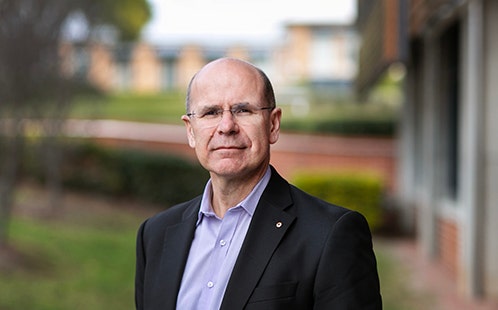
ABC RN transcript: Vice-Chancellor Professor George Williams discusses higher education sector, student support, and the impact of AI
The following is a transcript of an interview that aired on ABC Radio National Saturday Extra between presenter, Nick Bryant and Vice-Chancellor, Distinguished Professor George Williams AO.
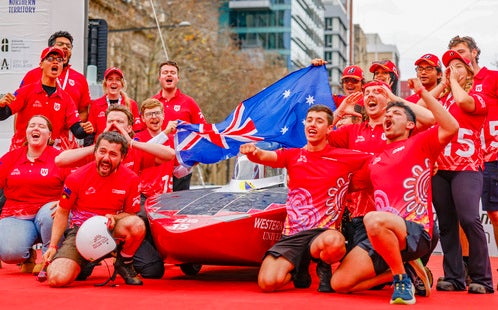
Western Sydney University are the number one Australian solar car team at the 2025 Bridgestone World Solar Challenge
Western Sydney Solar Car team has crossed the finish line placing preliminarily sixth in the world overall, and the number one Australian team in the world’s most prestigious solar car challenge.
Western Sydney University Statement on Cyber Incidents
Western Sydney University has issued an update to its community following confirmation that previously stolen personal information was published online, including on the dark web.