ABC Radio Sydney Breakfast transcript: Vice-Chancellor discusses fixing the nation’s crippling student fee problem
Transcript of an interview that aired on ABC Radio Sydney Breakfast between presenter, Craig Reucassel and Vice-Chancellor, Distinguished Professor George Williams AO, on Monday, 25 November 2024.
Craig Reucassel:
Look, you might have seen in the news this morning the idea of reducing the cost of university degrees and rent and housing has become a lot more unaffordable, and many students are thinking twice about getting a degree with a $50,000 price tag. Western Sydney University wants to slash fees and leave graduates with smaller debts. Here to tell me more is Professor George Williams, the Vice-Chancellor of Western Sydney University. Good morning, Professor.
George Williams:
Good morning, Craig.
Craig Reucassel:
Now, I saw this story in the paper that you're wanting to reduce, for instance, arts degrees from about $50,000 to $28,000. Is this something that you are going to do or can do through Western Sydney University, or is this something you're calling on the government to do?
George Williams:
Unfortunately, we can't do it. The government sets university fees for Australian students, so it's not something we can do. We're actually calling on the government to change those fee settings. They started at $1,800 some years ago, and the top degree rate now is $17,000 per year. And so that gets you your $50,000 arts degree. And we're saying the system is just out of kilter. There's a solution. It's in the government's own Accord report. And we're saying give students an early Christmas present. Let's change the fees for next year.
Craig Reucassel:
And does this impact, for instance, your university. Do you does this mean you get less money or does it not impact what the university gets themselves?
George Williams:
No, it's not actually about the university funding. It's about what the students pay. So, we're talking about the student contribution that the total cost. And that's the key. We're actually focused on the students. It's not our bottom line that's an issue. And what we're saying though is that many students just aren't coming to university in the first place. For example, we've seen big declines in high school education. The completion rate for public schools has gone down 10 per cent over recent years, and there's been a similar decrease in kids going to university. And that's actually the opposite direction the country needs to go in.
Craig Reucassel:
Have you spoken to any of the ministers or anyone in the federal government about this? Is there any kind of appetite for reducing fees?
George Williams:
I think everyone knows it needs to change. And Jason Clare, the minister, said this very clearly himself. Yes, there's been discussions. The Productivity Commission said it, and that's because fees have got out of control. When the system started, students were paying about a quarter of the cost of their degree. Now they pay about half. And that's a big change. But what's particularly true is where the fees have gone up most. It's for the arts degrees, and those are the students who earn least on graduation. And they also tend to be the poorest students. And not surprisingly, those students often aren't coping and often just don't come to uni now in the first place.
Craig Reucassel:
So, you're saying the fees are so big they're having an impact. Now, I mean, the government is talking about reducing the final HECS bill by a certain percentage, but do you think it's better to reduce the fees upfront?
George Williams:
Well, it's a lot cheaper for a start. I mean, the government's committed about $20 billion to reducing the debt that students have. Graduates have not current students of course, and also fixing indexation. They're good. But the real problem is the fees in the first place. It's a bit like saying we've got a housing affordability crisis, so let's reduce people's mortgages. But it's the cost of housing in the first place. Same thing. It's the cost of degrees. And fixing this issue and restoring some funding for maths and other degrees would be about $1.7 billion a year. So, it's a lot of money, but it's a lot less than the $20 billion the government's already committed. And we're saying, look, do it upfront. Current students aren't winning out of this at the moment, and they're the ones who actually are doing it toughest.
Craig Reucassel:
Alright. Well, thanks for speaking to us, Professor. George Williams there, Western Sydney University Vice-Chancellor coming to the rescue of art students.
ENDS
25 November 2024
Latest News
ABC RN transcript: Vice-Chancellor Professor George Williams discusses higher education sector, student support, and the impact of AI
The following is a transcript of an interview that aired on ABC Radio National Saturday Extra between presenter, Nick Bryant and Vice-Chancellor, Distinguished Professor George Williams AO.
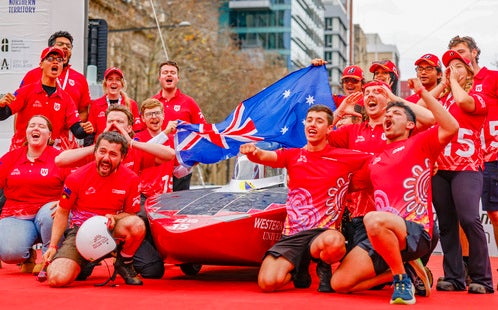
Western Sydney University are the number one Australian solar car team at the 2025 Bridgestone World Solar Challenge
Western Sydney Solar Car team has crossed the finish line placing preliminarily sixth in the world overall, and the number one Australian team in the world’s most prestigious solar car challenge.
Western Sydney University Statement on Cyber Incidents
Western Sydney University has issued an update to its community following confirmation that previously stolen personal information was published online, including on the dark web.