ABC Radio National Transcript: Will Labor's student debt cuts and reforms work?
The following is a transcript of an interview that appeared on ABC Radio National(opens in a new window) between presenter, Steve Cannane, Vice-Chancellor and President, Distinguished Professor George Williams AO and Greg Jerricho, Chief Economist. Australia Institute, on Tuesday, 5 November 2024.
Steve Cannane:
And staying with federal politics, the Albanese government says it wants to reduce student debts by 20%, costing the budget around $16 billion. The announcement was made over the weekend, but it doesn't address the cost of some degrees, which were significantly increased under the Morrison government.
The architect of the HECS scheme, Bruce Chapman, has described those changes by the previous government as, quote, the worst higher education policy in Australia ever.
Joining me to discuss these policies are the Australia Institute's Chief Economist Greg Jerricho, and Professor George Williams, the vice chancellor of Western Sydney University. George, I want to come to you first.
These changes, um, would be good news for graduates who haven't paid off their debts. But this doesn't help students right now with cost-of-living pressures, do you broadly support the changes.
Professor George Williams:
Look, I think it's actually directed at the wrong end of the problem.
And it's a bit like when you've got a housing affordability crisis dealing with mortgages.
What you need to deal with is the price up front. Um, it's the housing price that's the problem. And the same issue here is it's actually the student pricing that's the problem. And in particular, if you look at the humble arts degree, if somebody's studying history, philosophy or the like, that's now reached over $50,000 for next year, and that's a fee that's completely out of kilter with what these graduates will earn, and it will lumber them with an enormous debt. And I think relieving the debt later on just isn't the right fix. We need to make sure the prices are fair up front.
Steve Cannane:
George your university really focuses on getting young kids to university who come from families who haven't had graduates in their family. Do you think that those costs of degrees are putting the kind of people we want to go to universities for the first time, putting them off from going to university?
Professor George Williams:
Yes, and we see that very clearly and we do have two thirds of our students still are first in family to go to university in Western Sydney. And what we're finding is that a $50,000 debt is a real turn off for those students. And you've got to remember that an arts degree is typically the degree of choice. The pathway into higher education for women, low SES students indigenous people. And when we're dealing with cost-of-living pressures, we're dealing with students who are worried they won't have enough to eat while they study a big price up front. It means many are simply turning away from higher education.
Steve Cannane:
Greg, this is a degree, the arts degree that George was referring to there that many of our politicians got and got on the cheap. Um, is this a problem for the future of our education? Do you think the cost of these degrees.
Greg Jerricho:
Oh, absolutely. And I think we just saw also yesterday with the announcement of what's happening with the history department at the University of Wollongong that, you know, humanities and arts has not been treated with any real care or seriousness by governments, I think, for over 25 years. And I think really the big issue, while I think these changes are fine in the first instance, the problem is we still, as George points out, have the fee structure that Scott Morrison thought was a good idea. And it kind of baffles me that a labor government would agree.
Steve Cannane:
Greg. Last week, the Australia Institute released a report on the rising costs of university. Tell us about those rising costs and what impact are the announcements on the weekend might help in when it comes to alleviating those costs?
Greg Jerricho:
Yeah. What we found is that the costs of university degrees are, you know, they are soaring well ahead of inflation and also ahead of wages growth. And to the point where, you know, if you go from, say, about 20 years ago, if you just take into account the inflationary effects and the changes in degrees, you're looking at about, oh, about 12 to $13,000 extra on a degree above what would have been the case if they'd just gone up in line with inflation. And importantly, that's before we're really taking into account the big changes in the cost of degrees from the Scott Morrison. So that's not even counting those $50,000 degrees that are happening now.
So what we're seeing massive increase in the cost of university above the actual inflation and wages that we're seeing. And that's also extrapolating out to much higher debt levels that are really sort of, uh, as George points out a penalty actually on students, because even if they're not taking, um, the cost into account, what that's really saying is we know that this isn't going to affect your choices, but we're just going to slap you with higher fees anyway because of no actual policy reason.
Steve Cannane:
On Radio National Breakfast, it's four minutes to 7:00. We're talking to George Williams, Vice-Chancellor of Western Sydney University, and also Greg Jerricho, the Australia Institute's Chief Economist George, we talked a bit about before about your university and how it has so many people out studying there who are first in family to go to university. What? impact Um, well, sorry. How are your students coping at the moment with the cost of living crisis, of juggling university and the cost of living crisis?
Professor George Williams:
Well, they're really doing it tough. And I mean, as the Australia Institute report actually shows, the number of students who are studying full time and having to work full time has gone up 50%. And that's really tough. Full time study, full time work. And what I'm finding in speaking to some students is some are even taking a second job while they have to study to meet with cost-of-living pressures.
And those pressures are so high that we've got a lot of students who can't afford to eat and study. They're going without meals, turning up to class, hungry in the morning. And so one of the things we've had to do is introduce a free pantry. We give our students rice, oats and the like just so they've got the staples for the week, because of course, if you're hungry, you can't study. You tend to drop out. And it's as basic as that. For many students, just food is what you need to get through your education.
Steve Cannane:
Greg a younger people getting the wrong end of the stick at the moment with the tax burden, it seems like they're copying it with their university degrees. They're copying it with being cut out of the housing market. While over the last decade older people have got a lot of tax concessions on superannuation and the like.
Greg Jerricho:
Yeah, this has been what I've found. Some of the more silly response from some people suggesting, ah, that this is, you know, by giving a cut in, HECS debt that's somehow transferring the burden of, tax elsewhere. And I think hang on, we're, doing that with how we're taxing superannuation, how we're taxing capital gains or the discounts, uh, the, subsidies we give to the fossil fuel industries.
This might be one of the first times we're actually seeing young people getting some sort of a relief. Um, and even if it's a small one and I think it's only has to be the start, but it strikes me as a little bit hypocritical to see all these people suddenly coming out and discovering the fact that there might be a way to subsidise, uh, people in the economy when we've been doing that, as you say, very well, to wealthy people and generally older people like myself. Um, I think that's probably the poorest argument that I've seen about these changes.
Steve Cannane:
Greg, education is seen very much as a ticket to social mobility and a better life and a better income. What does this then mean for young people who are entering adulthood with these huge university debts hanging over them?
Greg Jerricho:
Yeah. Well, I mean, it really affects also, you know, their ability to buy a home because it is a debt and it is taken into account when you're going for a home loan. So it is just adding to that hurdle that you need to.
One of the good changes that I've seen proposed by the government is they're at least moving to a marginal, uh, HECS repayment scheme, sort of aligning it up with income tax rather than it being something that applies to your entire income. Whenever you go over a new threshold. That will certainly at least help the, um, those students in their early years, and also raising the thresholds because they'd gone down far too low, they were getting close to the minimum wage, which was just absurd.
So, you know, the HECS burden is quite real. And I think one of the problems is, not only do we have politicians who might have got a free education, but even people in the commentariat like myself who were in HECS, but we were in HECS, whether it was like an $1,800 flat fee for a unit and we kind of think, oh, what's the big deal? Well, it's very different to what it was when it was first designed by Bruce Chapman.
Steve Cannane:
Yeah. George. if I could just jump in there and get a 30 second response from you on that about the debt hanging over young people.
Professor George Williams:
Well, it is and the problem starts actually at uni. I mean, youth allowance is only $46 a day. We don't support them enough. Then. of course they graduate and were dealing with many sudetns who will litereally have a debt they will never pay off they will have a debt until death and thats the sort of thing students are worried about they're avoding and we need more graudates particularly in the arts i would say in this world and this is a really bad system.
Steve Cannane:
Okay Greg and George good to talk to both of you this morning. Thanks for your time.
Professor George Williams:
Thank you
Greg Jerricho:
Thanks Steve
Steve Cannane:
Thanks, Professor George Williams from Western Sydney University and also we heard from Greg Jerricho who is the chief economist with the Australian Institute.
ENDS
5 November 2024
Latest News
ABC RN transcript: Vice-Chancellor Professor George Williams discusses higher education sector, student support, and the impact of AI
The following is a transcript of an interview that aired on ABC Radio National Saturday Extra between presenter, Nick Bryant and Vice-Chancellor, Distinguished Professor George Williams AO.
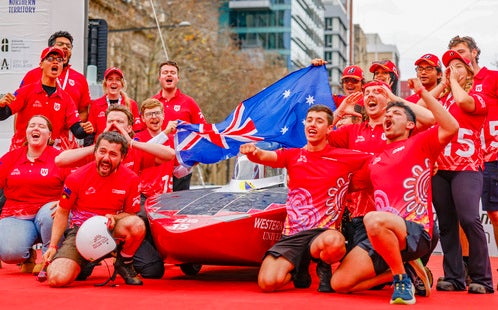
Western Sydney University are the number one Australian solar car team at the 2025 Bridgestone World Solar Challenge
Western Sydney Solar Car team has crossed the finish line placing preliminarily sixth in the world overall, and the number one Australian team in the world’s most prestigious solar car challenge.
Western Sydney University Statement on Cyber Incidents
Western Sydney University has issued an update to its community following confirmation that previously stolen personal information was published online, including on the dark web.