Opinion: A whole-university road map to sustainability impact
The following opinion piece co-authored by Professor Deborah Sweeney, Deputy Vice-Chancellor and Vice-President, Research, Enterprise and International) and Professor Kevin Dunn, Pro Vice-Chancellor, Research, was first published with full links on The Times Higher Education(opens in a new window).
It was an immensely proud moment in Western Sydney University’s history to be named number one in the world, for the second year in a row, in the 2023 Times Higher Education Impact Rankings. While other rankings may inspire competition and comparison, we feel the Impact Rankings are an opportunity to share, learn and collaborate and to help create a more just and equitable world. So in the spirit of collaboration, here are some of our takeaways on how curriculum, operations, research and engagement can be aligned with the United Nations’ Sustainable Development Goals (SDGs).
If sharing these tips makes for greater competition to remain number one in the world, well, we couldn’t be happier.
Use the SDG goals as a framework for strategy and planning
Our first tip is to set ambitious targets to address sustainability issues such as climate change and social inequality, plan actions, and track your institution’s progress against the SDGs.
Since 2015, Western has produced annual institutional sustainability reports that track our commitments to the UN-led Race to Zero for Universities and Colleges. Last year, Western also produced a sustainability decadal ambition, Sustainability and Resilience 2030, which sets out a road map to address climate adaptation and mitigation, and social inequality. Our sustainable energy plan sets targets for campus operations to be carbon neutral by 2023 and climate positive by 2029.
The university has fast-tracked these targets into action, with electricity supply across all its campuses now 100 per cent GreenPower accredited, four years ahead of target. Other operational initiatives that have come from these strategies include:
- the development of a five-year carbon transition plan and a carbon-farming portfolio
- roll-out of electric vehicle charging infrastructure, solar car parks and rooftop PV
- transition to Green Star-accredited CBD campuses and buildings (an accreditation awarded by the Green Building Council Australia).
Produce sustainability-literate graduates
Targeted education offerings allow students to better understand the global purpose of the SDGs and provide opportunities for students to acquire the knowledge and skills needed to contribute to the goals and promote sustainable development. Embed sustainability across the curriculum – from undergraduate courses to microcredentials – for students locally and globally.
Our collaborations with international partners in India, which deliver dual higher degree research programmes in agriculture, are equipping our students to tackle some of our greatest global threats, including climate change and food security.
Our 21C curriculum renewal initiative is committed to developing resilient and sustainability-literate graduates across almost all our degree programmes. New offerings for all undergraduate students include specialisations in climate justice, equitable technologies, eco-social design and manufacturing, water for life and urban evolutions for smart green cities. We have also developed a microcredential, Sustainability: Think, Care, Do, to provide the building blocks for sustainability thinking, values and action.
Our goal is that by 2030, all learners acquire knowledge and skills needed to promote sustainable development.
Lift research metrics
Support innovative and world-leading research that provides solutions to the grand challenges of sustainable development, climate change, social injustice, integrity and good governance. Ways to lift SDG-focused research include:
- Badge your publications portal with SDGs
- Distribute SDG-related keywords to researchers (Elsevier has published the criteria used to identify and categorise publications for each SDG based on publication title, abstract or keywords. Western’s Research Services team publish links to these lists on the internal research portal website. Authors can refer to these lists to see if their publication will be assigned to their intended SDG, and revise their draft title, abstract or keywords if required.)
- Celebrate SDG research (for example, Western Sydney University’s research magazine, Future Makers, publishes SDG-specific issues)
- Track alignment with SDG goals. Western Sydney University tracks the number of publications, field-weighted citation index of papers, proportion of papers in the top 10 per cent of journals as defined by Citescore; for SDG 5 (gender equality), we track what proportion of our publications have female co-authors.
Capitalise on partnerships and thought leadership
Working closely with a wide range of local and global partners can create impact and deliver on the SDGs, as Western Sydney University has shown. Research that breaks new ground and offers solutions to the challenges faced by the modern world often starts as a hyper-local project. Globally, the power of research empowers communities.
An example of this is Western Sydney University’s work leading the Australia India Water Centre (AIWC), which aims to address the critical challenge of water security, sanitation, water management and distribution in a warming climate. Among other things, projects led by the centre engage village communities to monitor and manage groundwater at the village level and have had profound impacts on regional communities in India.
Western Sydney University is also committed to using our rankings success to mentor several universities in Australia and across the globe – through intensive workshops, analytics and presentations – on how they can better align their curriculum, operations, research and engagement with the SDGs.
Our thought leadership extends to the community, where we make visible the work being undertaken across the university as part of its Sustainability and Resilience Decadal Strategy 2030. This is done through activities such as our Thought Leadership Event Series, involving free public events that engage both the Western and wider community.
The achievement in the Impact Rankings recognises our sector-leading efforts in driving important social transformation. We have used this accolade with distinction and conviction to urge the sector to take responsibility for these goals. The dot points above are only a few of the measures contributing to our success. Please feel free to reach out to Western, via email at odvcrei@westernsydney.edu.au for more information. We would be happy to work with you to better equip the next generation of thought leaders and civic-minded citizens solve the complex challenges of our times.
ENDS
28 July 2023
Latest News
ABC RN transcript: Vice-Chancellor Professor George Williams discusses higher education sector, student support, and the impact of AI
The following is a transcript of an interview that aired on ABC Radio National Saturday Extra between presenter, Nick Bryant and Vice-Chancellor, Distinguished Professor George Williams AO.
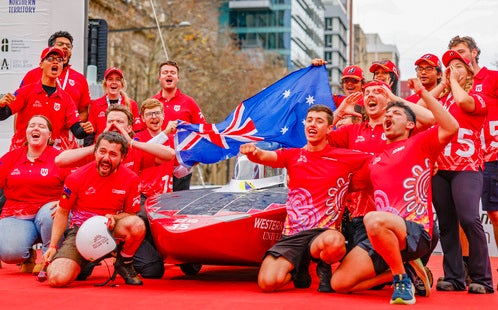
Western Sydney University are the number one Australian solar car team at the 2025 Bridgestone World Solar Challenge
Western Sydney Solar Car team has crossed the finish line placing preliminarily sixth in the world overall, and the number one Australian team in the world’s most prestigious solar car challenge.

Western Sydney University Statement on Cyber Incidents
Western Sydney University has issued an update to its community following confirmation that previously stolen personal information was published online, including on the dark web.