Tropical rainforests show phosphorus key to understanding world's ecosystems
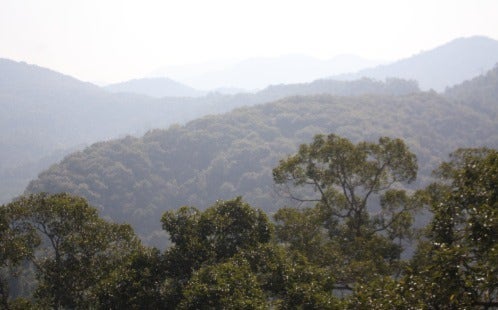
A new international study led by Western Sydney University researchers has quantified phosphorus constraints to photosynthesis in tropical forests, highlighting how accounting for this constraint can improve the world’s climate.
Tropical forests have an important role in the carbon cycle, absorbing more carbon from the atmosphere than any other ecosystem, and acting as key modulators of the global climate.
Despite being hotspots for biodiversity and range among the most productive ecosystems on the planet, they typically lack phosphorus – a major plant nutrient – which limits photosynthesis.
As part of the study published in Nature Communication, the research team performed the most comprehensive analysis to date across 12 different countries and took nearly 18,000 measurements to understand the link between phosphorus and photosynthesis.
Lead author Professor David Ellsworth from the Hawkesbury Institute for the Environment said the study reinforces that the higher the concentration of phosphorus in leaves, the higher their capacity to absorb carbon dioxide.
“For the first time, the analysis has established that phosphorus is a considerable constraint on the photosynthetic capacity of leaves worldwide,” said Professor Ellsworth.
“This finding has far-reaching implications considering that over a third of the world’s soils are below optimal phosphorus, as illustrated by the positive response of plant growth to the addition of phosphorus in the form of fertiliser.”
According to Professor Ellsworth, understanding photosynthesis and its environmental impact is pivotal for predicting the response of all the world’s ecosystems to the increasing atmospheric carbon dioxide concentrations and climate change, and therefore for predicting future climate change possibilities.
“The findings expand the available knowledge of how the world’s ecosystems are responding to climate change. It not only affects our understanding of the role tropical forests have in global climate change but creates opportunities to enhance the productivity of the forests themselves,” said Professor Ellsworth.
As part of the study, the research team derived a mathematical formulation that depicts the link between photosynthesis and leaf phosphorus and used it within one of the few global biosphere models which incorporates phosphorus cycling.
The modelling demonstrated how the discovery can be beneficial in predicting global photosynthesis, showing that tropical forests could absorb much more carbon from the atmosphere if these ecosystems were richer in phosphorus than they currently are.
For more information, download and read ‘Convergence in phosphorus constraints to photosynthesis in forests around the world’, here (opens in a new window).
ENDS
9 September 2022
Latest News

ABC RN transcript: Vice-Chancellor Professor George Williams discusses higher education sector, student support, and the impact of AI
The following is a transcript of an interview that aired on ABC Radio National Saturday Extra between presenter, Nick Bryant and Vice-Chancellor, Distinguished Professor George Williams AO.

Western Sydney University are the number one Australian solar car team at the 2025 Bridgestone World Solar Challenge
Western Sydney Solar Car team has crossed the finish line placing preliminarily sixth in the world overall, and the number one Australian team in the world’s most prestigious solar car challenge.

Western Sydney University Statement on Cyber Incidents
Western Sydney University has issued an update to its community following confirmation that previously stolen personal information was published online, including on the dark web.