Study finds termites may play pivotal role in climate change
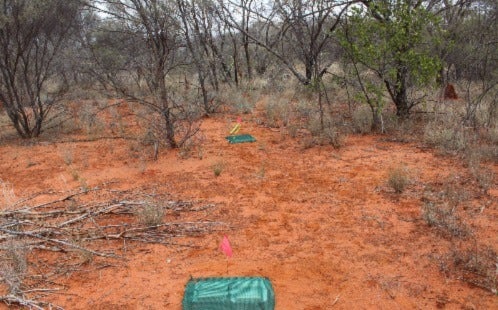
Global wood block decay experiment located in tropical semi-arid woodland in Alice Springs, Northern Territory, Australia. This site is part of the Terrestrial Ecosystem Research Network.
A new international study including researchers from Western Sydney University has revealed that termites play a critical role in the world’s ecosystems, particularly in the tropics, and they are expected to become increasingly important as temperatures rise globally.
Published in Science, the study indicates that termite activity is 3.5 times as sensitive to temperature increases than that of microbes (bacteria and fungi) so as temperatures heat up around the globe, the important role that termites play in wood decay will likely expand beyond the tropics.
The results suggest that regions with high termite activity should increase as the earth becomes warmer and drier. As a result, they could soon be moving closer toward the North and South poles as global temperatures warm from climate change.
Co-author Professor Jeff Powell from the University’s Hawkesbury Institute for the Environment said the study offers insight into the contributions termites make to the functioning of natural ecosystems, despite them being known as pests.
“The findings have shown us that the impact of termites is often underappreciated, particularly in the dry tropics where microbial decay of wood is slow. We can expect to see substantial increases in termite activity by mid-century,” said Professor Powell.
While microbes require water to grow and consume wood, termites can function at relatively low moisture levels. They can look for their next meal, carry what they require back to their mounds or move their colony into the wood they are consuming, even if the conditions are dry.
Termites release carbon from the wood as methane and carbon dioxide, which are two of the most important greenhouse gases. Therefore, termites may increasingly contribute to greenhouse gas emissions with climate change.
Led by researchers from the University of Miami, the study measured termite and microbial decay of wood at more than 130 sites around the globe, including the eucalypt woodland where Western Sydney University’s EucFACE (opens in a new window) experiment is located. The site is part of Australia’s Terrestrial Ecosystem Research Network (TERN).
“This is a great example of what a relatively simple experiment can achieve when the research community gets behind it in a coordinated way. Without this, it would not have been possible to uncover the massive extent to which the climate impacts termite activity.”
The study titled, ‘Termites sensitivity to temperature affects global wood decay rates,’ is available to download here (opens in a new window).
ENDS
26 September 2022
Photo credit: Jamie Cleverly
Latest News

ABC RN transcript: Vice-Chancellor Professor George Williams discusses higher education sector, student support, and the impact of AI
The following is a transcript of an interview that aired on ABC Radio National Saturday Extra between presenter, Nick Bryant and Vice-Chancellor, Distinguished Professor George Williams AO.

Western Sydney University are the number one Australian solar car team at the 2025 Bridgestone World Solar Challenge
Western Sydney Solar Car team has crossed the finish line placing preliminarily sixth in the world overall, and the number one Australian team in the world’s most prestigious solar car challenge.

Western Sydney University Statement on Cyber Incidents
Western Sydney University has issued an update to its community following confirmation that previously stolen personal information was published online, including on the dark web.