Statistical analysis weighs the risks in the fight against COVID-19
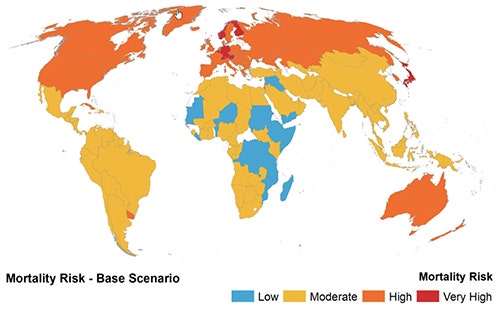
Image: Researchers generated a map to demonstrate the mortality risk of each country.
Western Sydney University researchers have used advanced statistical analysis to better understand how countries are impacted by COVID-19.
A funded collaboration with United Arab Emirates University (UAEU) allowed researchers from the University’s School of Computer, Data and Mathematical Sciences to access a range of global datasets – to determine which countries were well-equipped to fight a global pandemic.
A UAEU task force – comprised of experts in Data Science, Epidemiology, Viral Pathology/Infections and Econometrics – also collaborated on the project.
Dr Omar Mubin, alongside PhD students Mudassar Arsalan and Belal Alsinglawi, accessed global socio-economic and COVID-19 data from World Bank, NASA, Johns Hopkins University, and Environmental Systems Research Institute (ESRI).
Using the range of data-sets, the researchers assessed countries on the basis of:
- Population – including total size of population, and median age;
- Economy – including Gross Domestic Product (GDP) per capita, and current health expenditure;
- Health capacity – including the number of hospital beds, physicians and nurses available per 1000 people; and
- Density in urban areas.
COVID-19 data as of 13 May 2020 was also used as a means of assessing countries on the basis of their number of active cases; mortality rates; and the size of their ‘susceptible population’ not yet infected by COVID-19.
The results of the analysis, published in the International Journal of Environmental Research and Public Health,(opens in a new window) indicate that the countries with the highest mortality risk – due to their large ratio (and living patterns) of elderly population – include Japan, Norway, Germany, Switzerland, Austria, Belgium, Denmark, Sweden, Netherlands, and Finland.
“On 13 May 2020, most countries were at a similar or lower risk level than what would have been expected pre-COVID, with only 44 out of 153 countries experiencing a more than 20 percent increase in mortality risk," said Dr Mubin.
“In this study, the strongest predictor of a country’s mortality risk was its ratio of elderly people – which surpassed all other socio-economic and demographic indicators.”
Dr Mubin said the study shows the benefit of taking a multi-factor, weighted approach to determining a country’s preparedness for future pandemics.
ENDS
21 September 2020
Latest News
ABC RN transcript: Vice-Chancellor Professor George Williams discusses higher education sector, student support, and the impact of AI
The following is a transcript of an interview that aired on ABC Radio National Saturday Extra between presenter, Nick Bryant and Vice-Chancellor, Distinguished Professor George Williams AO.

Western Sydney University are the number one Australian solar car team at the 2025 Bridgestone World Solar Challenge
Western Sydney Solar Car team has crossed the finish line placing preliminarily sixth in the world overall, and the number one Australian team in the world’s most prestigious solar car challenge.

Western Sydney University Statement on Cyber Incidents
Western Sydney University has issued an update to its community following confirmation that previously stolen personal information was published online, including on the dark web.